Showing posts with label Latin. Show all posts

Saturday, March 7, 2026

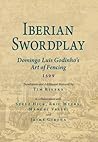
Iberian Swordplay: Domingo Luis Godinho's Art of Fencing


Iberian Swordplay: Domingo Luis Godinho's Art of Fencing (1599)Iberian Swordplay: Domingo Luis Godinho's Art of Fencing by Domingo Luis Godinho
My rating: 3 of 5 stars

I started picking my way through this work a couple of pages at a time, as the archaic language and the author's assumptions about the reader were very difficult to parse. Of course, this is a manual on a certain style of swordsmanship, not a novel or essay or short story, but a textbook. The glossary in the back was somewhat helpful, but as often as not it is self-referential, again, assuming much about the reader's background knowledge and experience.

I've been fencing, off and on, since college - foil, epee, rapier & dagger, and, most recently, messer. I'm not great, but I had good coaching (my first coach was an olympic bronze medalist), and I would feel pretty comfortable if things came down to a real duel with just about anyone (sharp blades make one sharper, as they say). But I admit that learning fencing theory was never my strong suit. So, this one was a bit of a struggle.

At a certain point, after nipping and poking at the work, though, I decided I needed to just plunge in, read, practice some of the techniques, as I understood them. That did seem to accelerate some of my learning, much the same as learning German or Latin or Swahili - immersion is the key.

Part one of the book, on "Sword Alone," was definitely the most tedious, but also the most foundational, as one would expect. A brief introductory chapter by Tim Rivera was definitely helpful, but if I could have any wish about this book, it would be that it was thoroughly annotated and illustrated by Rivera. Swordsmanship is something done in space, and trying to translate the written word into spatial movement in real-time is nearly impossible without some kind of visual representation. This was my biggest complaint about the manual - and it is a HUGE complaint.

Part Two: Sword and Shield, can be summarized: protect your hand, slash at your opponent's legs or stab him in the belly, and whatever you do, do it really, really quickly, like a snapping turtle.

There are other sections on a variety of topics, not all of which I will mention. Some standouts, though, were:

Part Four: Two Swords. Need to know how to clear a street? It's in there. Surrounded by enemies who are threatening your treasure or your lady? There are solutions to that.

I should note here, also, that in both the section on Two Swords and in Part Six: The Two-Handed Sword, there are very clear instructions on how a bodyguard should defend an individual in his charge, and there are a lot of details beyond just the proper footwork and cutting or thrusting techniques that I just would not have thought of. Things like: Where is it best to place your back (or not) at a four-way intersection? What if your back is literally against the wall? How do you defend yourself and another in those circumstances? And so forth.

I always wondered why those beefcake sword and sorcery covers and frontispieces (see: almost every issue of Savage Sword of Conan) had the hero standing and a woman kneeling or sitting at his feet. Turns out this was how people were trained to defend a woman from a crowd (royal bodyguards and such). When surrounded, you have to swing in wide arcs. If she's standing behind or beside you . . . well, it's bad optics, at the very least, to accidentally decapitate the person you're trying to protect.

Part Eight: Self-Defense and Tricks, might just as well have been titled "dirty tricks". Literally dirty, like keeping a pocket full of fine sand to cast into the eyes of an opponent who "has greater advantage" or to use against multiple opponents who justifiably want to kill you because you are a scumbucket. Godinho essentially says the quiet part out loud about how you got yourself into this stupid mess, here's how you get out, but in a more refined way. Screw honor, you've got to defend yourself! By far the most entertaining section of the book!

Will I stop reading fencing/swordsmanship manuals? Heck no. I benefited greatly from reading Cappo Ferro's Gran Simulacro multiple times in the past, and I am very much looking forward to tackling Hans Lecküchner's work on Messer fighting. I am unlikely to return to Godhino's principal work on Sword Alone (though I've taken a couple of small lessons from it), but the sections on Two Swords and Two-Handed Sword are gold - if only they were clearly illustrated.

View all my reviews

____________________

If you like my writing and want to help my creative endeavors, please ko-fi me at https://ko-fi.com/forrestaguirre. Every little bit is seen and appreciated! Thank you!

Wednesday, January 1, 2025

SPQR: A History of Ancient Rome

SPQR: A History of Ancient RomeSPQR: A History of Ancient Rome by Mary Beard
My rating: 5 of 5 stars

I am, by academic training, at least, a historian (MA African History, University of Wisconsin-Madison, '99, if you must know). So, I am rather persnickety about my history books. Note that I am not a student of Classic Roman history - I've been trying to fill that gap in my knowledge base the last couple of years through the History of Rome podcast and a little reading, including this book and some specious fiction in the form of I, Claudius. I've also been studying Latin because that's something I promised myself I would do from my childhood (thank you, Asterix & Obelix), so I recently read Ad Infinitum: A Biography of Latin and have just begun Lingua Latina per se Illustrata, which I'm enjoying thus far (it doesn't hurt that the first city mentioned in this Latin primer is Brundisium, or, modern Brindisi, where I lived as a child for a few years).

But what of Beard's SPQR? I have to admit that I was a bit taken aback by Doctor Beard's starting point. Did I mention my pickiness when it comes to history books? The book starts in an unlikely place, the political clash between Cicero and Catiline. Even with my rudimentary knowledge of Roman history and chronology, I can think of many other starting points that might be a better "spring" into the subject. As I read, though, my skepticism melted away. What Beard has done here is set a trap for the reader, a clever ruse to begin, not with history, but with historiography disguised as history. This is a genius move, as it sets the stage for the evidence that is presented in such a way that the reader, also, becomes a critically trained (at least heuristically) historian. Thus, SPQR is not only a history book, it's a history training ground.

The emphasis here, unlike other Roman histories I've sampled, is not primarily on military campaigns and military leaders. They aren't ignored, by any means (an impossibility if one is being honest about Roman history), but Beard does her level best to provide a broad vision of Roman society, inasmuch as the available evidence allows. You'll learn about all the big emperors, of course, but you'll also learn about slaves and freed-slaves and merchants, the more common people and the mass of humanity that kept the Roman machine oiled and working. This is a refreshing change from the prominent pseudo-idol worship of the emperors that makes its way into many high-level histories. Beard is, of course, restricted by the evidence, but her work in archaeology, as well as history, allows her a more "in the trenches" view of Rome and Romans, something I was hoping to find.

All-in-all, this is fantastic recounting of the first millenium of Roman history. I find it interesting that Beard ends the book at the moment when Caracalla, for enigmatic reasons, granted Roman citizenship to all people in the empire, ironically, and effectively ending the empire itself, or at least changing the structure of the empire to such an extent that earlier Romans would hardly recognize it. Maybe elitism has something going for it? You decide, but be sure to read this account before making that decision. You may be surprised at the parallels to modern life. The Romans still have something to say to us.

If you're interested in more Latin language and history books, try I, Claudius or Ad Infinitum: A Biography of Latin

View all my reviews

________________________

If you like my writing and want to help my creative endeavors, ko-fi me at https://ko-fi.com/forrestaguirre. Every little bit is seen and appreciated! Thank you!

Saturday, September 28, 2024

Deadmau5 aut Mus Mortuus?

 My work allows me an hour lunch. I try to consume all my needed food (gotta get that protein in) before lunch, if at all possible. That way, I have an entire hour free to mentally decompress. My workplace is about a one minute drive from a beautiful branch of the Ice Age Trail on one hand, and, across the street, the Janesville Optimist Community Park. The Ice Age Trail is a paved, slowly-winding path through prairie (with restored prairie grasses) and wood (with deer that are so tame, they don't spook until you are very close to them - I've wondered if they might eat out of your hand, but haven't been brave enough to test this yet). The Optimist Community Park has dirt and grass trails that cover 35 square acres.

On my lunch breaks, I like to take a half hour or thereabouts (or even ten minutes, if I have errands to run) and read while I walk. That's how I read the book I most recently finished, Ad Infinitum. I'll also occasionally turn on the Derive App and see where it takes me. And sometimes, I just walk in, stand, and listen to the birds (it's a bird-watcher's paradise). Whatever it takes, I go there to reconnect with my inner self during the work day. I'm dreading winter, when temps and conditions will make this walk far less likely. Maybe I'll use some of that time for writing.

Recently, like within the last two weeks, I came across a dead mouse in the Optimist Community Park. I felt sorry for the little guy, laying there with flies buzzing around him. So I gave him a little private funeral. My Latin is not great, so I had to settle for the (probably incorrectly-structured) text: Mus mortuus non respirare. I then gathered a few prairie flowers and laid them by him. The next day, the flowers were still there, but Mr. Mus was gone, likely eaten by crows. Of course, I knew that he (honestly, I have no idea how to check for a mouse's gender, nor do I want to know) was going to be eaten, whether by bird, bug, or bacteria. But I wanted to celebrate his little life, really celebrate life itself, as I am closer to the end than the beginning of my own. 


Truth be told, I hike the Ice Age Trail more than the Optimist Community Park trails. So fast forward a couple of days and, lo and behold, I find another mouse dead on the trail, likely stricken by a bicycle. Well, that was odd, I thought. What are the chances that a mouse would be schmucked by a bike while crossing an eight-foot wide paved path?

Apparently VERY high.

Over the course of the last two weeks, I've found five dead mice on my short hikes. And I just happened to get there before the scavengers did. Five dead mice in two weeks on the same stretch of tales. This is how conspiracy theories start. It's like the beginning to an X-Files episode. 

So, in all, I held five very brief mouse funerals. I admit that I checked the trail both ways before plucking prairie flowers. I know how prairie flower aficionados are. Had I been caught by one of them, I likely would have ended up paralyzed, stuffed into a bearskin to be burned alive. But I was able to dodge the prairie flower inquisitors and gave my little bit of homage to these little guys:


________________________

If you like my writing and want to help out, ko-fi me at https://ko-fi.com/forrestaguirre. Every little bit is seen and appreciated! Thank you!

Ad Infinitum: A Biography of Latin

Ad Infinitum: A Biography of LatinAd Infinitum: A Biography of Latin by Nicholas Ostler
My rating: 4 of 5 stars

Six months it took me to read this book. Six months. Not because of it's length, not because it was boring (though there were moments), but because it just took that long to slowly absorb the contents, which are expansive. Nicholas Ostler tackles a sweeping overview of how Latin was a force that shaped history, and how history shaped Latin.

I started "studying" Latin a few years ago, I think it was during Covid, but I was really only dabbling. I've covered my reasons for doing so and my plans for the future elsewhere, so I won't belabor that here. If you have any recommendations, by the way, I'm listening.

My reason for reading Ad Infinitum specifically was this: I stumbled on the book at an estate sale where an older professor for the University of Wisconsin-Madison had collected a very, very large book collection. If it hasn't been made clear yet, I am very picky about what I read and buy. There are only so many pages one can read in life, so I will remain choosy until I die, I suppose. I've wasted too much time reading works that I felt were a waste of my time (to be fair, you don't really know until you've at least begun reading the book), so I don't often take in orphaned books. This was an exception, largely driven by the fact that I happened to have dipped my toe in the language and had, at about that time, begun listening to the excellent History of Rome podcast. Here, then, was a book that bridged the gap between the two.

And the book acts as that bridge, and more. It's not a book primarily about linguistics, though there is a skeleton of the more academic issues of evolving phonemes. It is about culture and the influence that language has on culture and vice versa. It is about the evolution of a spoken and written tongue bending to the will of those who use (and abuse) it. It is more of a convoluted map of how we got to where we are today in regards to this seemingly mystic language and its uses.

Being in no way a Classicist, I do realize that there are some problems with the book, which have been pointed out in other reviews. But overall, I strongly recommend it to the lay reader who wants to understand the context of a language that we read and hear almost every day, but know next to nothing about.

If you're interested in more Latin language and history books, try I, Claudius or SPQR: A History of Ancient Rome

View all my reviews

________________________

If you like my writing and want to help my creative endeavors, ko-fi me at https://ko-fi.com/forrestaguirre. Every little bit is seen and appreciated! Thank you!

Wednesday, September 18, 2024

Mus Mortuus Non Respirare

 I've probably written that sentence incorrectly. There are tens of thousands of people who could correct me if I'm wrong. At least I think there are. But now it's my turn to learn Latin.


Where does this poor dead mouse come in? Well, I have to admit, it's a long stretch from this erstwhile rodent to this page, but in my mind it's not far at all. 

I've been "studying" Latin for a year now. Meaning I've been doing Duolingo. Meaning, I haven't really been studying, but more . . . familiarizing myself with Latin. 

This winter, I intend to begin an honest attempt to learn some Latin. I understand, I'll probably die before I'm fluent. But I'm going to give it my best college try.

Meaning, I'm going to treat it like a class. Sort of. 

As you know, I recently finished I, Claudius. And I'm currently reading Ad Infinitum: A Biography of Latin. I have SPQR lined up to read, as well. And I've listened to a fair clip of The History of Rome podcast. And, of course, I've been trying to translate the little quips from Asterix and Obelix since my youth. 

So, I've read around the language and dabbled a bit. But now it's time to get a little more serious.

I've got a little thumb drive with something like 200 Latin primers. Nice pickup from Etsy. But only recently have I picked up some honest to goodness books. Physical books. Something I can sink my eyes and brain into. They are:

Lingua Latina per se Illustrata: pars 1: Familia Romana, because I hear that this is truly the best book to learn Latin from (Reddit told me so)

Winne Ille Pu, and this one for a couple of reasons, not least of which is that when I lived in Italy, my third grade teacher, Mrs. Wells, who was the best teacher I had until college, read us Winnie the Pooh with all the voices, just like in the movies and when the movie came out at the Air Force base we lived at at the time (San Vito de Normani, if you must know), I stood in line for an hour only to have the theater sell out as we were ten people back in line and I cried and I cried and I cried. Yeah, I was a sensitive kid. But now I get Winnie the Pooh in Latin, and I will always hear in my mind Mrs. Wells, who could have slotted in on any of those movies and given all those professional voice actors a run for their money. No, I'm serious. She was *that* good!

Perseus et Medusa, because I have this recent fascination about Medusa that I can't explain and I'm fairly certain she is going to creep into my next piece of fiction. Almost 100% certain, in fact. 

And, finally, Medieval Latin Lyrics, because I understand the language was very different during the Middle Ages than it had been during the Classical Era and I want a taste of them knights-in-shining-armor kicking but while poorly-quoting Cicero. 

I think I'm going to just dive into all four at once. And I might also give a shot at De Spectris Lemuribus et Magnis because who doesn't like books about ghosts in Latin? 

I'm curious how others have fared in studying Latin outside of the context of a formally-taught course in a bonified educational institution? I suspect that it would benefit me to try that. Maybe later. Much later. When I can take college courses for free because it's interesting to watch retirees march to their grave with their nose in a book. 

Did I mention a book about ghosts in Latin? 

By the way, yes, I laid those flowers by the dead mouse. He just looked so vulnerable there, and I wanted him to be remembered. Plus, it gave me a reason to practice what little Latin I do know, even if it's wrong. Besides, when the world is cold and dead outside and I'm trying to just survive the Wisconsin winter, I can look at this post and think back on the very hot day I took that walk and realize that there's always another spring coming. Well . . . almost always. 

________________________

If you like my writing and want to help my creative endeavors, ko-fi me at https://ko-fi.com/forrestaguirre. Every little bit is seen and appreciated! Thank you!

Thursday, September 5, 2024

I, Claudius

I, ClaudiusI, Claudius by Robert Graves
My rating: 4 of 5 stars

Why "I, Claudius"? It's a good question. I, Forrest, typically hate biographies, even historical biographies (and I am, by training, a historian). When I lived in Italy, as a young child, I was mostly ambivalent about the place, outside of the amazing food (which is only vaguely like 99.9% of "Italian" food served in America), some of the architecture (we found pillars to old Roman shrines out in the artichoke fields and WWII bunkers on the beach when out exploring), and my initial exposure to Asterix & Obelix. Later in life, as I reflect back on it through nostalgic glasses, Italy was alright. In fact, I'd like to go back and visit.

So, naturally, I should study some Italian, right?

No.

I'm studying Latin. Slowly and haltingly, much in the way Claudius spoke. And I find myself not just trying to learn the grammar and vocabulary, but poking around the language itself and exploring it's origins, it's metamorphosis over time, and the cultures which spoke and wrote it. That is reason number 1.

Reason number 2 is a little more banal. I really liked Robert Grave's book The White Goddess. It's not perfect, but it is compelling enough, warts and all, that I will revisit and reread it again in the future. I can't say that about a lot of non-fiction, if I'm being honest. I wanted to see what Grave's did with a fictional book, based strongly on historical accounts (many of them fictionalized, no doubt).

Reason 3 is Caligula. Who isn't interested in Caligula? If he doesn't at least pique your interest, I don't know if we can be friends. He's one of the more intriguing crazed megalomaniacs in the historical record and if even half the things that are claimed about him are true, he makes even contemporary crazed megalomaniacs (take your pick from any of the superpowers) look tame in comparison. Besides, I don't know if you know this, but Thomas Negovan has worked on a team that has re-done (not "restored," but actually "re-done") the titillating movie about Caligula into something coherent that showcases actor Malcom McDowell's greatest performance, the "Ultimate Cut".

Now, my assessment. It continually held my interest, which is not something I can say about most biographies (fictional or, ha-ha, "non-fictional"). I had listened to the History of Rome podcast some time ago and got to Diocletian or so, so I had a little bit of an idea of what was going to happen. Still, already knowing the end, Graves held my interest enough that I blasted through the last third of the book fairly non-stop. As is usual, I was reading two other books at any given time while reading "I, Claudius," but the lame, stuttering emperor kept me coming back for more, taking up more of my "spare" time than I'd care to admit. Most of the time the book read as smooth as butter.

I attribute this to the voice that Graves breathed into Claudius. Claudius comes across as very human, full of foibles and fears, but with a good sense of humor. Wise, witty, and clumsy as an oaf. I felt for the guy, or at least for his fictional representation. I suppose I shouldn't have been surprised. After all, as he points out in the ultimate non-sequitur of an ending, he considered himself, first and foremost, a historian.

And were the Claudius parts juicy? If by "juicy," you mean bloody, yes. If you mean "sexy," there's nothing sexually graphic in the novel. Graves uses hints, allegations, and some colorful allusions to hint at the debauchery that was happening (mostly) behind the scenes. But if you're allergic to violence, you might want to reconsider. You think horror movies are violent? Brace yourself.

Overall, though the language was very straightforward (and I like my prose a little more stylized), this was an extremely satisfying read. Graves shows a light touch in the areas that are speculative and chooses to emphasize certain aspects of the historical record (which may or may not be factual, but are at least based on fact) in order to "wow" his readers.

I have to add that my copy of the book is a 1953 paperback that I bought on Ebay. This book has seen some years and, while it arrived in great condition (i.e., I got what I paid for), the thing literally fell apart in my hands as I read it. I can't think of a more apt representation of the slow crumbling of the Roman empire under a trio of despots, the broken chunks of which were put into the hands of the man who chronicled its decay, Claudius himself.
__________

If you're interested in more Latin language and history books, try SPQR: An Ancient History of Rome or Ad Infinitum: A Biography of Latin

View all my reviews

________________________

If you like my writing and want to help my creative endeavors, ko-fi me at https://ko-fi.com/forrestaguirre. Every little bit is seen and appreciated! Thank you!