Wednesday, July 15, 2026

Edifice: A Graphic Novel


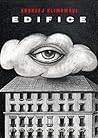
Edifice: A Graphic NovelEdifice: A Graphic Novel by Andrzej Klimowski
My rating: 3 of 5 stars

I was drawn in by a blurb written by the Quay Brothers. While they are my favorite movie directors of all time, they . . . might not be the greatest of graphic novel aficionados. Yes, I'm well aware of their background in graphic design, and I am rather fond of their Black Drawings. But with this blurb on Klimowski's book, I think they might have jumped on the hyperbole train.

I liked Edifice but did not love it. I appreciate the attempts to impart meaning or to deconstruct meaning through a series of darkly surreal, if fairly plain, charcoal sketches interspersed with some limited dialogue. Perhaps if I took phenobarbitol and listened to Penderecki and Ligeti while I read, I might have been in a more receptive mindset. But without sensory enhancement (or suppression), I see mostly a neat little graphic novel with rather ordinary (I'm talking execution here, not subject matter) charcoal drawings and the occasional clever twist of perspective and/or chronology. In other words, it's no Cinema Panopticon, Quay praise aside.

View all my reviews

____________________

If you like my writing and want to help my creative endeavors, please ko-fi me at https://ko-fi.com/forrestaguirre. Every little bit is seen and appreciated! Thank you!
Monday, July 13, 2026

The Rigor of Angels: Borges, Heisenberg, Kant, and the Ultimate Nature of Reality


The Rigor of Angels: Borges, Heisenberg, Kant, and the Ultimate Nature of RealityThe Rigor of Angels: Borges, Heisenberg, Kant, and the Ultimate Nature of Reality by William Egginton
My rating: 3 of 5 stars

Anti-nomy: 1. a contradiction between two beliefs or conclusions that are in themselves reasonable; a paradox. 2. William Egginton's favorite word.

A work on logical brilliance requires a text that is logically brilliant. While most would agree that Jorge Luis Borges, Werner Heisenberg, and Immanuel Kant were among the most beautiful minds the human race has expressed, putting their works to the general public in a clear manner is a fool's quest. Or, at least I'm too foolish to try such a feat.

Egginton does. And while he excels in examining the biography of each of these thinkers, the explication of their insights becomes long-winded to the point of confusion. There is a reason the words "clear and concise" often appear together. Meandering about in such already-troubled waters as quantum physics, late-stage philosophy, and high-concept literature only causes paths to cross so many times that the reader can become lost. They recognize the path's they've already crossed, but approaching them from so many different angles in rapid succession is dizzying (for us dumb people).

Perhaps this is why I appreciate works such as Gödel, Escher, Bach: An Eternal Golden Braid or Hierarchy Theory: A Vision, Vocabulary, and Epistemology so much. They are as long as they need to be. No longer. And while I admittedly do not fully grasp those works, I could always sense the thrust of their arguments - their beginning, progression, and goals - even if I didn't fully grasp the final product. There is a certain . . . pardon the pun . . rigor in these works that I found, not absent, but muddied in this book.

This is not to say that I didn't enjoy reading the work. On the contrary, I greatly enjoyed the biographical sections on each of these men, in particular. I've always loved Borges' fiction, for example, but knowing what I know now (from reading this book) about his biography, I think I've found a kindred soul in many ways. I won't go into details because I don't want to impugn anyone I might inadvertently "expose" (past or present). Let's just say that when you're in a foxhole "together," you become friends fast, and Borges feels like a friend now.

The sections on Heisenberg and the Nazi question are also insightful about the human desire to live and survive under a regime that is so far out of the norm of human decency; the ways that one "makes do" and subverts such regimes by subversion and careful deflection. While never excusing facism or its adherents, Egginton provides a nuanced analysis of Heisenberg's choices as a scientist and a human vis-a-vis the Nazi regime.

And Kant is presented as a man on borrowed time performing a philosophical race against the clock before death inevitably takes him. While somewhat speculative, the author does an admirable job of getting inside the philosopher's head and heart, turning one man's quest for the ultimate answers to being into a bit of a thriller.

In essence, though, the thesis of the book can be boiled down to Heisenber's quote: "We have to remember that what we observe is not nature in itself but nature exposed to our method of questioning". This is repeated in many ways throughout the book, but the essence remains the same. We are only as smart and observant as our observational tools. We do not see reality, we see our sight of reality. I am reminded of the argument that in order to prove there is or is not a God, one must see everything, but one must do it all at once, in all times and all places, in order to prove, once and for all, that there is or is not a God. In other words, one must become God to prove or disprove God.

And that, my friends, is an antinomy.


View all my reviews

____________________

If you like my writing and want to help my creative endeavors, please ko-fi me at https://ko-fi.com/forrestaguirre. Every little bit is seen and appreciated! Thank you!


Saturday, July 11, 2026

Death In Spring


Death in SpringDeath in Spring by Mercè Rodoreda
My rating: 4 of 5 stars

Two threads tied me up in this book. 1) the cover: Yes, I am a sucker for good covers. And for some reason this one had echoes for me of Brian Evenson's The Wavering Knife (possibly my favorite short story collection of all time) and A Collapse of Horses , as well as my own Heraclix & Pomp, and 2) the recommendation by the always spot-on Sam Pulham of Sherdstube, the single best book-tuber out there.

Upon cracking the cover and peeling it open (I use this phrase quite intentionally - those who have read the book will understand the grim reference), I found that the surface impression of an affinity with Brian Evenson's work was something that ran much deeper. Surreal, bleak, and inexplicably violent, with a tone of Magic Realism gone horribly wrong, this book precedes Evenson's presentation of the same by a good many decades and makes me wonder if Brian hadn't read Rodoreda's text early in his career. If not, they both came to the same place, stylistically speaking, or at least in that signature tone. The book crosses the line between fable and memoir, but the memoir of a young (later older) man living in a village that is full of violent rites like the sewing up of the dying in the Dead Wood . . . after filling their throats with concrete so their souls cannot escape (like many of the bizarre traditions carried out here, it's never explained why the soul's escape is a bad thing).

The cycle of violence goes through many manifestations and rituals, all of them unexplained, just cultural "givens" that one lives with. I suppose this has something to do with the genesis of the work in Franco's Spain. Populations under dictatorships tend to merely accept the violence imposed upon them with that familiar phrase (which I hate) "it is what it is". The inhabitants of Rodoreda's Death in Spring are no different. Imagine an entire society of Kafka's antagonists, all in on the game, but no one knowing why the rules are what they are.

This vortex of ritual violence also takes what, in other hands, would have been a simple "coming of age" story and twists it back in on itself in such a way that the antagonist "grows up" to become his father (whom we witnessed sewing himself up in a tree in an act of self-annihilation before being "rescued" by the villagers, if only long enough to pour cement down his throat and inter him in the tree again). Even the "boy's" step-mother becomes his wife (so far as I can tell) who abandons him when their child is killed by other children in the village - by this time, the boy has become a man resembling his father in most every way, most notably by the disfigurement of his face from being forced to swim the river that runs beneath the village (to ensure it will remain stable) and having his forehead torn off on the sharp rocks in the dark tunnels under the village.

This one is not for the faint of heart. Nor for the overly empathetic. If you are currently struggling with depression, this is NOT the book for you.

If you are ready to dive in, though (pun intended), to a book that will move you in strange ways and that contains some beautiful poesis. Perhaps it's time. And time. Again. And again. And again.

I'll leave you with a beautiful bright spot (there are a few, despite the overall angst of the work), something wistful and sweet (n.b., "Mourners" are a kind of bird, named for reasons that you can gather from your reading):

I jumped back into the river. The water that enveloped my legs still seemed to hold her. We had been in this water together. Mourners were flying above the blue and purple river, beneath the branches, searching for mosquitoes and soft grass. Night arrived, and suddenly I scarcely knew my way back to the village: from Pedres Baixes to the slaughterhouse and from the slaughterhouse to the Pont de Fusta, where the river beneath the bridge transported stars and pieces of moon.


View all my reviews

____________________

If you like my writing and want to help my creative endeavors, please ko-fi me at https://ko-fi.com/forrestaguirre. Every little bit is seen and appreciated! Thank you!