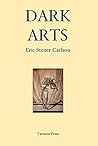
 Dark Arts by Eric Stener Carlson
My rating: 3 of 5 stars
Let me start by saying that I absolutely love Tartarus Press. In fact, I just had Mark Valentine's most recent collection from them show up in my mail this past week. My first Tartarus book was a copy of Meyrink's The Golem, which a good friend of mine gifted me many, many years ago. I think I own about twelve volumes from Tartarus, most of them hardcovers (though I'd have to verify that number). I've never been disappointed by a Tartarus publication. Unfortunately, that streak may have come to an end with the current volume. Carlson's Dark Arts isn't bad, it's just not up to par with the other Tartarus books I've read. I suppose not every volume can be outstanding. I also just encountered what I would consider Wakefield Press's weakest volume that I've read so far. Maybe it's a bad batch. Maybe it's just me, who knows? But I have to call them like I see them. And here is how I see each of the stories in this volume:
Can a story in which not one, but four deaths occur (one being an alleyway murder) be considered . . . comforting? Soft? Even loving? Carlson tells just such a tale in "Golden Book," in which an Ikiryo meets a young girl destined for her first encounter with death. This story is more of a blessing than a curse, as dark as it is.
"Coffee Shop" was ripe with dazzling poetics. Unfortunately, the incredible potential of the plot and language was unrealized. I wanted so much more than what the ending had to offer, but then again, that might have been the point of this story of trapped desperation?
I feel the same way about "Divining Rod" as I did about the last story. So much poetic potential, so little punch. This tale seemed to meander, directionless, like a series of disjunct writing exercises strung together on a frayed, insubstantial plot line. But again, maybe that was the point? I'll never know. Or maybe that is the point and I'm just too shallow of a reader to realize it?
I thought that maybe I would warm up to Carlson with the next tale. "Leopard-Spotted Scarf" is a touching (if tinged by horror) tale of a woman daring to become her childhood self, yet again. It's a bittersweet tale that doesn't telegraph the surprise ending, though one can likely figure out what's happening beforehand from the subtle cues left by the narrator. It's a Twilight-Zone-esque tale, which is one of the highest compliments I can give a story
Alas, the relative highs of "Leopard-Spotted Scarf" weren't reached again over the next few stories. "Corridor" is full of anticipatory horror past and present. Two journalists wait for the terrorists who are about to take them hostage. One has suffered throughout his life from an extreme neurosis about what will happen to him in the future. The other is terrified by the prospect of capture and death. But in this case, one's terrors can atone for the terror of another. A good (not great) tale of strange redemptions.
Somewhere along the way, I lost the thread of "Bradycardia". The heady mixture of dream and waking life, along with what might be psychosis, goaded along by a manipulative lover(?) gets almost too convoluted. There's a fine line between complex and incomprehensible, and I wavered over both sides of that line throughout.
The premise of "Stray," a story told by a dog about his many previous lives, was, to be honest, not to my liking. But Carlson handled that premise with tenderness and an ongoing emotional charge that won me over. I didn't like the idea, but the execution was handled by such a deft hand that I couldn't help but love the story.
Mood and atmosphere dominate "Strasse 60, Berlin". This story has a heightened sense of tension that gives it a higher ceiling of dread and eeriness than other stories thus far in the collection. The press of confusion is palpable. Chronology is shuffled and the narrator is misdirected by the phantoms of his own memories. A disconcerting, very effective story. This was more of what I had hoped for.
"Salt" is an excellent story of gaslighting by an authoritarian regime. It's a twisted narrative of unraveling untruth and an emotional gut punch to a narrator that may or may not be insane, but is absolutely in a lot of trouble.
Despite a baldly-telegraphed "twist" and some pushy histrionics, I rather liked "Monsieur Machine". Delivery aside, this was an excellent tale of love and ambition coming into stark contrast, then resolution of the dialectic. Given its mechanistic themes, there is an evocation of emotion that moves the reader while horrifying at the same time. Here love and loss combine to create awe and the awful.
I liked "I Loved You at Your Darkest," but didn't love it. Pardon the horrid attempt at a pun. Yes, the story twisted in an unexpected way, but resolved too quickly, in my mind, with the narrator able to make logical leaps using clues that shouldn't have evoked his conclusions. Another good, but not great tale, straining my belief a touch too much, which was the kiss of death (another horrible pun, given the plot).
I heard hinted echoes of Dhalgren in "The Atelier," a dystopian post-disaster (and pre-even-bigger-disaster) tale set in a fractured Europe held together by authoritarianism. But Delaney's novel was far superior to this tale, which is only a faint, thin shadow of the former. I found rays of hope in the hopelessness, but, again, this story just wasn't really "for" me.
Again, it's not a bad collection, just not up to my expectations of Tartarus' usual work. Do I regret buying it? No. I don't think I can ever regret buying a Tartarus title - they are, to me, the height of craftsmanship and elegant design. Would I buy it again, knowing what I know now? Also no. Like I said: maybe it's just me. High expectations + more experience over time = jadedness, I suppose. Then again, maybe it's not just me. You'll have to decide for yourself.
View all my reviews
____________________
If you like my writing and want to help my creative endeavors, ko-fi me at https://ko-fi.com/forrestaguirre. Every little bit is seen and appreciated! Thank you!

No comments:
Post a Comment