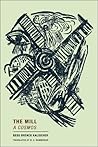
 The Mill: A Cosmos by Bess Brenck Kalischer
My rating: 3 of 5 stars
I believe this is the lowest rating I've given to a Wakefield Press title yet. It makes me sad, because I love what Wakefield does: bring fantastic obscure works in translation to light in the English-reading world. They've done some fantastic work in the past (including the amazing work of Marcel Schwob, Marcel Bealu, Otto Julius Bierbaum, and, most remarkably, Jean Ray). So, you'll excuse me if my expectations are sky high . . . but they are.
My unrealistic expectations were met with the introduction to this volume. As with every other Wakefield Press book I've read, the translator's introduction, this time by W.C. Bamberg, is worth the ticket price alone. It's an extremely evocative piece about this essentially unknown author: well-researched (with a hint of the historiography involved, even), captivating, sympathetic, and enlightening. This is the fine scholarship I've come to (unfairly?) expect from Wakefield. At times, the writing in the introduction out-paced the writing in the actual story.
It didn't take long after reading the introduction to become somewhat disenchanted. What seemed to start out as a staccato poesis descended into pure Dada. I understand that makes the work "of its time," but that doesn't excuse near-incoherence. Yes, the story is about a woman holed up in a sanitorium, but the experimental form . . . well, the experiment just didn't work for me.
The section "The Island of Destiny, or Encounter with the Caliph" was the first truly coherent narrative of this work. It started on page 25 and sustained through page 32, but I have to admit that making it to this section was a feat in and of itself. I've read plenty of stories with insane (or at least highly neurotic) and unreliable narrators, plowed my way through some notoriously difficult prose (Proust, Joyce, and Beckett, I'm looking at you), and read more than my share of stories about madness. But the first 25 pages of Kalischer's work here had me nearly leming the book, but I decided to press ahead. It is a short work, after all, and I'd bested tougher (though better-written) material.
After that the narrative gets wobbly, teetering on the edge of coherence, threatening to fall into Dada at any moment. It's sometimes difficult to discern between playful intellectual brilliance and an utter collapse of reason. It's almost as if Kalischer weaves in and out of each, with no warning about what direction she is turning; blind curves ahead. Sure, the narrator is struggling with mental illness, but a reader needs some kind of compass, even a weak one. Still, I pressed on.
Lest you think this ship has utterly sunk, that all was lost, that's not true. Later, near the end, I uncovered "On Sirius". It is by far the best section of the book. It's a gentle, smoothly flowing prose poem, not entirely lacking disjuncture, but not as chaotic as some earlier sections of the book. It is a piece that is of a piece, well-put-together, but not stodgy. I can (and have) wrap(ped) myself up in it. It is comfortable, but not so cosy as to be uninteresting. If the entire book was written this way, it would be at least a four-star book for me. Alas, that can't be. The neurotic narrator, like most humans, had a long string of near-coherence which, of course, wouldn't last.
However, I didn't mind the ending being disjointed. In fact, I think it worked quite well, given that we had a comfortable baseline in "On Sirius" from which we could jump off. The tragedy of this last section felt real and poignant. A good ending, given what came immediately before it. But the first part of the story started off in such a stark, jarring manner that I just couldn't make the connection with the narrator until halfway through the book. In fact, I wonder what the book would have read like had it begun with "On Sirius" and the erstwhile early material was tagged on to the back of the story (after the sanitorium episodes)? Possibly a stronger narrative? Unfortunately, Kalischer isn't around to ask for a rewrite.
Still, kudos yet again to Wakefield for presenting a work obscured by history and doing so with all the reverence and academic rigor it deserves. Yes, it fell short for me, but that's not stopping me from continuing to dip in the stream of Wakefield works. In fact, there's another waiting on my shelf right now that I am eager to read. I'm still on the Wakefield train and won't be getting off any time soon!
View all my reviews
____________________
If you like my writing and want to help my creative endeavors, ko-fi me at https://ko-fi.com/forrestaguirre. Every little bit is seen and appreciated! Thank you!

No comments:
Post a Comment