Saturday, September 18, 2021

Gustav Klimt: Complete Paintings


Gustav Klimt: Complete PaintingsGustav Klimt: Complete Paintings by Tobias G. Natter
My rating: 5 of 5 stars

I first saw this beautiful book at the gift shop of Vienna's Kunsthistorisches Museum when my wife and I visited there in 2019. I lusted after the book, but I had already shot my wad on book spending, mostly when we visited the "booktown" of Hay-on-Wye, Wales. Keep in mind that I had just consumed possibly the largest amount of art treasures (consumed with my gaze, that is) that I had ever seen. And I have visited a fair amount of art museums in my day. So, for me and this book to look out across the room and catch each other's eye was nothing short of love at first sight. Of course, one sets themselves up for failure when they romanticize a relationship that has not yet happened, and we did hit a couple of rough spots in our little 663 page fling. But all in all, I'm wrapped up in the afterglow. We loved and we loved with great gusto. Granted, it was all one sided - me indulging in the beauty of my lover. Love is sometimes like this.

As with any great book, I learned a great deal. I had never actually read a bio of Klimt (sorry, Wikipedia - I'm seeing someone else), and his life had a fair amount of twists and turns, from his young talent being recognized and rewarded, to the deaths of this brother and father (which greatly affected him), to the many, many love affairs he had (he sired 14 children - yes, you read that right). Klimt was a very, very interesting person.

This is not to mention his skill as an artist. His early work was intimately tied with some background in architecture and his greatest commissions were for artwork in state buildings or upper-class residences. Many of the "paintings" you've seen are actually murals. The cover of the book itself is a prime example of this. I was very excited to read the section about the secession building in Vienna, which my wife and I visited. He didn't do all of the art on the building, but he had a very, very strong influence on it, being the official leader of the secession movement. It is, to be candid, one of the most beautiful buildings I've seen in my life.

Taschen, the book's publisher, spares no expense in showcasing the fabulous art. For instance, pages 119-122 are a four-page full-color fold-out spread of the Beethoven Frieze. This is only one of four such fold-out spreads, if I am counting correctly. I didn't realize these fold-outs were a part of the book when I first purchased it (the book is bought wrapped tight in plastic). The book is littered with beauty. It's almost overwhelming. Such is Taschen!

I sort of knew that Klimt did portraiture, but I was unaware that he drew so many beautiful portraits. Klimt was a master at capturing personality. The Portrait of Rose von Rostborn-Friedmann is a good example. There is an adventurous spirit there (she was an alpinist who was one of the first women to scale two notable peaks), with a strong, sensual attractiveness that equals her pioneering elan.

As I alluded to earlier, I didn't agree with the editors all of the time. At first, I didn't buy the argument that Klimt was influenced by the Fauves after his golden period. The colors were all wrong: not fauvist at all. Later, though, I could see some Fauvist influence in the backgrounds of his later portraits. It wasn't as obvious as the authors portrayed it, but it's there, I'm willing to concede. Also, It's in landscapes, Tobias Natter (the editor) claims, that Klimt is most like the Symbolists. While I see that in some of his landscapes, I think it's in his mosaic works that I see the resemblance in a more profound, concrete way. Yes, the early landscapes are ethereal and hazy, like some of the Symbolists, and even his portraits show influence from Fernand Khnopff and Jan Toorop, but the outright iconography in his golden, bejewelled works speaks more to the mythic and symbolic to me than either his landscapes or portraits.

If you think Klimt's paintings are good, take a look at his drawings. The editor calls them "a parallel universe, existing alongside his painterly ouvre". So very true. Klimt's paintings and drawings are two sides of the same coin, each distinctive and each valuable. As with coins (I've collected a few medieval silver coins), one recognizes that both are beautiful and equally valuable, but any given viewer tends to prefer one over the other. It's obvious how Klimt's paintings have endured, but his much less-well-known drawings show a deft hand that might be overshadowed by the renown of the paintings. One thing I appreciated about the book's presentation of the drawings is that the editors chose to view Klimt's drawings not just through the lens of subject matter, but through the lens of mood and emotion. While they aren't always convincing in their categorization of this drawing or that, the mere attempt is bold and causes the reader to look at Klimt's drawings in a different, more interesting light.

Klimt's obituary provides great insight into the artist's influences, providing, with hindsight, a great window into his creative world:

What initially struck the viewer as being Klimt was not him, but something with which he was connected. Japan, China, Byzantium and the ancient and modern Orient. Italian and modern English Pre-Raphaelitism. French decorative and magical painting of the Moreau kind, Low Countries mysticism from the region of Khnopff, with colonial goods and gods in between. But if he took something from everything, it was because he was nothing less than an eclectic. He simply used this as nourishment and transformed it into Gustav Klimt.

The end of Klimt is, however, not quite the end of this review. I love works that push me into other stories, and this book is no exception. Here, the never-finished portrait of Ria Munk, who committed suicide after her scandalous affair with Hanns Heinz Ewers has stolen my attention. I will take many things from this book, but this portrait and the story before it, around it's unfinished creation, and it's aftermath (pushing well into the World War 2 era - Ewers was a noted Nazi supporter who was later considered "deviant" by the regime) is the sort of thing that epic myths are made of.

I think I'll be feeling the influence of this book for a long, long time.

Gustav Klimt is dead: Long live Klimt!


View all my reviews

__________

If you like my writing and want to help out, ko-fi me at https://ko-fi.com/forrestaguirre. Every little bit is seen and appreciated! Thank you!

Saturday, July 31, 2021

John Betjeman: Collected Poems

John Betjeman: Collected PoemsJohn Betjeman: Collected Poems by John Betjeman
My rating: 5 of 5 stars

Almost exactly two years ago, in the summer of 2019, my wife and I travelled to Europe. One of our stops was the "booktown" of Hay-on-Wye in Wales, near the English border. We were staying in the Cotswolds and Wales was about 45 minutes away. I have some Welsh heritage (with rumors of some familial connection to Lord Tennyson, though I was never able to pin my mother down about details on this before she died), and I was DEFINITELY interested in buying books while I was over there, as my tastes run to the British and, well, those types of books are obviously more easily available in the UK.

After visiting I-don't-remember-how-many bookstores (there are over 20 of them in that village of under 2000 people!), we stopped in one last little shop, a little out of the way from the rest. I bought a copy of Arthur Rackham: A Life with Illustration that had caught my eye. That was the last book I bought in Hay-on-Wye before we left town for our AirBnB back in the Cotswolds.

But on our way out of that little shop, a book caught my eye for no particular reason other than that it was facing out from one of the shelves I was passing by and I wanted to soak in every tiny detail before I left this slice of heaven on earth, probably for the last time in my life. It was a copy (not the edition I'm reviewing here) of John Betjeman's Collected Poems. I had honestly never heard of the man. Yes, he was the Poet Laureate of United Kingdom until his death in 1984 (one year before I arrived in the country as a teenager for my three-year stay there) and I probably should have heard of him. But back then, I was more interested in Motorhead and marijuana than poetry, so . . .

I read the back cover, flipped through a couple of pages (under the watchful eyes of the shop owner, who was, I think, eager to get the store closed up, but too polite to kick this brash American out of her establishment) and was surprised to find *gasp!* rhyming poetry! I took a mental note of the name and left the shop, later adding the book to my Goodreads To Be Read list.

I don't rightly recall when I ordered the book, but I do recall ordering Major Poems and Selected Prose of Algernon Charles Swinburne at the same time (yes, through Amazon, I must admit, which I usually try to avoid, truth be told, but it was during Covid and it was a weak moment). This will become important later . . .

And not long after it arrived, I began reading. Yes, my memory had served me correctly, the Poet Laureate of the United Kingdom, against all academic protocol (possibly intentionally, given his tumultuous relation to the academy) wrote in rhyming verse . . . almost exclusively! Only one of the poems, "Before the Lecture," is not written in rhymed stanzas, until one comes to his epic biographical work "Summoned by Bells," which is written in free verse. Both "Before the Lecture" and "Summoned by Bells" cover his relationship with the academy (and his heartache about having to drop out of Oxford, more specifically - this shall also become important in a moment), so perhaps he wanted to speak "their language" so that they could understand exactly how he felt about them? We'll never know.

Despite the "quaintness" of the rhyming, and sometimes because of it, Betjeman shows an incredible breadth, depth, and power in his writings. For example, "Original Sin on the Sussex Coast" is an unsubtle reminder that childhood is not the age of innocence you might think it to me. Betjeman is a poet, but he's not naive. On the contrary, his slices of life sometimes cut deep.

"1940," a gut-wrenching poem about the horrors of war, demonstrates this quite well.

1940

As I lay in the bath the air was filling with bells;
Over the steam of the window, out in the sun,
From the village below came hoarsely the patriot yells
And I knew that the next World War had at last begun.
As I lay in the bath I saw things clear in my head:
Ten to one they'd not bother to bomb us here,
Ten to one that they'd make for the barracks instead -
As I lay in the bath, I certainly saw things clear.
As I started to dry, came a humming of expectation;
Was it the enemy planes or was it young Jack
And the rest of the gang who have passed in their aviation
Setting across to Berlin to make an attack?
As the water gurgled away I put o a shirt,
I put on my trousers, and parted what's left of my hair,
And the humming above increased to a roaring spurt
And a shuddering thud drove all the bells from the air,
And a shuddering thud drove ev'rything else to silence.
There wasn't a sound, there wasn't a soul on the street,
There wasn't a wall to the house, there wasn't a staircase;
There was only the bathroom linoleum under my feet.
I called, as I always do, I called to Penelope,
I called to the strong with the petulant call of the weak;
There lay the head and the brown eyes dizzily open,
And the mouth apart but the tongue unable to speak;
There lay the nut-shaped head that I love for ever,
The thin little neck, the turned-up nose and the charms
Of pouting lips and lashes and circling eyebrows;
But where was the body? and where the legs and arms?
And somewhere about I must seek in the broken building
Somewhere about they'll probably find my son.
Oh bountiful Gods of the air! Oh Science and Progress!
You great big wonderful world! Oh what have you done?


Betjeman is not limited to the tragic, however, his work spans the full gamut of human emotion and experience. It's as if no corner of life goes unexplored, whether happy or sad, dark or light, private or public. I cannot fully explain the full breadth of the man's mind. Betjeman, as they say, contains multitudes.

While in the midst of discovering Betjeman and marveling at his ability to work within the strictures of rhyme while teasing out some of the most evocative, emotive series of words I've read, I listened to my favorite podcast, Weird Studies, when they aired episode 103: On the Tower, the Sixteenth Card of the Tarot. As part of that discussion, JF Martel and Phil Ford talk about the "miracle" that poetry is, that enobling meaning can come from such an intentionally-constrained exercise as writing a rhyming poem. This miracle is plainly evident in Betjeman's poetry. I would say that it is Magic.

About Magic: say what you will about chance, but when a number of seeming "coincidences" line up in a row in strange, but seemingly intentional ways, you might see an interesting stochastic structure, but I see Magic.

Magic, for some reason I cannot define, often happens in "threes". This is how it manifested when I read the last section of this book, "Summoned by Bells," Betjeman's free-verse biographical sketch.

Now, I admit to feeling a bit of a kinship with the man, simply by connections - connections that only I know, but he does not (that I know of): We were both failed academics who had to drop out of school (this is why I have an MA and not a PhD, though I count my lucky stars that I never did become a professor, which sounds like Hell-on-Earth the more I learn about it). We were literary-minded and shared the same disposition when it came to school, sports, and being bullied as children. We both balked at our respective father's vocation while young, and in fact, a little older, rebelled against the person himself rather openly and brashly, until, later in life, we saw the honor of our fathers' careers and, I believe, the honor in our fathers.

I say this to make it clear that I don't come at this from an unbiased position. But I can't characterize the experience of reading this last section as anything less than Magic, or I would be a liar to myself.

"Summoned by Bells" is a chronological (I think - correct me if I'm wrong) recounting of Betjeman's life from early childhood in London, through a stay in Cornwall, school at Oxford, and time spent in the Cotswolds to the west.

The account isn't always flattering. In fact, it often shows Betjeman's weakest points of character. I love that in a couple of his biographical sketches Betjrman effectively says "Look what I got away with. I'm not proud of it, but I'm a clever coward." His candor is endearing. He was a brave man to share these experiences. I dont know that I'm as brave. A tip of the hat to a vulnerable trickster; deceptive, but self-effacing.

And yet, at times, serious. Maybe too serious. He recounts:

The smell of trodden leaves beside the Kennet,
On Sunday walks, with Swinburne in my brain


And it struck me: The Swinburne Connection. I was reading Swinburne and Betjeman at the same time. I had earlier noted the strong affinity between the two in their form of expression (though one was far more atavistic than the other). Here, I saw the connection explicit, direct.

You may call it self-suggestion, or perhaps my brain making the subliminal connection between the two in my subconscious until I saw the name "Swinburne" in the Betjeman book with my conscious mind and made a neurological connection.

I still call it Magic.

One of the reasons I so wanted to go to Hay-0n-Wye is because I am a fan of Arthur Machen, the Welsh author of The Great God Pan, among other works. In fact, I picked up a copy of The Hill of Dreams while there. In every bookshop we stopped in, the name I looked for was "Machen". I had hoped, nay, lusted to buy a Machen book while in Wales. Thankfully, and oddly enough in a town with over 20 bookstores, I eventually found this volume in a little horror bookstore, almost tucked behind the counter on a small round table quite hidden unless you moved a certain way around the counter. It was a quest halfway across the world to find this hidden book!

So, imagine my surprise when Betjeman mentions Machen's Secret Glory and it's obvious that it had a powerful impact on him. I liked this man even more. I was sad to know we would never meet. And, yet, through this Magic, we kind of do.

The day before my wife and I would leave the UK, flying for Germany and Austria, we took a long hike, twelve miles, through the English countryside, crawling the Monarch Trail through the Cotswolds. You can read about that whole "adventure" here. Little did I know, two years ago, that I was setting the world in motion for the next Magic connection between Betjeman and myself.

Toward the end of "Summoned by Bells," Betjeman mentions, quite out of the blue, I thought, and goes on at length about, Sezincote, a wonderful piece of architecture that my wife and I stumbled across on our grueling hike in the Cotswolds in 2019 (I even have a photo of Sezincote in my Cotswolds post).

And soon he mentions Bourton-on-the-Hill, which is the village where we stopped for lunch at a pub that we fell in love with. And he mentions Longborough. And Moreton-in-Marsh - the EXACT route of our widdershins trek through the Cotswolds. Again, so-called "coincidences" occurring one after another is, in my eyes, Magic. Reading this book of poetry is, for me, weaving a powerful spell! The more I learned about Betjeman, the more I felt like I had been unknowingly summoning his ghost my entire life.

I should like to one day meet John Betjeman in some kind of afterlife. We would have a lot in common, we would share similar stories with differing details, I would likely find him affable, likeable, perhaps even brotherly.

And yet, I shall never, ever be able to write as well as the man.

He is infinitely approachable and yet eternally untouchable.

View all my reviews

Wednesday, June 30, 2021

The Black Meadow Archive - Volume 1


The Black Meadow Archive - Volume 1The Black Meadow Archive - Volume 1 by Chris Lambert
My rating: 5 of 5 stars

I was introduced to The Black Meadow Archive - Volume 1 through the album of the same name. After getting the digital copy and becoming enamored of it, I sought out the physical LP and paid a good clip of money for it. Sometimes I know what I want and I'm willing to spend what I need to in order to get it. I very rarely buy vinyl, so this tells you how much I like the strange, haunting sounds of this album. So, when I saw this book . . . well, I had to know the tales hidden behind the dulcet horror of these songs. And here they are.

"The Lair of the Coyle" is a great mythic story of a knight who is cursed to poverty all the days of his life. A good little tale, with a touch of the gruesome, as one should expect from medieval stories.

"The Legend of the White Horse" is a beautiful piece of folk-fabulism, mythic and banal at the same time. I could hear this being sung and spoken by a bard of old. Timeless and haunting.

I love blackberries. They are one of my favorite fruits. So, I wondered what the song "The Blackberry Ghost" was all about. Now that I've read the story of the same name, I know. But now I don't know if I want to know. Next time I eat blackberries . . . I shall be very, very careful.

The exquisite subversion of folkloric norms in "A Voice from the Heather" is a spectacularly positive, affirmative, yet ultimately horrific work of art. It simultaneously upends and reinforces the morality tale, surprising at every turn, and there are many turns. Possibly one of my favorite fables in recent memory. Calvino would have loved this, and I love Calvino, thus . . .

More blackberries: "The Blackberry Swim" is like something straight out of Der Struwwelpeter or Grimms' Fairy Tales (the uncensored versions) - gaudy in its gruesomeness. Imagine folk horror meets splatterpunk. I love blackberries, they really are one of my favorite things in the world. But after reading this story, I might hesitate, just momentarily, before eating the next one. But I'll get over it. I hope.

Even more blackberries: "The Heart of the Blackberry Field" is an exquisite example of Folk Horror. It hits all the right notes with careful timing, creating a perfectly sinister, yet innocent tone. We are one with the land, and the land is one with us. You, too, will become one with the land. Trust me, you will. When I think of the term "psychogeography," going forward, I shall think of this tale first and foremost, at least in a rural sense. Perhaps I'm mapping my own definition onto the term, as it was originally coined to describe exclusively urban applications, but this is how I choose to interpret it. Call it rewilding psychogeography.

The bardic poem "He Took Her Hand" betrays its oral storytelling origins by the clever use of mnemonic refrain. Structurally, it reminds me of some of the works I studied while a student of African History. But this is a very British volume. Still, the structures echo each other quite strongly. This is the sort of horrific tale one would hear in a dark pub just before closing. The series of permutations of this refrain render it effective and, yes, memorable.

"A Dead Man on the Moor" is atmospheric, but the lack of any real underlying motive and scant background make for a sparse story. Not a bad story, just not as rich and deep as the others.

A peasant morality tale, "The Ploughman's Wrath" illustrates the virtue of hard work and honesty and the punishment due to the lazy and dishonest. This is, however, just one possible story among many mythical explanations for strange features in the land. It makes one wonder how many unspoken tales might exist to explain otherwise unexplainable phenomena, all lost in the mists of time. Will we ever recapture them?

Okay, a little piece of dark poetry in the middle of the book. Okay. Seems a little weird that there isn't more poetry in here, but this book is all about weird. It's not that "The Song of the Meadow Bird" is out of place, it just seems slightly out of genre. Then again, a few of the stories have a poetic sensibility, if not true mechanical poesis, so maybe it does fit in.

"The Ticking Policeman" is a wonderfully weird story that is oh so very British: well-mannered and potentially violent, should one step out of line in the slightest. The understated humor is like something out of the more refined skits on Monty Python's Flying Circus (yes, there were some of those in the midst of all that insanity).

"March of the Meadow Hags" is my favorite piece in this volume. A diabolical pear tree and skinwalkers feature most prominently in this incredibly weird tale. It is told through a series of seemingly unrelated documents - one of my favorite ways to write and, yes, to read. Wonderfully dark and sinister! This is the sort of story I wish I would have written myself.

"The Maiden of the Mist" is bittersweet and tender. It might make you a little teary-eyed. It did that to me. A touching story.

"The Audire" is an unexpected (at least by me) story about Syd Barrett. The mystery of Radomes on the northern moors is explored. I don't even know what to say about this story. I enjoyed it. But it was strange, even for a man who loves strange stories. Truth be told, I'm a bit jealous that these ideas have been explored and I won't discover them in my own writing. But I'll take the gift.

"The Wretched Stranger" reads as if it had escaped from a deep trough of creepypasta. And I do mean escaped. This story will keep crawling out, smiling the whole time, no matter how many times you kill it. But trusting your hunches might just buy you some time before its inexorable arrival.

"The Village Under the Lake" is convoluted and requires some amateur mental gymnastics to understand. The confusion adds to the intrigue, however. The narrator is restrained in imparting information because the way that the information was imparted was piecemeal and confused. Besides, you don't really want to know everything about the village under the lake! Trust me, you really don't want to know.

I like the story of the "Ghost Planes" as much as the haunting song on the album (if it can be called a "song" proper - it's more like a soundscape). A wonderfully cryptic sewing together of various patches of accounts of Ghost Planes flying above the moors from throughout history.

I also have a digital copy of the album "The Black Meadow Archive: The Lost Tapes". It covers some of the stories in this book that were not covered in the first album. It is equally as moody and grey. Unfortunately, there never was a physical LP done of this one. At least . . . not in this reality.

View all my reviews

__________

If you like my writing and want to help out, ko-fi me at https://ko-fi.com/forrestaguirre. Every little bit is seen and appreciated! Thank you!

Thursday, June 17, 2021

Interzone

 Call me a punk, if you must. I love Zines. I recall the days way before the internet was public, when it was only used by the military (my father confirmed to me once that he was using it, in a more primitive form, as far back as the early '80s), when Zines were a primary form, no THE primary form of communication amongst the punk underground. They'd spring up at record stores and sometimes at concerts, usually given away for free, though I'm sure some enterprising young capitalists (i.e., not punks or were they so not punk that they were punk?) sold some for cash. Or Dead Kennedy's patches. Or something.

The thing about Zines is that they were (and can still be) inherently subversive. From the Samizdat of the Soviet Union to the backstreet record store Zines of Omaha, Nebraska, there was also a subtext of "screw the establishment" in these little handmade, stapled books of cardboard and paper. Remember, this was before photoshop, so you literally had to cut and paste and copy real photos (or copies of such) by hand. This was production outside of the publishing industry, and intentionally so. Distribution was likely by some kid carrying a few copies in the inside pocket of a trenchcoat asking the record store if they could leave a few copies. Communication between fans was facilitated by either snail mail or phone numbers typed or written in the back. Again, this was meant to avoid the scrutiny of "the man".

If our imaginary distributor was anything like me, this kid hopped fences, walked through piss-drenched back alleys, crossed abandoned lots on the edge of town, and generally ambled where others would not go. This sort of walking the seams of society was not limited to urban settings. I took great delight in wandering those areas of suburbia and even on the edge of the country where no one wanted to be. Where the sprawl of capitalism smashed up against the wilds of the country, where weeds grew up between old asphalt and tin roofs caved in on crumbling cinderblock buildings covered in graffiti, where Bad Things happened. 

It's a wonder that, in all my wanderings, I was not once mugged or murdered or worse. I had my fair share of confronting feral dogs (twice), stepping on rusty nails (took one right through my left foot, bloodying my bobos on the top), drinking water I shouldn't have (that hand-pump in Italy that had me hallucinating with a 108 degree fever - I will never forget those hallucinations . . . terrifying!), and generally just exploring these waysides where no one sane (or sanitary) went.

I love those places. I still do. I was on foot a lot more back then as I was too young to drive. But even now, if I make some time (and it has to be made, I don't just "have" the time anymore), I will take the circuitous route on foot to a destination, cutting through the abandoned parking lots and over the tracks (sometimes over the train's hitch itself) to get where I'm going. I prefer to live my life this way. I don't routinely trespass in places marked as private property. Notice that I use the word "routinely". Sometimes, I can hardly help myself.

Which brings us to this little Zine: Interzone:


Yeah, you'll have to pay for it. But you're a grownup now, you can probably afford it. But besides the start up cost, this little beaut has an incredibly punk aesthetic and it's philosophically as punk as it gets.


Was it all done on photocopiers? I doubt it. I mean, take advantage of technology if you can, says I. There's no shame in this. But it looks like it was done using the old cut and paste methods, replete with polaroid borders around the photos. Maybe it was all done with a polaroid and photostat, who's to know?

"What is this?" you're asking. It's an essay by Cormac Pentecost about what these areas between civilization and the wilds symbolize. I don't want to spoil it, but capitalism and its failures are at the center of the discussion, even as the places themselves are on the edges of throwaway society. Marion Shoard and Mark Fisher are quoted at length, which should be enough of a draw for those even mildly interested in hauntology and psychogeography. This essay straddles the tripartate line between history, philosophy, and activist politics. I am reminded of the later work of Michel Foucault, but with a decidedly less academic tone. In ways, it is a sort of elegy to times past, when such "edgelands" were more common, where late-stage capitalism hadn't quite subsumed everything in its path. But it's more than just a mawkish look backwards. Many of the insights hint at a ways forward, not just looking back at the loss, but providing a way through the loss via an examination of these edgelands and their features.

For those much younger than I (there are many more of you every day), if you want a glimpse into what life was like in the '70s and '80s for those of us who liked to adventure in these in-between spaces or if you're simply trying to get into why Generation X is the way it is, you might want to give this a spin. 

For everyone, I think that Interzone is a great reminder that those liminal spaces can be appreciated for what they are, where they are, and what they symbolize. They can be a motivator to do your little thing to make society a little bit better . . . and a lot weirder. Weird on!


__________


If you like my writing and want to help out, ko-fi me at https://ko-fi.com/forrestaguirre. Every little bit is seen and appreciated! Thank you!


Monday, June 14, 2021

Sacrum Regnum II


Sacrum Regnum IISacrum Regnum II by Daniel Corrick
My rating: 5 of 5 stars

After being entirely blown away by Sacrum Regnum I, I was excited, but a touch guarded, when approaching this second volume in the series. While I saw a lot of names that I normally love, I was wary of the sequel, worried that it would either fall flat or "jump the shark".

My fears were completely unfounded. This second volume absolutely lives up to the promise of the first. My only disappointment is that a volume three was never compiled.

But why focus on what might have been, when we can focus on what is? And this volume is absolutely brilliant! By that, I don't mean bright and shiny, oh no, this volume is dark, in places very dark. I mean smart, intelligent, dignified, and, dare I say it: literary? It is, with the first volume, a Symbolist master stroke, and a worthy bow to the Symbolist and Decadent literature of the past, without being enslaved to it.

My praise for Sacrum Regnum II does not, however, mean that I felt entirely comfortable with it. Not by a long shot.

For example, I feel, as the kids say these days, "seen" after reading John Howard's tale of a slightly neurotic numismatist, "Into An Empire". Yes, I saw myself in the protagonist on several levels. John, how did you get into my head? This hits too close to home for this mildly neurotic wannabe numismatist. I even restrict myself to pre-1776 Germanic state silver coins in a similar manner to the story's main character, Payton. Seriously, I feel naked before your pen. That is to say, I could completely immerse myself in Payton.

Next, "The Human Cosmos" is Charles Wilkinson at his best. Strong echoes of Italo Calvino ring throughout, and that is some of the highest praise I can give a story. An ambiguous story (in the best way possible) of fabulism that ends poised on the knifes' edge of dark and light. I am reminded of my favorite quote by Calvino: I am a Saturn who dreams of being a Mercury, and everything I write reflects these two impulses. Wilkinson hits both sides of that balance at the same time.

Colin Insole's "Dreams from the Apple Orchards" (which I have read before) is an excellent example of psychogeography, where the landscape itself pulses with the negative energy of those who lived their before. The setting is the character, the setting that has seen so much of corruption and baleful intent. A thin veneer separates the trappings of civilization from the base layer of chaos beneath.

I had wanted to read Thomas Strømsholt's fiction before, but this was my first chance to do so. "Szépassony-völgy" packs an unexpected gut punch. Strømsholt layers a seed of utterly mindless random brutality under a veneer of mythic legend and romantic nostalgia and longing for past love. The contrast is striking and invokes a strong existential response in the reader, leaving one's head reeling. Powerful.

An entire section about author Quentin S. Crisp, replete with an interview with the author and a piece of short fiction, entitled Crispiana opens a window into the brain of the author, at least what he's willing and able to share about his brain. An interesting peek at an author whose work I quite like. As with the first volume of Sacrum Regnum, I love the collection of fiction, non-fiction, poetics, and reviews. An eclectic selection, but with it's own firm voice.

The Poetics section in this volume contains work by Mark Valentine, Loha Connell, and Bethany van Rijswijk, along with a translation of Stefan Grabinski's "Red Magda".

Ah, kids. Can't live with them, can't bury a fire hatchet in their forehead when they are possessed by fiery arson demons without feeling some degree of guilt. Watcha gonna do with "Red Magna"? This brilliant (pardon the pun) translation will lodge itself in your brain, just like an axe. The effect is no less painful. I did warn that some of these works go to very dark places.

Mark Valentine turns his always-keen critical eye on novelist Claude Houghton in his article "The Stranger Who Opens the Door - The Novels of Claude Houghton". As is usual, the reader is sent off scurrying to find the work of another forgotten author. Valentine is an archaeologist of literary treasures that need to again see the light of day. This essay is no exception!

Martin Echter's essay on the aesthetic principles espoused and practiced by Hanns Heinz Ewers is an exemplary examination of not only the writer's oeuvre, but of the undergirding philosophy that drove Ewers' work. A marvelous examination of an incredibly underrated author.

I had read, with interest, Mark Valentine's essay on Mary Butts from his collection Haunted by Books, whom I had not heard of to that point, with interest. Now, with Nigel Jackson's essay "Obscene Ikons: Desacralization & Counter-Tradition in the Work of Mary Butts," I have felt compelled to add her complete short fiction to my To-Be-Read list. For those who know me well, you know I don't add things to my TBR list lightly. I curate it a great deal (and am often chided for how few books I have on my TBR list on Goodreads). So, yes, I expect something special from Mary Butts' work.

. . . and the review of Georg Trakl's The Last Gold of Expired Stars in the book review section cements my decision to buy that book, as well. Thankfully, it was already on my TBR list.

There is some high praise for The Ten Dictates of Alfred Tessler by D.P. Watt. But isn't Watt always deserving of high praise? Yes. Absolutely.

A critically-constructive eye is placed upon Alex Miles' debut weird fiction collection The Glory and the Splendour. I haven't read said collection, but the assessment here seems fair, yet firm: there's potential here, but it needs work. It's strangely refreshing to see a review that is measured and doesn't overstate the work being reviewed, but sees raw potential.

Another balanced, insightful review, this time of Quentin S. Crisp's All God's Angels, Beware! clearly explains what it is that makes Crisp's work tick. I have yet to see a clearer explanation of how he does what he does when he writes. It is unique, quirky, weird, and charming at the same time. It has heart and this essay shows how and why this is done. An important essay on Crisp's fiction, to say the least!

When I read through the list of forthcoming books here, I am reminded of how good of a year 2013 was for literary fiction of the sort that I love. Halcyon days, to be sure. Hopefully, they'll return. In some small way that's happening, but we need an updated equivalent to Sacrum Regnum or an outright resurrection of the same to really seal the deal, as far as I'm concerned. Where is our Sacrum Regnum? And here I go again, pining for the past by longing for the future. I'm tempted to try to make it happen myself. It's been a while since I've edited . . . hmm . . .

View all my reviews

__________

If you like my writing and want to help out, ko-fi me at https://ko-fi.com/forrestaguirre. Every little bit is seen and appreciated! Thank you!

Monday, June 7, 2021

Vienna Part I

 After our visit to the UK, which ended on a wonderful, exhausting day hike, we were off to Heathrow the next day to fly into Munich. After a very pleasant talk with the Munich police (no, really, they were super nice) we entered Germany and drove our rental car to an outlying hotel where we spent the night before heading to Vienna the next day.

And by "rental car," I mean the Mercedes that I splurged on. It was almost my 50th birthday, and . . . you know . . . the Autobahn!!! Now for some, a Mercedes is pretty run-of-the-mill, but not to this guy, whose fanciest car ever is the Camry sitting in my driveway.

I should note, also, that I was almost born on the Autobahn. My Dad had to drive my Mom from Frankfurt to Wiesbaden, where the hospital was, when she was in labor with me. There was a traffic jam and my Dad, being a brash American, decided to drive up the shoulder to bypass traffic. Mom was apparently about to pop! And, of course, he was pulled over by the Polizei. However, like a scene out of a bad movie, when the officer saw my mom's condition, he turned on his siren and led my Dad up the shoulder of the Autobahn all the way to the hospital. I waited until we were inside to make my entry into the world.

So, I had a sort of affinity to the Autobahn. I made sure to watch a LOT of youtube videos on Autobahn etiquette, because I was certain (and correct) that driving like an American there would land me in handcuffs explaining myself to some US diplomat. 

I'll be honest: Germans (and Austrians) are some of the best drivers I've ever encountered. Granted, that's comparing them to drivers in Italy, the Philippines, and Utah (ugh, Utah drivers - UGH!!!!), but the combination of courtesy, a strict adherence to the rules of the road, and a certain confidence in their driving ability made driving the Autobahn a pure pleasure.

I'll anticipate your next question: How fast did you go? Well, I topped out at 225 KMH or so, or around 140 MPH. Yeah. That was good stuff. Would definitely do it again, in a heartbeat. Natalie got some really bad pics of me approaching that speed, but she was a little freaked out that she might bump my arm and make this our last drive ever, so she only got the following shot. To be honest, I was really worried about her bumping me, too. What is the quote from Mario Andretti? "If you're in total control of your car, you're not racing." Or something like that:


After checking in to our Air B-n-B (thank you, Vera, you were wonderful!) we got passes for the U-bahn and headed to Figlmüller, which is, from what I understand, fairly famous for its schnitzel. You can see the extensive "specials" menu in the background behind Natalie here. We chose . . . um, let's see . . . uh . . . oh, yeah . . . schnitzel!


And, oh my, if you're in Vienna, make the time to get a meal here. Oh my, oh my, oh my. I ate mine like any good Wisconsinite would:


Okay, so Door County isn't exactly accurate here, but we had been in Europe for a week. I just forgot the correct proportions. Besides, I like abstract art.

There was also a potato salad that was to die for, but pictures of potato salad are so blasé, I will pass. The chocolate cake at the end, however . . . you know, I'm typing this while fasting. Sometimes I really hate myself:


Then there was this apple-soda sort of thing that I absolutely fell in love with: Almdüdler. I had it a couple more times while we were over there. I need to find a US source for this. NEED . . .


Why do all the best things in German-speaking countries have "ü" in them? I don't know.

After dinner (Tip: You'll DEFINITELY want to get reservations ahead of time!), we headed to Stephansdom to check out that beautiful cathedral. 


And, lest we forget: Gargoyles are everywhere in Vienna:


Yes, it is as gorgeous in person as in the pictures. No, actually, it's better!

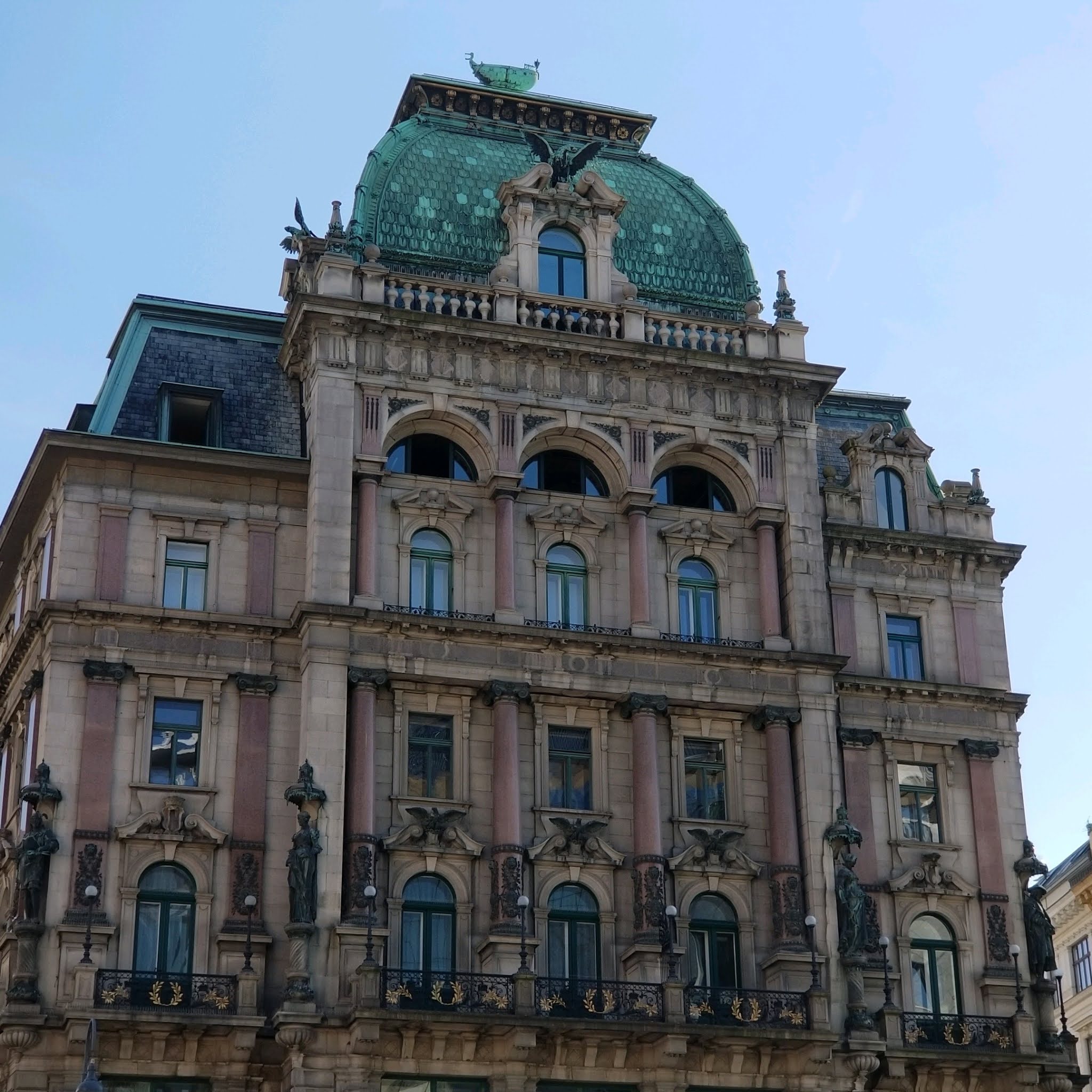
One bit of advice: If you visit Vienna, LOOK UP!!! There is so much gorgeous architecture there, from gothic to art nouveau to modern and everything in-between. It's an architectural historian's dream. For example, there's this building (I never did get the ID on this one, as with many buildings there, since I was too busy gawking to worry about names), which is right on Stephansdom Platz.


Or, there was this very cool modern building that faced Stephansdom. Note the thinned reflection of Stephansdom in the photo I took here.


Also note that in that upper window area was a statue that looked down (probably with great condescension) on the Platz. I couldn't tell what the statue was, but I got the impression that some power broker of some type had his office in there:


Most people just went about their business, completely ignorant of this inanimate onlooker. I had about a dozen story ideas flash through my brain when I saw this. I'll need to work on those.

And we saw this beautiful art-deco cornerpiece on our way to the Secession building:


I had visions of Wim Wender's "Wings of Desire" here. No, it's not Berlin, but this style would have fit right into the movie. Or maybe "Blade Runner"?

On to the Vienna Secession building, which was absolutely stunning. Here, try pictures, not words:


Again: more beautiful in person, but you get the idea. I'd say this was my favorite building that we saw on our entire Europe trip. I was absolutely gobsmacked.

After waking up from that architectural dream, we took the U-Bahn (the transportation system that makes Vienna one of the most "livable" cities I've visited) to Marien Theresa Platz. I'll skip the history lesson (you can look up Maria Theresa on the interwebs) and show our first impression of the old Empress:


Yep, she had her back to us, the old snob. So we favored her by going around front:


As you can see, night was falling, so we turned our backsides to her (turnabout's fair play, as they say) and headed for Hofburg Palace and the surrounding buildings. 


The palace was all nice and such, but I had really come to see . . . Orcs?


Isn't that some fine, fine Orcitechture? And don't try to tell me it's not an orc, it totally is, and you are wrong!

There was an interesting building that was obviously made for grand entrances and exits to the palace grounds that we quite liked:


Hercules beats people up, absconds with women, you know, his typical schtick. What I love the most about this, though is this lion "hiding" atop the gate (#rollforinitiative):


And these decked out battle maidens:


I would totally want these paladin-ladies (Paladiens?) in my adventuring party. They are ready to rumble!

Lastly, there was this super-cool piece of statuary of an aquatic nature, though I'm not sure which myth it represents. Anyone? Bueller?

When we approached this statue, some guy was taking a picture of someone who was either his sister or his girlfriend and she looked EXACTLY like the woman at the top of the statue. I mean EXACTLY (well, except for the clothing). I didn't get a picture of her, unfortunately. But somehow, even though I tried hard to protect people's privacy, I caught some girl who had weaseled her way in just as I was taking my shot. She most definitely did not look like the statue and was, I am hoping, cursed by the goddess of the statue to be . . . I don't know, infested by eels or sea urchins or something?


On the way back to our place, we did some window shopping. We spotted the following in a window and were sad that we didn't have hundreds of Euros to just blow on an outfit for our grandson that he'd outgrow in a few months.


Is that not the kyooootest little boy outfit you've ever seen? Oh that I had money to throw around like that. *sigh*.

Then, of course, I spotted the following jacket in a window (the first of many such jackets I would lust after and not be able to justify buying):


So, our sartorial ambitions crushed by financial reality, we went back to our Air BnB to rest up for the next day and our visit to the Kunsthistorisches Museum Wien.

__________

If you like my writing and want to help out, ko-fi me at https://ko-fi.com/forrestaguirre. Every little bit is seen and appreciated! Thank you!


Sunday, May 30, 2021

Opium and Other Stories


Opium and Other StoriesOpium and Other Stories by Géza Csáth
My rating: 5 of 5 stars

This is a tale about a book. Not this book only, but a specific copy of this particular book, the one that's sitting on the desk in front of me as I type this up.

I had not heard of Csath until a few months ago, when this book arrived as part of an exchange package with an author whose work I greatly admire. I traded one of my books for one of his and he sent "extras". I was very pleased with this, and this copy of Opium and Other Stories was part of the package. I saw that there was an introduction by Angela Carter and thought "well, if she wrote the intro, it can't be all that bad". And, of course, Opium. The connection to decadence (as well as the cover art - clearly from the Symbolist era, my favorite era of art) told me that I would at least like some of the stories contained therein.

I was mistaken. I liked all of the stories, and a few of them were exceptional.

But we'll get to that in a moment. Back to the story about the book. I was told that there were some pages missing from the book, but I completely and utterly forgot this by the time I began reading it. I don't typically look ahead at what I'm going to read outside of checking the next story up (in order to ascertain if I can read it with the time remaining that day/lunch hour/whatever or if I need more time, as I am an admittedly slow reader). So, I "discovered" (re-discovered, really) that some pages were missing . . . and to be quite honest, the missing pages made me love the book all that much more. Why? Because I am not a fan of tidy endings. And because I hate it when authors spoon-feed me too much information. I like the mystery of maybe not fully understanding everything that happened in a novel or story. Sure, I like to know enough to follow the thread, but I abhor when the author tries so desperately to tie off every single loose end. I much prefer that the author let me use my imagination to fill in the blanks and make the connections. That way, the story becomes "mine" in a way. And it sticks in my brain better that way. I am more vested in the happenings, the characters, even the setting if some bit of it is left to my imagination.

In this case, it wasn't the author who did this, it was the fact that a few pages were physically missing from the work. One story (the title story, in fact) was without a beginning, so I had to imagine one up. Another was missing the end, so I . . . imagined one up myself. Now, I wouldn't want to do this with something with an overly complex plot and lots of characters, but in this case, with these short stories, it worked for me and worked for me quite well.

Who was Csáth? He was a gifted neurologist who wrote on the side and who struggled with a powerful opium addiction throughout his short life. At one point he shot and killed his wife and tried to commit suicide, but was unsuccessful and was, thence, institutionalized. He escaped and, after being stopped by Serbian border guards, he swallowed poison, this time successfully committing suicide. A tragic life, to be sure, and one can sense traces of a troubled mind throughout these works, a few of which give graphic descriptions of animal torture and murder (of both animals and humans). there is no doubt that his artistic side was overshadowed with darkness. At least one of these stories ("The Black Silence"), I would consider required reading for horror aficionados. Had his work been available in English translation sooner and had his work been more widely distributed, I feel that this work would have been considered a classic.

But again, I'm getting ahead of myself. To remedy that, let me introduce my notes to the various stories:

"The Magician's Garden" is a wonderfully evocative tale of mysteries, somehow obfuscated by the characters' frank admittance of them. Attila Sassy's illustrations (peppered throughout the book) lend a distorted elegance to Csáth's beautiful prose. The words are strongly redolent of symbolism, the art somewhere between Beardsley and Klimt, with an utterly alien quality unique to Sassy.

"Paul and Virginia" is a simple story, self-effacingly so. And yet, with one small twist, Csáth sends the whole setup into a maelstrom of conflicting emotion. Iys incredibly effective for a four page piece of what moderns would call "microfiction". But there's nothing micro about it. This little twist sends the story well beyond the bounds of the words, deepens them into mixed poignancy and, perhaps, regret.

I want to say that "An Afternoon Dream" is a brilliant symbolist tale. But I don't really know what that means. Reminiscent of Symbolist art, I suppose (I am reminded of Gustave Moreau, in particular, or, perhaps - a bit later - Fernand Khnopff or Klimt), though this might just be some kind of artistic synesthesia which I suffer. Nevertheless, it is a beautiful tale, mythic, poetic, and, yes, brilliant.

"Saturday evening" is a quaint recollection of domestic life, with the ambiguously sinister (?) Sandman waiting in the wings, watching, looming.

don't think that it was just the name "Trepov" in the title "Trepov on the Dissecting Table" that made me think of Nabakov. No, the voice is similar, and the peasants-eye view of day to day life in the face of death was Nabakov to a "T". Strong echoes of the Russian here. Oh, and the story really is all about Russians.

"Erna" is a bitterly funny morality tale. It is, like most of the stories herein, very brief, so to say too much is to spoil it. It is a brilliant and cutting character study with a bit of a twisted sense of humor, which is to say, I liked it quite a bit.

At first, I thought that "The Surgeon," with its philosophical allusions, would delve into the depths of the epistemology of time, but the story took an abrupt term toward physiology that reveals the titular surgeon as an absinthe-addled madman. My kind of guy, truth be told.

"Meeting Mother" is a ghost story, I suppose, but different than any other ghost story I've read. Or it is a hallucination, who can tell?

"Murder" strips the act of any kind of romantic notions and wallows in the utterly futile banality of what it feels like to take another man's life. It's disturbing for the profound emotional effect it has on the one telling the tale. The continuously surging regret is palpable.

Don't let the title fool you, "Little Emma" is the most horrific thing I've read in a long time - animal torture, caning, and hangings throughout. This is highly disturbing stuff!

And, oddly, the next page in this copy of the book is missing, so I'm going to start the next story "Opium" three pages in, not knowing what came before. Intriguing . . . an adventure!

Csath gives an interesting argument for "Opium," namely that only during the transcendental high are we truly alive, and what appears to be hours to the outside are thousands of years to those who are living. Thus, it's all worth the sacrifice. While I don't agree that it's all worth it, I've been in that headspace before, and it's always a temptation to dive back in. Too bad Csath imploded.

What's a decadent collection of stories without a tale of insanity and unfaithfulness? Such is "A Young Lady".

"Festal Slaughter" is a tale of peasants, but not idyllic. These are rough people, treated roughly, especially Rosie, whose only respite from her hard life and the harder life to come, lay in the comforts of sleep. I wonder if Jonathan Wood's excellent novella The Deepest Furrow wasn't at least partially inspired by this tale.

"A Joseph in Egypt" is a wonderful subversion of the story of Potiphar's wife in the form of a dream. It evokes a certain dream sense of simultaneous longing and contentment that often accompanies the best dreams.

"Musicians" is a communally-depressing piece, well, maybe just more fatalistic, about an end of an era and those who got out just in time. Reminiscent of Steven Millhauser's work, in ways, but definitely a step darker in mood (which is saying something, if you've read much of Millhauser).

I am absolutely convinced that if "The Black Silence" had a wider audience, it would be considered a classic of horror literature. It is an extremely effective story packed into very few words. It is written such that the emotional effect bursts out far beyond the confines of the story itself. This really is a must read!

"Railroad" teaches a hard lesson: silence and inaction exact a price, a festering inner rot from which one cannot escape. Brutality must be met with justice, or the brutalized may decline, even die, because justice has not been sought by the victim.

"Toad" is the first story in this volume that was a decidedly "meh" story. I suppose it was inevitable. Not a bad story, just so-so.

"The Pass" the highly-erotic tale of a young man's journey across fields of nude figures, is balanced on the edge between Symbolism and Surrealism. One is left wondering what to think of the observer/narrator and his cultural milieu as much as how to puzzle out the protagonist's actions and inaction.

My copy of this book is missing the last page of the story "Matricide". I love that fact. It makes this book unique and quirky. Now, I shall have to make up an ending:

The constable discovered their mother dead the next morning. Irene's father, a drunkard who had been out the night before, was blamed for the crime. The elder married Irene, then the younger tortured and killed them both. The end.

I chose to listen to a black metal album while reading "A Dream Forgotten" just for some background music, specifically Andavald's album "Undir skyggoarhaldi". Turns out, this was the perfect soundtrack of anguished dirges for this story. Perfect, or as the narrator laments: "Horrible. Horrible."

Anyone who has spent time alone with the dead remains of a loved one knows the poignancy and strange, numb pain of the story "Father, Son". I'm one of those. This story breaks my heart a little bit more. Simple, but powerful for those who know, and I know . . .

"Souvenir" is a reminiscence of an author (not Csáth himself, I mean, but a character in his story) that touches on the hidden pangs of longing after a lost, young love, the premature ending and subsequent spoiling of a nascent youthful romance. I remember those feelings . . .

"The Magician Dies" is strangely prescient, at least by way of Symbolism, of Csáth's forthcoming death by opium, or by reason of opium (via suicide). A haunting choice for the last story in this remarkable volume, tying the artist to his legacy through one of his own stories. Yes, "haunting" is exactly the right word.

And "haunting," like the feeling slightly sickening feeling that one has after reading highly disturbing works, but with less "ick" factor, is how I would describe the collection. There is no doubt that this was written by an opium addict. Even without the explicit references to drug use, one can sense the dream-like quality (some of the stories are explicitly about dreams, obviously) tainted with an underlying darkness, a sinister something lurking within many of the narrative voices throughout the work that struggles with an epiphanic, almost angelic other that pulls the reader simultaneously heavenward and down to hell. Csáth's life was clearly spent being torn in both directions and ultimately torn apart by those diametrically-opposed pulls. Would that his life (not to mention his wife's) not ended so, but one wonders what his stories might have been like had he not suffered so. We'll never know, just as I'll never know the true beginning or ending of two of the stories in this volume - and I don't care to know. Let me live my mystery!

View all my reviews

__________

If you like my writing and want to help out, ko-fi me at https://ko-fi.com/forrestaguirre. Every little bit is seen and appreciated! Thank you!