Showing posts with label Philosophy. Show all posts

Monday, August 17, 2026

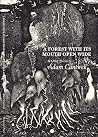
A Forest with its Mouth Open Wide & Other Stories


A Forest with its Mouth Open Wide & Other StoriesA Forest with its Mouth Open Wide & Other Stories by Adam S. Cantwell
My rating: 5 of 5 stars

Full disclosure: Adam Cantwell and I are what was historically-termed "pen pals". Or at least we've written a few letters to each other. If you can't handle the fact that this review is likely biased by our correspondence, then maybe you should just bugger off. I like Adam. And I like his writing. There, I said it.

In my miserable berth I grew deathly ill. The cold and torpor drew what was left of me to my low-lying parts; here my pain and ennui sloshed and settled and was distilled. The whispering proximity of the lethal sea called these dregs down ever further, and day after day my spirit seeped through tar and pitch and blackly down.

My liquid remains decanted through desert voids of seawater. It was an alien medium, primal, its essence was not the tang that clings to the red flesh of salmon or the morning chill borne on the fog but the dead-cold and salt of bones and freezing stars. My nothing-substance popped and dispersed, particles radiant from the dumb core, shreds of lost desire given over to huge black currents.


This quote, from the opening story "Orphans on Granite Tides" should give you a notion of the solace and comfort you'll find within the pages of A Forest with its Mouth Open Wide & Other Stories, i.e., none. I've earlier reviewed this story (I have the original publication from Les Editions de L'Oubli (aka Mount Abraxas Press), though this is the revised text as it originally appeared in Bastards of the Absolute , which I have not read. I don't know what the exact revisions are, but this version seems a hint darker than the Mount Abraxas version. Maybe I'll ask him in my next letter. I seem to owe him one, especially since his last mailing was a short stack of vinyl records from his musical projects Spaceboy and Villains.

The second story, "Black Chroma," is set in what seems to be a post-apocalypse, though it may be the structure of the narrator's mind that is collapsing (this may be the case with many of the narrators in this volume), rather than civilization. Paranoia and agoraphobia combine to expose (him?) to the bright pinpoint lights of the cosmos, a nakedness only occulted by self-burial.

Profoundly existential, yet hopelessly defiant (I am reminded of one of my favorite poems, William Ernest Henley's Invictus ), "The Chamber in the Universe" examines monuments, devotion, power, hope, and death. The temple representing as empty vessel exposing the hollowness of existence, while being the instrument by which the common-builder nudges the cosmos, even a particle's-width; one of the most human of desires: to matter, even when nothing matters. To make one's mark forever in the void.

"The European Monster Part Two" is dark and obtuse, much like the philosophy of Emil Cioran, the inferred inspiration for the story (first published in a volume of stories dedicated to the Romanian philosopher). Here the narrator finds himself in a labyrinthine situation, becoming a part of a (political? criminal?) machine at the heart of which is the titular monster, perhaps a modern Minotaur.

"Torso in Shadow" puts the baffled and baffling narrator in the subways beneath NYC, which may or may not be disintegrating above. Surely it is convulsing, socially or physically. Amidst these convulsions, in the underground, the narrator meets a woman. Perhaps this is Adam and Eve witnessing the birthing pains of a new world. Difficult to tell. But the attempt must be made. An ouroboros of a story, eating itself.

Originally written for a tribute anthology to Borges, "The Bow, the Arm, the Arrow" echoes the Argentine writer's sometimes-journalistic style, but with a tonal nod to Millhauser, as well. The story reminds me of a long-form vlog I recently watched about the composer Penderecki (a favorite of mine), but with the narrator experimenting with literature, rather than music. Sometimes experiments go wrong.

The titular story in the volume actually appeared alongside one of my own stories in the Mount Abraxas anthology Frostsigils , an homage to Paysage d'Hiver. As one would expect, it is dark, downright Gothic, and one can feel the cold sink into one's bones while reading. It's all about atmosphere, and it delivers that in shadowed robes with the deep moaning toll of an immense black iron bell.

With "Vod the Wrecker," I again find myself as "TOC mates" with Adam in the Raphus Press anthology Ghost Trains. But where I treated the train in question as a haunting presence, here, Vod is the brooding master, a near-god, over the twisted metal entrails of what was once the most powerful force in America. Vod destroys, remakes, and rides the bones of the ur-train like a pyrrhic steed, into oblivion.


In the amber-filtered urine-gray aged-out green glass of insulators, crystallizing dumbly over centuries, he saw an enviable solitude and immobility. The enamel of insignia and livery, some burned to peacock craquelure; the bent-blue of sulking steel glazed over with a million dullnesses of black and charcoal.


Transformation of the individual and of the world are the subject of "The Oligomancer". Here a migrant child of an itinerant oil-platform worker watches the world turn inside out from a privileged (so to speak) observation point on the derelict platform. A slowly unfolding apocalypse gives indicators from the horizon about the collapse of the outside world, which can't help but affect his own inner world. Again, the line between psychic and physical reality is not only blurred, it is completely shattered.

And, finally, "The Hag, the Cutthroat, the Amputee" is the musing of a being who, like Charon of Greek myth, ferries the dead across to their final destination, particularly those whose demise is caused by war. He(?) is very adamant to note that he is not Charon, and his thoughts regarding the dead make it clear that he does not share the detached observations of his more famous counterpart.

Those are the stories and my skewed observations of them. You want objectivity? Good luck finding it in this universe. But I will end by deferring to one of the great nihilists of our age, Thomas Ligotti, who stated, quite correctly:

The stories of Adam Cantwell's . . . could be fairly equated with the works of Kafka or Borges if their prose were not so luxuriant and surprising at every turn.

I have nothing more to add.


View all my reviews

____________________

If you like my writing and want to help my creative endeavors, please ko-fi me at https://ko-fi.com/forrestaguirre. Every little bit is seen and appreciated! Thank you!

Thursday, August 13, 2026

The Silver Surfer: Parable


The Silver Surfer #1 "Parable" Part 1 of 2 by Stan Lee and Moebius by Stan Lee
My rating: 4 of 5 stars

[This review is for both volumes of the mini-series combined]

I've been a Silver Surfer stan (pun intended) since the early '70s when I first encountered the character on the news-stan(d) - okay, I'll stop.

I had spotted "Parable" when it was first published, but I was out of high school and trying to be "cool" by ignoring comics at the time. What an idiot I was. A few years later, I realized the error of my ways and got back into comics but had lost track of this mini-series until a few years ago. I'm not quite sure how that happened. Moebius is one of my favorite artists and The Silver Surfer is one of my favorite Marvel characters.

In this treatment, the art, as one would expect, is absolutely amazing. Moebius' Galactus, sans-crackle, would still warm Jack Kirby's heart, I would think. I wonder if anyone interviewed him about this miniseries before he passed away? One is quite curious what his thoughts would be. And Moebius' style lends itself to the sleek action sequences one would expect in such a tale.

But the action only catches the eye. It's the philosophy and psychology underneath it all that holds the reader's attention. The writing is not perfect, by any means - at times it sounds like it's trying too hard to be "wise" and "insightful," which lends a sort of hokeyness to some of the dialogue, sometimes to the point where it is downright painful. But if one can look beyond the treacle, there are some solid pearls of wisdom and insights into human psychology that would explain the current socio-political mess we are in. This miniseries was so prescient it could have been written today, this very hour, without skipping a beat. And I fear that it will always be applicable, no matter what happens in the political landscape. It is a parable that sees beyond its years, a sort of cosmic-action scripture, if you will. It is so accurate that it's scary. I'm afraid that Norrin Radd's near-nihilism is very, very close to a bigger truth, and we can't handle that truth.

View all my reviews


____________________

If you like my writing and want to help my creative endeavors, please ko-fi me at https://ko-fi.com/forrestaguirre. Every little bit is seen and appreciated! Thank you!

Monday, July 13, 2026

The Rigor of Angels: Borges, Heisenberg, Kant, and the Ultimate Nature of Reality


The Rigor of Angels: Borges, Heisenberg, Kant, and the Ultimate Nature of RealityThe Rigor of Angels: Borges, Heisenberg, Kant, and the Ultimate Nature of Reality by William Egginton
My rating: 3 of 5 stars

Anti-nomy: 1. a contradiction between two beliefs or conclusions that are in themselves reasonable; a paradox. 2. William Egginton's favorite word.

A work on logical brilliance requires a text that is logically brilliant. While most would agree that Jorge Luis Borges, Werner Heisenberg, and Immanuel Kant were among the most beautiful minds the human race has expressed, putting their works to the general public in a clear manner is a fool's quest. Or, at least I'm too foolish to try such a feat.

Egginton does. And while he excels in examining the biography of each of these thinkers, the explication of their insights becomes long-winded to the point of confusion. There is a reason the words "clear and concise" often appear together. Meandering about in such already-troubled waters as quantum physics, late-stage philosophy, and high-concept literature only causes paths to cross so many times that the reader can become lost. They recognize the path's they've already crossed, but approaching them from so many different angles in rapid succession is dizzying (for us dumb people).

Perhaps this is why I appreciate works such as Gödel, Escher, Bach: An Eternal Golden Braid or Hierarchy Theory: A Vision, Vocabulary, and Epistemology so much. They are as long as they need to be. No longer. And while I admittedly do not fully grasp those works, I could always sense the thrust of their arguments - their beginning, progression, and goals - even if I didn't fully grasp the final product. There is a certain . . . pardon the pun . . rigor in these works that I found, not absent, but muddied in this book.

This is not to say that I didn't enjoy reading the work. On the contrary, I greatly enjoyed the biographical sections on each of these men, in particular. I've always loved Borges' fiction, for example, but knowing what I know now (from reading this book) about his biography, I think I've found a kindred soul in many ways. I won't go into details because I don't want to impugn anyone I might inadvertently "expose" (past or present). Let's just say that when you're in a foxhole "together," you become friends fast, and Borges feels like a friend now.

The sections on Heisenberg and the Nazi question are also insightful about the human desire to live and survive under a regime that is so far out of the norm of human decency; the ways that one "makes do" and subverts such regimes by subversion and careful deflection. While never excusing facism or its adherents, Egginton provides a nuanced analysis of Heisenberg's choices as a scientist and a human vis-a-vis the Nazi regime.

And Kant is presented as a man on borrowed time performing a philosophical race against the clock before death inevitably takes him. While somewhat speculative, the author does an admirable job of getting inside the philosopher's head and heart, turning one man's quest for the ultimate answers to being into a bit of a thriller.

In essence, though, the thesis of the book can be boiled down to Heisenber's quote: "We have to remember that what we observe is not nature in itself but nature exposed to our method of questioning". This is repeated in many ways throughout the book, but the essence remains the same. We are only as smart and observant as our observational tools. We do not see reality, we see our sight of reality. I am reminded of the argument that in order to prove there is or is not a God, one must see everything, but one must do it all at once, in all times and all places, in order to prove, once and for all, that there is or is not a God. In other words, one must become God to prove or disprove God.

And that, my friends, is an antinomy.


View all my reviews

____________________

If you like my writing and want to help my creative endeavors, please ko-fi me at https://ko-fi.com/forrestaguirre. Every little bit is seen and appreciated! Thank you!


Tuesday, November 18, 2025

The Life and Opinions of Tristram Shandy


The Life and Opinions of Tristram ShandyThe Life and Opinions of Tristram Shandy by Laurence Sterne
My rating: 5 of 5 stars

In my quest to "use what I have," a subset of "minimalism," I'm digging back into books that I have read before, but not yet reviewed. I believe I picked up this (now very beat up) copy of Laurence Sterne's The Life and Opinions of Tristram Shandy as an undergraduate at BYU. I don't exactly remember why I chose this book. I think I just spotted it on a bookshelf in a used bookstore near campus, read the back copy, and decided to give it a try. I was a humanities major as an undergrad, so it behooved me to read "classics," and this was one classic that I had never heard of until that point. I was young and dumb then and didn't have the toolkit to really analyze literature quite yet. I was building that toolkit.

Turns out, for this novel, I didn't need a toolkit.

Because Tristram Shandy defies analysis.

Plot? You've got to be kidding. The main character isn't born until page 170.

Setting? The vast majority of the story takes place on the grounds and house of the Shandy estate, though several pithy journeys wind their way into the narrative. There is a section on France (largely dismissive and with much of the "action" taking place at night, unseen by Tristram himself).

Speaking of which: Action: If you're looking for acts of heroism, you'll hear some referred to, mostly by Corporal Trim, the (extremely lovable and innocent) servant of Tristram's Uncle Toby. These are viewed with a simplistic eye and lack any of the bombast of most modern thrillers. Teh highest levels of excitement are reserved for 1) references to battles in which characters (most notably, Uncle Toby) have been wounded, 2) arguments between servants and, sometimes, their masters, 3) arguments about the birth of the boy and his naming, and 4) philosophical arguments.

Philosophy? The novel is lousy with it, but philosophers are often misquoted (whether intentionally or not is difficult to tell), misidentified, and their words maladjusted to whatever argument is being presented at the time (which is coming from Tristram's father most of the time).

Culture? Here we are hitting something important and, ostensibly analyzable. But who has time to learn all the mannerisms of mid-18th century England? Thankfully, the novel is also lousy with endnotes (and I don't mean "bad" when I say "lousy," I mean "infested, as with lice"). It's a whimsical window to the England of the 1700s. America didn't even know what it was missing.

Structure? Ah, mmm, about that . . . the only structure here is digression. It reminds me of the time as a grad student I had to learn to read French, after having studied German for four years and Swahili for two. French . . . has no structure. Everything is an exception. This drove me absolutely batty. In fact, "French for Reading Knowledge" is the only class I ever failed in college. It doesn't help that the teacher had us construct sentences from scratch for the final, something we were never taught and never instructed to study. We were taught to read, which I could do pretty well. But then the final came and we were supposed to construct a bunch of sentences from nothing in French. I'm still pissed about that one. Anyway, after studying the firm rules of German and Swahili grammar, with a couple of idioms sprinkled here and there (and easily recognizable, for the most part, from context), I was thrust into the spaghetti code of French "grammar", where, I will repeat, everything is an exception, with very few rules that I could fathom.

But as much as I hate(d) French, I love the digressions of Tristram Shandy. And this lack of structure, this worship of the digression, is by design. To quote Sterne:

Digressions, incontestably, are the sunshine; - they are the life, the soul of reading; - - - take them out of this book for instance, - - you might as well take the book along with them; - one cold eternal winter would reign in every page of it; restore them to the writer; - - - - - he steps forth like a bridegroom, - bids All hail; brings in variety, and forbids the appetite to fail.

The heart and soul of the book, then, is The Digression. Not just those used by the author in creating the "story," but also by each individual character in telling tales of yore, quoting philosophers (poorly), and even in the manner in which they read certain treatises and tell certain tales, themselves full of digressions.

And what of the characters? Here is where Sterne hits his highest notes, particularly in the characters of Uncle Toby and Corporal Trim, two grizzled veterans, stout of heart and dedicated wholeheartedly to their "hobby horse" of large-scale reproductions of military campaigns in which they participated. I really fell in love with these two warm-hearted characters and their banter, which, of course, spilled into, yes, even more digressions.

Speaking of the "hobby horse," here Sterne, though a pastor, is far from innocent in his insinuations. This novel is bawdy. Thoroughly so. To the point that I am shocked that Sterne didn't lose his clerical office. As any shrewd Englishman would, however, he hid the bawdiness in euphemism, some of the most clever euphemisms I have ever heard (and I was raised around soldiers who would make you question the physical ability of one to stick one's body parts into the suggested receptacle - the physics are staggering).

So, I say pishposh to all the deep post-modern analysis of the academy. This is a novel that is meant to be read and enjoyed, not dissected and analyzed. It's a morass of facades, innuendo, and false leads, baroque in its segues and sidestreets, and all the more beautiful for its chaotic complexity.

View all my reviews

____________________

If you like my writing and want to help my creative endeavors, ko-fi me at https://ko-fi.com/forrestaguirre. Every little bit is seen and appreciated! Thank you!

Wednesday, September 24, 2025

The Wander Society


The Wander SocietyThe Wander Society by Keri Smith
My rating: 4 of 5 stars

Pretentious? Yes. But I like pretentiousness. But I actually LIKE pretentiousness in writing. Sure, it's a little "twee" at times, but so what? Keri Smith is living her best life. Get over yourself.

What he have here is non-fiction disguised as fiction. It's a handbook, really, an eclectic mix of false story that entices one into the Wander Society. There is a touch of armchair philosophy and a lot of practical types on how to be impractical, which is a wonderful undertaking. Whimsy is the heartbeat of everything you'll find in this work. If you take yourself really seriously, you are going to be seriously disappointed.

My favorite sections were "The Wander Society's Tactical Guide" and, most importantly, "Assignments/Research/Field Work". These are were the rubber (of your soles) hits the road (or the dirt or mud or gravel). This is what I was looking for when I first heard about this strange little book. Before reading the book, I had already implemented my own brand of "Leave Behind," as Smith names it, a calling card, if you will, and a tribute to life, death, and the struggle between the two. It's been exactly a year since I started the practice of beautifying death on the trail, and, in fact, I laid a garland on a critter this afternoon. Poor little guy! If I don't memorialize his little life, who will?

This book has also helped me as I do my best to go analog and ditch the smart phone. Walking, especially wandering (there is a difference) is a great way to immerse oneself in analog, as long as one is willing to turn their phone off or leave it at home while on the trail. It's a beautiful, horrifying, lovely world. Look up from your screen for a while and take it all in. The Wander Society can be used as a tool to help you learn how.

Remember "Solvitur Ambulando" and "non omnes qui errant perditi sunt"!

View all my reviews

____________________

If you like my writing and want to help my creative endeavors, ko-fi me at https://ko-fi.com/forrestaguirre. Every little bit is seen and appreciated! Thank you!

Saturday, September 6, 2025

Des Lewis' Brainwright and My Writing

 Here, a very brief post, a mere link, really, to Des Lewis' Forrest Aguirre and the Brainwright for my old age. As some of you know, Des is a master of reviewing works of fiction in such a way as to re-present the work to new audiences by offering a detailed analysis that is less explanatory and more exploratory, not ingesting and regurgitating the material, but painting a picture of a painting with other eyes. His reviews are a kaleidoscope, zooming in and out, lensing, coloring, sometimes distorting to catch images out of the corner of the intellectual eye that one would otherwise miss. As I said, they re-present the work in fully self-sufficient strokes.

Now Des has examined his reviews through the lens of what I will call a Deep-Observational Engine, which takes the whole of his output (which has a vast and riddling complexity) and twists the kaleidoscope on the reviews themselves. For my own work, this is fascinating to me. I have no argument with the conclusions, but note that many of the threads presented here were not anything intentional on my part. Some were, of course, but some are just organic threads that emerge through my writing process from somewhere deep inside. When I read the review, it gives me reason to reflect not only on my work, but on myself. I think back to "where I was" in life at the time I wrote each of those stories, and I can see windows back into my own experience (the experience of living, not writing) two steps removed from my own biased analysis of myself. It's a refreshing view and lends perspective that I otherwise wouldn't have.

As always, Des: fantastic. You are a modern Wizard.

____________________

If you like my writing and want to help my creative endeavors, ko-fi me at https://ko-fi.com/forrestaguirre. Every little bit is seen and appreciated! Thank you!

Tuesday, August 12, 2025

Minori Leather bag and Mudita Kompakt phone

 I'm not usually one for product reviews, but every once in a while I find something that's just such high quality that I have to let people know (no, I'm not being paid or sponsored to say this or anything else in this review, for the record, but if you find this mildly entertaining or even useful and you'd like to contribute, see my kofi link below). I just bought two such items (well, I bought one of them months ago, but it's one of those "time will tell" things that I had to let play out): 1) the Boulder Leather Crossbody bag by Minori Leather, and 2) the Mudita Kompakt phone, both of which are pictured here:


Let's start with the bag, as that will be quickest. I absolutely LOVE this bag. It's perfect for travel, and I'll be using it on my Alaska cruise next week! Great size: fits my Boox Go 10.3, a composition book, and my Leuchtturm 411 writing book, as well as my passport and Mudita Kompakt phone (shown in the photo for reference size). This arrived QUICK (buying locally helps, folks). I love the weathered look and this looks to be bomb-proof. Solid construction, tight stitching, zippers are smooth. I'll probably have to leave it in my will for my kids. Strongly recommended. "It's just a bag," you say? Yeah, kiddo, wait until the apocalypse and we'll see who's begging for something to comfortably carry.

As for the Mudita Kompakt: I made the decision a long time ago to try to simplify my life and move toward a more analog existence. If you've read my blog, you've seen windows into that journey. And for my next trick, I'm (gasp!) ditching my smart phone. Well, at least I am after my Alaska trip because I need it for the boarding pass and such. But my everyday carry does NOT include my smartphone anymore. I could go on for days about the many ways that we are being manipulated by the builders of smartphones and those who create apps for them, and how we need to simplify our lives more and spend less time on social media and online in general, and being offline more lets us focus on things we love more (like, for me, writing and playing RPGs), but I really don't need to. Many, many people have done this before, mostly on youtube (ironically, if you watch youtube on your phone): here, here, here, here, here, here, here, here, here, here, here, here, here, here, and here. I'm sorry, you're welcome, and welcome to my rabbit hole.

So, the Mudita Kompakt does not run any google-fied apps. It can't. And I'm happy about that. It is a simple phone, with an e-ink screen (which minimizes that blue light that burns into your retinas at night from watching cat videos on your smart phone for too long - you know who you are) that is easy on the eyes and aesthetically pleasing. There are apps, but you can't access the App Store, which is fine by me. There's an alarm, calculator, calendar, camera (awkward to use and black and white through the viewfinder, though the pictures are taken in color), chess, E-reader, Maps, Meditation (really a glorified timer, if I'm being honest), Music (which needs some work. A lot of work, in fact), Notes (which also needs work - too few characters, to be sure), a recorder, and a weather app (fairly accurate). It's got some "warts" - music is just playable alphabetically or on shuffle, not by artist or album, but I'm confident they'll fix that in an update; maps has some latency issues because it's e-ink, but then the whole intent of the phone is to slow you down and make you think more intentionally, so it does that; the notes app definitely needs to allow more characters, and the screen is ultra sensitive, so I often find myself putting the phone into "Offline+" mode, which shuts off the phone, camera, microphones, and all wireless communications at the flick of a switch (psst: this is the phone privacy advocates have been looking for all along) and locking it. I had a lot of problems with pocket-dialing until I figured out I need to flip into Offline+ mode and lock my screen if I didn't want to inadvertently call someone. Like I said, it's ULTRA-sensitive and needs work, which I'm told they are doing.

Which brings me to another point: Mudita actually listens to their users. The proof is in the pudding. I've spent a fair amount of time on the Mudita forums and seen the complaints of users (myself included), and they have responded not just with patience and tact, but with updates that make sense. Yes, there is more work to do - I bought the phone on its kickstarter, so I knew there would be bugs - but I'm confident in Mudita's ability and willingness to address any shortcomings. However . . . if you think you're going to get a black and white smartphone, think again. That's not what this is about. This is about mental freedom from the grip of a smartphone. It's intended to keep you OFF the phone, to DISconnect and, thus, reconnect with yourself, your thoughts, your time, your surroundings, your hobbies, and your loved ones. Pretty revolutionary stuff.

My experience has been . . . good. At times, very difficult. I don't think I understood how strongly I was addicted to my smart phone (and still am until this trip is done) until I took the plunge. I have an addictive personality, so smartphones are built like a hook for suckers like me. So, if you can put down the smartphone and social media "anytime I want to" - this phone isn't really for you. But if you are looking to get more calm into your life, to avoid the jittery anxiety of the online world, and reclaim yourself and your time, give it a try. If you have any questions about the phone or my journey, I'd be glad to answer them.

And speaking of journeys, I'm about to take one! You'll probably see photos (taken by my Kompakt) in the not-too-distant future. Alrigh, packing my new bag for Alaska!

____________________

If you like my writing and want to help my creative endeavors, ko-fi me at https://ko-fi.com/forrestaguirre. Every little bit is seen and appreciated! Thank you!

Sunday, June 15, 2025

Illuminations: Essays and Reflections


Illuminations: Essays and ReflectionsIlluminations: Essays and Reflections by Walter Benjamin
My rating: 5 of 5 stars

In a weird and unplanned synchronicity, I read Walter Benjamin's Illuminations at the same time I read Rebecca Solnit's Wanderlust: A History of Walking. I had no idea that these works had any connection with each other, but there is a very strong connection in their analysis of the work of Baudelaire. More on this later.

It took some time to get to Benjamin's excellent and very eclectic collection of essays. Hannah Arendt's introduction is extensive and interesting, laying a foundation for what is to come by examining Benjamin's light in both a historical and intellectual context. I came through it feeling well-equipped to tackle Benjamin's sometimes-abstruse work. Rather than a barrier to getting to the source material, Arendt provides a useful and understandable bridge to Benjamin's core ideas.

We start with "Unpacking My Library," which every book-lover should read, but, more especially, every book collector. I'm admittedly somewhere between the two poles of reader and collector Benjamin presents, but I lean more toward the former than the latter. Benjamin, an admitted book collector (there is an underlying hint of shame in the title as he presents it, as if it is a guilty pleasure), points out the collector's foibles with a great sense of self-deprecating humor.

"The Task of the Translator" presents several thoughts on translation, including the very interesting question of one's linguistic machismo when translating. Should the translator impose his language on the one being translated, or should he allow the language being translated to inform and even form his own? I have always respected "good" translators and their work, but now I question what, really, does "good" mean in this context? I don't have a firm conclusion, but I do have a lot of thinking to do as a result of reading this essay, which was probably Benjamin's intent.

In his essay "The Storyteller," Benjamin parses out the different characteristics, not of structure, but of the worldview of storytelling (as in: around a campfire), the short story, and the novel. He reflects on collective vs individual memory, the impatience of modernity (don't get me started), and how the absence of death and the view of eternity it provides has shaped fiction, in general. The irony of Benjamin's demise is not lost on me. It's a bittersweet read, precisely because of what followed.

As much as I love Kafka, it's apparent that I need to read more of him. I guess The Collected Stories (all of his short stories) and The Trial aren't quite enough. I feel like such a poser . . . Maybe I should read him in German to feed my ego a little. In any case, I found Benjamin's "Franz Kafka" inspiring. Absolutely one of the best summations of the spirit of Kafka's work that threads the needle between analysis of Kafka's psychological state of mind and the more metaphysical/surreal aspects of Kafka's work. I've been a fan of Kafka's work since I was young and this rekindles the fire to dive back in again.

Sadly, I know very little about Brecht's work, having only read (in German) "Der kaukasische Keidekreis". But while I should read more of Brecht's work, I know something about the man himself. I had a professor in college who was a Brecht expert. James K. Lyon, from whom I took my German literature classes as an undergrad, wrote the book
After doing some more research and interviews, Professor Lyon discovered that every Wednesday night, Brecht would have friends and acquaintances over so he could show them what was going on in Germany at the time. They watched (and discussed and mocked) German propaganda films - hence the anthems and salutes. But this poor lady thought Brecht was a communist and a nazi!

Now on to Proust and Baudelaire. The Freudian analysis of Proust and Baudelaire feel flimsy, at best. I get the analysis of memory regarding Proust, and the examination of time might have some basis in psychology, but the Freudian dream-connection just hangs by a weak thread. I found Benjamin's Marxist analysis of Baudelaire much more convincing than his Freudian analysis of the poet. After reading this, I definitely need to read Flowers of Evil yet again. In fact, I should make that a regular practice. I can't stand French as a language (everything is an exception, sorry, but give me German, Swahili, and Latin rules all day long), but if I were ever to attempt to learn it again, it would be for this sole purpose: Reading Baudelaire.

As I said earlier, I was reading Solnit's Wanderlust at the same time as this book. I'll probably save most of the correlations for my review of Solnit's work, but there was an amazing amount of connection, with Solnit quoting Benjamin critiquing Baudelaire, while herself analyzing Baudelaire's work, not only on the figure of the "Flaneur," but also on walking as a socio-political act. Fascinating stuff, especially since my wife and I had recently returned from a vacation in Europe where we figure we clocked in around 90 miles of walking in two weeks.

The book continues with Benjamin's analysis and critique of film in "The Work of Art in the Age of Mechanical Reproduction," which is not so interesting when addressing the work itself as it is fascinating when one looks at the audience and the change it engenders in them vis-Ă -vis their appreciation of static art. I might also add that the exploration of strangeness that an actor undergoes when acting in front of the camera and of that same actors dissociation with self led me to think about real and rumored instances of actors who fell too far into their characters and never quite shook the stain to their psyche. Granted, many of these stories are overblown and sensationalized, but I have spoken with some actors who have had to essentially detox from their role to return to normalcy.

The final essay "Theses on the Philosophy of History" is be far the most challenging piece in the collection. It is a somehow timely piece of class history and touches on resistance to fascism in ways that many people now are exploring and re-exploring. Benjamin's arguments might be difficult to understand and sometimes seem to cater to the "party line" a little too cleanly, but they are worth consideration and contemplation.

All-in-all, this is an intellectual/philosophical grab bag on a wide variety of topics. Each is addressed in a different way - you won't find Benjamin pounding the same drum repeatedly - and one will have a variety of emotional and intellectual responses to the whole. But one cannot argue that the work is insignificant. Far from it.


View all my reviews

____________________

If you like my writing and want to help my creative endeavors, ko-fi me at https://ko-fi.com/forrestaguirre. Every little bit is seen and appreciated! Thank you!

Monday, May 26, 2025

The Creative Act: A Way of Being


The Creative Act: A Way of BeingThe Creative Act: A Way of Being by Rick Rubin
My rating: 5 of 5 stars

I studiously avoided reading reviews of this book until I was done because I (correctly) predicted there would be those who praised it as a new book of holy scripture and those who would utterly trash the work as thin and inconsequential. Neither of those two camps is right. And while I do not condone tossing a book before you've given it a fair chance (though I have utterly given up on a book or two, opinions will differ on what a fair chance is. I can see the naysayers who feel that the book is a bunch of twitter quotes strung together, and I can even see why people who went into it not expecting a philosophically-oriented book would be turned off to it (though why you would think that a book about creativity would NOT have a philosophical orientation is beyond me). That said, I lean towards the cult of those who sing this books praises. I'm not all-in drinking the Kool-Aid, but I am at the edge of the clearing watching everyone line up, considering.

If one reads the book to the end, one finds the admission:

You are you.
The work is the work.
Each person in the audience is themselves. Uniquely so.
none of it can truly be understood, let alone distilled to simple equations or common language.


And herein lies the heart of the matter. Creativity is very difficult to pin down. There are exceptions and contradictions. What works one time doesn't work the next. That's the whole point of creativity. If you're looking for an end-all-be-all truth, study Accounting. Paint-by-numbers is not creativity, and it never was. It's good practice, and one can learn principles from it, but the true teachers in creative acts are experience, intuition, and failure.

Rubin does, however, share practical ways of thinking/being for those who might be struggling through the creative process. He also shares ways to ensure that you are creating good art when you think you've got a finished product. Any writer who's been writing for a while will tell you that the most difficult part of writing is editing. And if they don't, you can bet that their work shows it. I can categorically state that my early work, even those for which I was paid good money, could stand another edit. Or two. Or ten. Here Rubin doesn't spare the rod, but reminds us of our responsibility to create the best work we can, while giving us some tools to work with.

Now many of these tools come in the last third of the book, but if one doesn't buy into the foundational principles (remember that old concept of "willing suspension of disbelief"?), then the latter parts of the book are going to be far less impactful. No, you don't have to drink all the Kool-Aid, but you have to be willing to read and observe with an open mind. If you can't at least accept, theoretically, that "art is our portal to the unseen world," then this book is not for you. But if you'll give that thought a serious chance, the rest of the book will make sense to you. Again, if you want paint-by-numbers-so-you-can-monetize-everything-with-high-productivity, you need to look elsewhere.

If you're onboard with exercising a little faith, you'll be able to grok the book. The practicum really starts with the chapter on "Seeds," about a third of the way in. From here to the end, I've marked so many passages and taken so many notes that I won't take the time to put them all (if any) into this review. I've begun marking it up (in pencil - yes, I write in my books) with marginal notes, much like the ancient rabbinical scholars used to litter a verse of scripture with their annotations. As a result, this book has become highly personal to me and will continue to do so as I revisit it. It serves as a mirror to my own creative process, revealing all of its beauty and flaws. I will gaze into this book many times in the future both for inspiration and for practical solutions when I'm stuck (and there are many methods given for how to become un-stuck in the last third of the book).

I have a handful of reference books that I keep "hot at hand" in my writing area. An old Roget's Thesaurus, Tim D. White's Human Osteology, Francis D.K. Ching's A Visual Dictionary of Architecture, and now: Rick Rubin's The Creative Act: A Way of Being.

View all my reviews

____________________

If you like my writing and want to help my creative endeavors, ko-fi me at https://ko-fi.com/forrestaguirre. Every little bit is seen and appreciated! Thank you!

Sunday, December 29, 2024

To Those Gods Beyond


To Those Gods BeyondTo Those Gods Beyond by Giorgio Manganelli
My rating: 5 of 5 stars

I have yet to read an Atlas Press title that hasn't surprised me and delighted me. Giorgio Manganelli's To Those Gods Beyond is no exception. Again, Atlas captures and presents the work of a heretofore-unknown-to-me master of literary expression with near perfection. I'll explain the "near" at the end. Even with that forthcoming caveat, this is an outstanding work that should be read more widely. I absolutely see why Italo Calvino praised Manganelli's work and why Atlas published this book. The first 50-ish pages alone are worth the price of entry. Far more, if you ask me. The book is divided into seven sections, which I've outlined below. Calvino remarked on the coherence of the work, which is seemingly all over the place. I agree, but I can't quite put my finger on exactly how it coheres. This bears more examination and thought.

Manganelli's essay "Literature as Deception" flatters the writer's vanity, crowning him buffoon, but in the sense of The Fool in the tarot. The foolishness is freedom and the buffoonery wisdom. The writer is, in essence, the trickster god of words and semantics. I wholeheartedly agree with his assessment. At least I flatter myself thusly. Call me a vain fool.

"A King" may be an existentialist shudder from the whispering of death or it may be a eulogy to solipsism itself. But why not both? In any case it is as bold and majestic as the title.

"Simulations" takes the narrator from kingship to poverty to being a renegade and, finally, to nothing but a "child's hallucination". Manganelli, like Beckett in his famous trilogy, breaks down the character to the point of less than nothing, a mere figment of imagination. The last paragraph is a masterful paradigm shift from the observer to the observed; an existentialist epiphany.

"A Few Hypotheses Concerning My Previous Reincarnations" is exactly what it purports to be, which is a baffling thing for any reader. Suffice it to say that the "S" word (-uicide) figures prominently in the narrative as the author tries to piece together his past life. It's a whimsical and tragic examination of identity and the twisted roads one can go down when reflecting on the self.

"Ignominy" sees the (yet another) dead protagonist slowly reason themself into the state defined by the title. The self-awareness of The Dead leads them to disappear in the ever-diminishing (or, rather, spreading thin to near-infinity) of the self. Ignoring, it seems, is both ubiquitous and inevitable for those without a body and, hence without a firm place in space and time. All dissolves into near-nothing.

In hindsight, it's plain to see that the title of the book: To Those Gods Beyond derives, in tone and principal, at least, from the story "An Impossible Love". Here, Hamlet (deceased) finds means to communicate with the Princess of The Princess of Cleve (also deceased) by means of a verbal catapult that launches missives across realities. But what is between and behind those realities? The answer is rather distressing.

The lengthy and exhaustive essay "Disquisition on the Difficulty of Communicating With the Dead" is precisely what the title promises. Where does one begin searching to find the dead, seeing that we have no way to measure those who have no body? Where are they hiding? And what language would we or should we use when communicating with them, once found? More importantly, do they even care? Or are they just stupid?

Now, on to my only complaint. I understand why Alastair Brotchie's afterword was, well, after the rest of the book. Here Brotchie tries to provide a framework for the volume as a whole, attributing all the references to death to an ongoing metaphor about writers and literary work. The evidence feels very thin, with Brotchie admitting as much, and I was absolutely unconvinced. Besides, the afterword saps the work of its mystery - the speculation, often with a darkly humorous twist, about what the state of the dead actually is. All I can say is that I'm glad it wasn't at the beginning, as the tenuous, yet overwrought analysis of Manganelli's work wouldn't have spoiled the joy of To Those Gods Beyond so much as polluted it utterly. I'd rather it just not have been a part of this volume.

So, excising the weak afterword, this is a strong collection of . . . well, it's not exactly easy to find an appropriate genre category for this work. It's its own thing. Unique. A bit of an enigma. And I love it for that.

View all my reviews

________________________

If you like my writing and want to help my creative endeavors, ko-fi me at https://ko-fi.com/forrestaguirre. Every little bit is seen and appreciated! Thank you!

Saturday, July 27, 2024

A Perfect Vacuum


A Perfect VacuumA Perfect Vacuum by Stanisław Lem
My rating: 5 of 5 stars

This is, admittedly, the first time I have read a work by Stanislaw Lem. I'll be reading more, after this. Much more, in all likelihood. Of course, Lem has been lauded for decades by critics and colleagues alike, so he was always on my list of authors I ought to read. But, stubbornness being what it is, it wasn't until I listened to an episode featuring Lem's work on Weird Studies a couple years ago that I felt I needed to read his work. As usual, Weird Studies pushed me again into uncharted territories. More on that later.

I've been a fan of Science Fiction for many decades now, a habit I picked up from my father, who also read a lot of Science Fiction (I have to note that one of my proudest moments as a son was when I was able to call Dad up and let him know I had been published in Asimov's Science Fiction magazine). I don't recall seeing a Lem book on his shelf or his bedside stand, but then again he worked for the US military, so I'm not sure how it would look for him to read Lem's work, given the Cold War and all that rot. All that aside, I have to credit Lem with causing me to question, yet again, the definition of Science Fiction. These are not works of spaceships and laser-blasters. It's not even about aliens, per se, though there are times where the humans in these pages act or at least think in truly alien ways. These stories are, first off, not stories: They are imaginary reviews of imaginary pieces of literature. Fictional reviews of fictional books. The "science" comes in through the imaginary books themselves, in large part, and one might even say that the science involved is actually the philosophy of science and the philosophical implications of science itself.

We start, though, with a purely literary focus. Well, not purely literary, I suppose, if you view comedy as "unliterary". If you're seeking a laugh-out-loud (at times) story rife with self-deprecation and a surprising depth of philosophical thinking, you want to read "Les Robinsonades". It is absolutely brilliant. Right from the get-go of this collection, I could why so many people love (and hate) Lem. He has a cutting wit, which he combines with a sometimes laser-focused logic to create a sardonic, but philosophically-sound critique of a variety of "sciences" that may or may not live up to their "scientific" claims.

One of the funnier notions of "Les Robinsonades" (or the critique thereof) is that the titular Robinson has dismissed his servant Snibbins, a corollary to "Friday" of Defoe's Robinson Crusoe, only to find his thoughts haunted by the servant and completely unable to escape the need to avoid Snibbins at all costs.

Poor Robinson, who wanted so to avoid shoddiness, who intended to surround himself with chosen ones, has befouled his nest, for he has ensnibbined the entire island.

Later, upon encountering Snibbins again (unavoidable on the island, one supposes):

Why does Snibbins, who previously only spat at the whales, turn out to be their ardent admirer, even to the point of requesting metamorphosis (Robinson says of him, to Wendy May, "He wants whaling")?

"Gigamesh," which Lem opines in the first introductory essay of this book "was to the least of my taste," is a labyrinthine chain of literary analytic drivel so abstruse as to drive even the most seasoned of academics mad. Reading it drove me through a safari of emotion, from respect to fascination to skepticism to anger to fury to hilarity. It felt a lot like being in graduate school again. In the end, it's so intentionally bad as to be comical. "So bad it's good"!

"Sexplosion" is, as the title implies, a view of what society might become if all the stops were pulled on the intersection of capitalism and sex. Want all the sex you can have? Be careful what you wish for. And what happens if a catastrophic event suddenly makes sex not only undesirable, but downright anathema to happy living? Well, let me tell you about the intersection of rampant capital and the vice of food . . .

"GruppenfĂĽhrer Louis XVI" is every bit as crazy as it sounds: a cadre of SS officers flee to South America after WW II and create a kingdom based on bad third-hand history. Yes, the whole story is a fake review of a book never written, but I would read it, for sure. The premise is a fascinating social train-wreck and I can't peel my eyes away. Calvino and Sarban smashing into each other, face-to-face at 100 MPH!

Lem tries to out-beckett Beckett by taking the central conceit of the Irishman's imploding narrative in his famous trilogy and pushing it (or pulling it like a black hole) even further. "Rein du tout, ou la Conséquence" is a review of a book that not only was not written, but indeed cannot be written: a literary perpetual negation machine in which language itself utterly collapses.

"Pericalypsis" is science-fictional prophecy at its worst. Lem essentially foresees the proliferation of bad information that buries all good, meaningful information by its sheer mass (internet and A.I., I'm looking at you) along with the mountains of trash choking the landscape and seas. The solution presented by the fictional narrator is the worst possible solution. I'd leave it to your imagination. But you can't imagine just how bad it is.

"Idiota" is a side-wise examination of Dostoevsky's similarly-titled work. It is at times a condemnation of the Russian's work, and at times laudatory; Lem, tell me you're trying to critique The Idiot without critiquing The Idiot.

What happens when the "sanctity" of classics is besmirched by a tool that allows the easy disassembly and reassembly of great pieces of literature into penny-dreadful, even pornographic content? Ladies and gentlemen, I present "U-Write-It". Lem lambasts the uneducated and the academic elite all in one fell swoop! My, oh my, would he have hated US politics in the 21st-century.

"Odysseus of Ithaca" follows dungeoneers of the trash stratum (note another Weird Studies reference) in a quest for hidden genius, the type of intellect so profound that it is completely unrecognized by geniuses of the second order. You can probably see where this is going . . . or isn't going. Come read a tale of genius eternally undiscovered.

"Toi" outlines the logical impossibility of writing a book about the reader and an author's (failed) attempt to write the impossible. It is the weakest piece in this collection and yet, compelling.

"Being, Inc." presents the impossibility of each person on Earth selecting their fate, down to the fine details, from a catalog administered by corporations that arrange events such that everyone, eventually, has their desires arranged for and met. Of course, things get complicated when one considers capitalist competition in such an economy. One wonders where Lem, who lived through communism and the Solidarity movement in Poland, might fall in his preferences of economic systems. I suspect it was a bit of a sliding scale for him.

I think, in "Die Kultur als Fehler," the critic convinces himself, over the course of the review, that the author of the book is completely correct, which is the exact opposite of what the reviewer implies at the beginning. We see what seems to start as the opening of a Hegelian dialectic, but straightaway jumps to the opposite conclusion, leaving Hegel (and all supporters of "Civilization") behind. I'm reminded of a skeptic on youtube recently flipping his opinion about whether or not the moon was . . . brace for it . . . an artificially-constructed celestial object.

Right at the crossroads of philosophy and physics, "De Impossibilitate Vitae and De Impossibilitate Prognoscendi" examines the intersection and collision of probability theory and existentialism. What is the likelihood that you, as an individual different from all other individuals, exist at all? It's a rich question and Lem tackles it with a great deal of understated humor. You really are amazing!

. . . and so, but for the diarrhea of the mammoths, Professor Benedykt Kouska also would have not come into the world.

I can't understand why people were giving me weird looks for laughing out loud while I was reading this.

In "Non Serviam" Lem asks "the big questions" about life, morality, faith, existence, and God. He does this by positing what would happen, in terms of philosophical discourse, among virtual beings created by humans wielding computers with sufficient programming ability that the programmers become, effectively, gods. It's a compelling read, to say the least. I strongly suspect that the Brothers Quay were influenced by this story (they began their careers in Lem's native Poland, after all), and one cannot avoid comparing this work with the works of Philip K. Dick.

As for the concluding review/story, "The New Cosmogeny," I'll leave you to the Weird Studies examination of the same story. They explore it in much more depth and with more erudite insights than I can provide. Hopefully their analysis will also drive you to read A Perfect Vacuum.

View all my reviews

________________________

If you like my writing and want to help my creative endeavors, ko-fi me at https://ko-fi.com/forrestaguirre. Every little bit is seen and appreciated! Thank you!

A Token Derangement of the Senses


A Token Derangement of the SensesA Token Derangement of the Senses by Damian Murphy
My rating: 5 of 5 stars

I never ceased to be amazed by the way I feel when I read Damian Murphy's writings. The settings change, the circumstances of exploration and discovery (always a theme) change, the characters change, yet there is always a specific feeling to a Damian Murphy story. That feeling is indescribable, incommunicable, if you will. And even if I could communicate it, I don't think I'd want to. It's a resonance that must be, by its nature, within me and no one else. But I hope that other readers can feel their own resonance with his work. I sense that many do.

A Token Derangement of the Senses, unlike just about everything I've read by Murphy, takes place in the midst of war, and is told by one of the soldiers. Yes, soldiers, or at least those who appear to have served in the military at one point or another, can be found in other works. But this is the first I've read that takes place on the field of battle . . . but it's a strange battle, one you would not expect, where the enemies are not so obvious (though they are caught in the throes of The Great War), and the front line is less a line and more of a liminal zone between ordered civilization and the chaos of destruction. It is a place of secrets and subliminal communications, where some spaces are permanently sealed off from the rest of the world and one is unable to enter by mundane means. Much is, in a word, Mystery. And it's weaving between these hidden places, these occulted structures, that I find that feeling described earlier. You must journey there yourself to find your feeling, your resonance.

This volume also contains "Wittgenstein," a short piece, also set in a time of war, penned by Alcebiades Diniz Miguel, the man and motor behind Raphus Press. It is of a more philosophical than magical bent, contrasting the high-mindedness of intellectual knowledge against the blood-and-mud reality of combat experience and its aftermath.

The book itself is, as with many Raphus Press books, dignified, with a whiff of fine art; solid, refined; correct to its contents, but elevated out of the trenches, despite its subject matter.

View all my reviews

________________________

If you like my writing and want to help my creative endeavors, ko-fi me at https://ko-fi.com/forrestaguirre. Every little bit is seen and appreciated! Thank you!

Sunday, July 21, 2024

Cathode Love


Cathode LoveCathode Love by Matthew Brendan Clark
My rating: 5 of 5 stars

Matthew Brendan Clark is an alchemist of decadence, mixing a strong literary and analytical brew to create something more powerful than the sum of its parts. Lead to gold? No. More like silver to gold, but the mix and presentation add significant value to each piece, giving a cumulative effect from beginning to end. One is reminded of the boundaried eclecticism of Strange Attractor and the wonderful Sacrum Regnum I and Sacrum Regnum II.

After an excellent introduction, the post-introduction introduction, "Now Departing . . . Reality," is a careful examination of the impossibility of communicating, something I've addressed myself at length. But Clark does so in a more careful way, I think, exploring to the very dusty corners the limitations we have as humans.

But in doing so, he opens doors, much like a Oulipo philosopher, showing that acknowledging the severe limitations of human ability to share perception actually cracks open the wall to one's own imagination. In our vain attempts to communicate, we give each other seeds that take root in our minds and our imaginations are opened to new vistas that are ours alone.

The first piece of writing not penned by Clark is Michel Leiris' "The Heiroglyphic Monad". It's is a brief philosophical treatise, told by a surrealist, outlining some of the ideas found in the writings of John Dee. A heady mixture in and of itself, which gives hints to the overall thematic content of Cathode Love.

I'm not sure if Marina Warner's essay "The Writing of Stones" constitutes an apologia for metaphor or science, both or neither. In the end, Warner finds a Hegelian dialectic moment in the stones collected by Roger Caillois, erstwhile surrealist. Here "material mysticism" and "convulsive beauty" are brought into contentious focus with one another over the subject of of, of all things, Mexican jumping beans. There is a lot to digest here, and it's a topic I've thought about extensively, so much so that I twirl around, infinitely, like an astronaut orbiting a black hole. The divergent threads might never merge in my mind, at least not as smoothly as Warner presents, so I have to be content to be on the edge, forever circling, until something breaks in my mind one way or the other. Perhaps this is why I like writing so much - the Apollonian side of me is gratified by the order of grammar and syntax, while the Dionysian side of me enjoys wrestling that same syntax into disorder (sometimes slight, sometimes more radical) in order to wedge open cracks in the armor of logic.

I was very glad to see Remy de Gourmont's "Introduction to the First Book of Masks," the symbolism manifesto, in many ways, contained in Cathode Love. This piece actually inspired me to compile and edit Text:Ur, The New Book of Masks many years ago, so, for me, it's seminal. I'm sure it was for many others, as well. The symbolism movement, while still a little obscured by time, spawned much of the early modernist movement. And I have to admit here that the Symbolist art movement (which featured two of my favorite artists: Gustave Moreau and Odilon Redon) is, by far, my favorite artistic era. So between the visual art and the written word, I enjoy a sort of artistic-synesthesia, if you will.

In his essay "Prison Food," Clark muses on poetry's ability to blossom from the depths of suffering. Or, in his words, we can benefit our lives by "assuming that poetry operates as an escape from hell". Though I don't think that poetry, whether we are writing it or reading it, can fully alleviate our internal suffering, it can provide some reprieve from the pangs of sorrow.

Antonin Artaud pushes for a mystification of what was becoming, in his day, utilitarian theater, in his essay "Metaphysics and the Mise En Scene". He creates a sort of artistic synesthesia (do you sense a theme here?) in his rolling commentary on visual art (featuring Van Leyden's painting The Daughters of Lot), poetry, and, most of all, theater, pointing out the metaphysical nature of Leyden's piece and Balinese shadow puppetry.

Artaud's "The Theater of Cruelty" is a Dionysian manifesto for the stage, criteria for a ritual more than a play, or the reuniting of the play with ritual. I see now exactly where Hermann Nitsch drew his inspiration for "The Fall of Jerusalem". Here, Artaud is as concerned with occult matters as dramatic matters. His focus on hieroglyphs and holy places betrays a neo-platonic reach to connect with the beyond.

I am not fond of werewolf stories or their ilk, as I find them hackneyed and largely predictable. But Count Stenbock's "The Other Side," of which I've heard rumors for years, has such a beautiful poetic resonance, that it's impossible for me not to love it, just like it was impossible for Gabriel not to love the woman with piercing blue eyes and golden hair, even though he condemned her (and himself) in the process.

Here's a bit of healing for your soul I discovered while perusing the next section of the book: Reading Baudelaire on the back porch on a cool summer evening with Dave Brubeck playing in the background. A sip from the balm of Gilead. A little moment of bliss. You're welcome. Now back to the book . . .

David Tibet's essay "Why I Looked to the Southside of the Door" is, as one would expect with his writing, elliptical, peeking around the corner, just out of sight, and absolutely enveloping in its charisma. From Coptic grammar to more nicknames than I can keep track of to, of course, Current 93 (don't all roads lead to Current 93 after all?), we journey with Tibet through vast halls of intellect, getting a glimpse of how the man sees the world.

In "A Dream Through Death," Matthew Brendan Clark gives a short, if thorough, retrospective on the films of French director Jean Rollin outlining his works, biography, and distinctive ouvre. Am I a huge fan of Rollin's films? No. Will I examine them in a different light and with a more careful eye, especially those films I have not yet seen? Absolutely, and directly as a result of this essay.

After a short eulogy to Roger Gilbert-Lecomte, eight of the drug-addled poet's works are presented in the original French and in translation. I've not read much of the former-surrealist's works, but after this introduction I will be reading much, much more. "Wind out of a space steeper than the edge of eternity" indeed!

"Clarimonde" is not my first encounter with Theophile Gautier, but it might be my most profound. This is the epitome of the gothic romance story, vampirism, and all. It's a crushingly beautiful work, giving full feeling to the experience shared by all humans of being violently-pulled between two natures, two entire beings, Manichean dualism of the heart (and in this case, the body and soul, as well). A profound work.

"An Interview with Catherine Ribeiro" is my introduction to the music of Catherine Ribeiro + Alpes, a genre-melding psychedelic band redolent of early Pink Floyd, but unique. Since I make it a habit to listen to the Floyd's "Live at Pompeii" from time to time, this is a welcome introduction.

Jess Franco's "Lorna . . . The Exorcist" sounds like the sort of movie that would disgust even the 19th-century decadents. Not my cup of tea. I enjoyed the essay, which was informative and insightful, but I won't be watching the movie.

The inclusion of Remy de Gourmont's "Hell" seems appropriate in a book that flies to the heights and descends to the depths. But these are the heights of tortured bodies and the lows of forlorn hopes. Gourmont embraces them all!

"The Lock of Faith" is, by the author's own admission, a fragmentation recounting of a sexually-charged, yet terrifying dream. Unedited, it shows a raw, shattered reality that many will recognize from their own dreamtime forays. Edited, this could be a compelling tale, dark, sensual, and surprising. The germ is there, waiting to grow. Perhaps it's a bit indulgent for Clark to have included this in his own anthology, but it doesn't lessen the impact of the whole.

The short prose-poem "Chlorotic Ballad" by Joris-Karl Huysmans is an exquisite sliver of his larger works, concentrated beauty and grim dreadfulness all wrapped up in velvet and rubies. Each sentence seemed like a little explosion through which one could see the author's longer works, like the heretofore-unseen backdrop to a sky torn asunder, revealing the stunning reality beyond.

Saint-Pol-Roux takes the reader (and the "Yokels" of the story) from banal lust to an apotheosis of the sublime in "The Perceptible Soul". This vibrant account of an esoteric transformation, not only of the stage performer's persona, but of the very hearts and minds of the Yokels, is a wonder to read, a high point of aesthetic beauty and profound reverence, which ends on a suitably surreal note.

A mystical strain of Catholicism (or a catholic strain of mysticism) permeates Saint-Pol-Roux' next piece, "The Immemorial Calvary". At what point does the quest for hope destroy the vessel of hope, only to integrate into one's very soul? Saint-Pol-Roux explores that very question, and finds a bittersweet, if positive answer.

Clark's final essay, "For the Saints of Failure . . ." is a work of beauty and genius, a manifesto, if not for artists, then for those who appreciate art, especially in its strangest, most outre forms. It is a beautiful benediction to the works that appear before it in this volume, and to the volume itself. Finis opus coronat!

All-in-all, I strongly recommend buying a copy direct from the editor/author. It's an absolutely beautiful artifact, inside and out. It's obvious that Clark poured a lot of love and creative juices into this volume. I honestly wish there were more books like this in the world, where someone has taken great care to curate and present a cohesive group of fiction and non-fiction to form a sort of "world view" artifact. The anthologies I mentioned at the beginning of this review are exactly the sort of anthologies I mean. Anthologies, especially those that combine fiction and non-fiction, are becoming a rare sight these days. Clark, I think, recognizes this and has presented Cathode Love as a rare treasure, indeed.


View all my reviews

________________________

If you like my writing and want to help my creative endeavors, ko-fi me at https://ko-fi.com/forrestaguirre. Every little bit is seen and appreciated! Thank you!

Thursday, July 11, 2024

The Bullet Journal Method


The Bullet Journal Method: Track the Past, Order the Present, Design the FutureThe Bullet Journal Method: Track the Past, Order the Present, Design the Future by Ryder Carroll
My rating: 5 of 5 stars

I stumbled into bullet journaling back in mid-2015. My usage was sporadic and thin, and my bullet journal remains thin to this day. I have a month calendar on one side, and bulleted/iconified lists on the other of things to do, things to study, and things to buy. Looking back, I missed many, many months, and I absolutely did not use the bullet journal up to its full potential. Now that I am making a conscious effort to be more intentional in bringing my life out of so much social media (don't worry, I'll stick around for Goodreads, my blog, discord, and substack) and making the ongoing effort of re-establishing myself in the analog world, I find that the bullet journaling I've been doing has been slipshod, lackluster, inadequate. I need more.

So, I started following the founder and author of The Bullet Journal Method, Ryder Carroll, on Youtube (a pseudo-social media that I am not giving up), which just whetted my appetite even more. I didn't want to spend an exorbitant amount of money to attend Bullet Journal U (at least not yet), I did order the book the second I saw it.

Well, the book has met and exceeded my expectations. And while much of the information is available "out there," I suspect that some of it is not. Besides, I like having the reference handy in a good old hardcopy book, because that's how I roll. This allows me to peruse things at my leisure wherever the heck I like. It also facilitates me memorizing parts that are important to me, as I have great difficulty memorizing things on a computer screen. I am a visual and kinesthetic learner, so having the book in my hands while I study is important to me. Having the physical book makes referencing things, quite literally, handy.

I won't go into much detail on the guts of the book. It is both a workbook for crafting your own "bujo," and a meditative piece on the art of intentionality. And while the book is divided into five sections (1. The Preparation, 2. The System, 3. The Practice, 4. The Art, and 5. The End), the philosophy of bujo and the nuts and bolts of the actual journaling are threaded together throughout. I find this to be a reinforcing feature, not a division-inducing bug. If you want to find sections focusing more on one than the other, that's easy enough to do. But The System and The Practice are integrated in a sort of familial yin-yang back-and-forth that is unavoidable in writing this sort of guide.

Would I recommend jumping right in and absorbing it all at once? Maybe, maybe not. In my case, that would not have worked. I had to spend nine years on the "thin end of the wedge" before I was ready for the thick end. If I had dived into the deep end, knowing myself, I would have faltered even more than before in those early days. Now that I have a well-established habit of doing the most very basic practice of bullet-journaling (which served me well for many years) and I feel the need, I'm ready to deepen my immersion. Perhaps you're one of those obsessive people who has to do it all at once - go for it! Or, if you're like me, get the book and start slow. As you notice and appreciate the difference it makes over the long haul, you will likely want to do more.

Again, part of the reason for me wanting to do more is to deepen my analog immersion and have reason to avoid the time-wasting of social media; to live with intention. I'm excited to have this tool in my box for that excursion. If my prior experience is any indicator, this will help immensely!

View all my reviews

________________________

If you like my writing and want to help my creative endeavors, ko-fi me at https://ko-fi.com/forrestaguirre. Every little bit is seen and appreciated! Thank you!

Monday, May 20, 2024

The Frost Crabs of Friedrich Wilhelm Nietzsche

 Mount Abraxas Press again astounds with a novella from the heretofore-unknown-to-me Michael Uhall, The Frost Crabs of Friedrich Wilhelm Nietzsche, subtitled "A Novella of the Wierd". I've expressed my admiration for the selection and beauty of Mount Abraxas books (some of them having been written by yours truly) many times. I have, in one of my earliest entries ever on this blog, lauded the novella form. I've read and loved my share of books with arctic themes or set in the arctic.  And though the depth of my studies in philosophy is extremely limited (though I have read more than what I've posted about here on this blog - notably Deleuze, Kant, and the Existentialists, including Sartre), I do enjoy hovering around the edges of philosophical works. 

Here, Uhall presses all the right buttons. Like he's mashing the control board of the paragraph above. This has come as a veryvery pleasant surprise. Even the physical object is a notch above the extremely high quality of production I expect from Mount Abraxas. The cover is heavier than previous covers and with sort of a waxy finish that I absolutely love. 


But it's between the covers (or the layers of the Weltseele, as Nietzsche might say) that the magic happens. Maximillian Talcott, a Bostonian seafarer, of sorts, is ship-wrecked on tiny island and rescued by a strange submersible craft piloted by no less than the philosopher Friedrich Wilhelm Nietzsche, who has replaced himself "back home" with a body double, an man plucked from the asylums, who has died, given the illusion of the famous philosopher's demise. At this point, I was more than a little worried that the novella would devolve into a pastiche of Verne's 20,000 Leagues Under the Sea, with Nietzsche replacing Nemo. And for a few pages, this is exactly what seemed to be happening. 

Then the story . . . turned. And I wondered if Nietzsche had indeed died and the madman he spoke of was actually the man who stood before Maximillian. The book never explicitly rules this possibility out, and I thought it a brillian masterstroke, if only in my own mind. It might explain a lot, because this tale descends into madness bordering on horror, but with enough restraint that the Dionysian elements are tempered by an Apollonian restraint . . . but just barely. A "new" sun-god of a sort emerges, just as a molting crab emerges from itself. But this molting, this transormation, this growth is something much deeper than the mere physical shedding of an old form for a new one. There is an element of the numinous in all of this, which shocked and surprised me, which is something that is tough to do to this jaded reader. I am waiting to see what Uhall creates next. This is an auspicious start that shows some writerly "chops" that are to be admired. Highly recommended. But don't ever think about eating crab again. Ever. Forever.

________________________

If you like my writing and want to help my creative endeavors, ko-fi me at https://ko-fi.com/forrestaguirre. Every little bit is seen and appreciated! Thank you!