Showing posts with label Vinyl. Show all posts

Monday, August 17, 2026

A Forest with its Mouth Open Wide & Other Stories


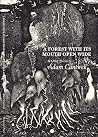
A Forest with its Mouth Open Wide & Other StoriesA Forest with its Mouth Open Wide & Other Stories by Adam S. Cantwell
My rating: 5 of 5 stars

Full disclosure: Adam Cantwell and I are what was historically-termed "pen pals". Or at least we've written a few letters to each other. If you can't handle the fact that this review is likely biased by our correspondence, then maybe you should just bugger off. I like Adam. And I like his writing. There, I said it.

In my miserable berth I grew deathly ill. The cold and torpor drew what was left of me to my low-lying parts; here my pain and ennui sloshed and settled and was distilled. The whispering proximity of the lethal sea called these dregs down ever further, and day after day my spirit seeped through tar and pitch and blackly down.

My liquid remains decanted through desert voids of seawater. It was an alien medium, primal, its essence was not the tang that clings to the red flesh of salmon or the morning chill borne on the fog but the dead-cold and salt of bones and freezing stars. My nothing-substance popped and dispersed, particles radiant from the dumb core, shreds of lost desire given over to huge black currents.


This quote, from the opening story "Orphans on Granite Tides" should give you a notion of the solace and comfort you'll find within the pages of A Forest with its Mouth Open Wide & Other Stories, i.e., none. I've earlier reviewed this story (I have the original publication from Les Editions de L'Oubli (aka Mount Abraxas Press), though this is the revised text as it originally appeared in Bastards of the Absolute , which I have not read. I don't know what the exact revisions are, but this version seems a hint darker than the Mount Abraxas version. Maybe I'll ask him in my next letter. I seem to owe him one, especially since his last mailing was a short stack of vinyl records from his musical projects Spaceboy and Villains.

The second story, "Black Chroma," is set in what seems to be a post-apocalypse, though it may be the structure of the narrator's mind that is collapsing (this may be the case with many of the narrators in this volume), rather than civilization. Paranoia and agoraphobia combine to expose (him?) to the bright pinpoint lights of the cosmos, a nakedness only occulted by self-burial.

Profoundly existential, yet hopelessly defiant (I am reminded of one of my favorite poems, William Ernest Henley's Invictus ), "The Chamber in the Universe" examines monuments, devotion, power, hope, and death. The temple representing as empty vessel exposing the hollowness of existence, while being the instrument by which the common-builder nudges the cosmos, even a particle's-width; one of the most human of desires: to matter, even when nothing matters. To make one's mark forever in the void.

"The European Monster Part Two" is dark and obtuse, much like the philosophy of Emil Cioran, the inferred inspiration for the story (first published in a volume of stories dedicated to the Romanian philosopher). Here the narrator finds himself in a labyrinthine situation, becoming a part of a (political? criminal?) machine at the heart of which is the titular monster, perhaps a modern Minotaur.

"Torso in Shadow" puts the baffled and baffling narrator in the subways beneath NYC, which may or may not be disintegrating above. Surely it is convulsing, socially or physically. Amidst these convulsions, in the underground, the narrator meets a woman. Perhaps this is Adam and Eve witnessing the birthing pains of a new world. Difficult to tell. But the attempt must be made. An ouroboros of a story, eating itself.

Originally written for a tribute anthology to Borges, "The Bow, the Arm, the Arrow" echoes the Argentine writer's sometimes-journalistic style, but with a tonal nod to Millhauser, as well. The story reminds me of a long-form vlog I recently watched about the composer Penderecki (a favorite of mine), but with the narrator experimenting with literature, rather than music. Sometimes experiments go wrong.

The titular story in the volume actually appeared alongside one of my own stories in the Mount Abraxas anthology Frostsigils , an homage to Paysage d'Hiver. As one would expect, it is dark, downright Gothic, and one can feel the cold sink into one's bones while reading. It's all about atmosphere, and it delivers that in shadowed robes with the deep moaning toll of an immense black iron bell.

With "Vod the Wrecker," I again find myself as "TOC mates" with Adam in the Raphus Press anthology Ghost Trains. But where I treated the train in question as a haunting presence, here, Vod is the brooding master, a near-god, over the twisted metal entrails of what was once the most powerful force in America. Vod destroys, remakes, and rides the bones of the ur-train like a pyrrhic steed, into oblivion.


In the amber-filtered urine-gray aged-out green glass of insulators, crystallizing dumbly over centuries, he saw an enviable solitude and immobility. The enamel of insignia and livery, some burned to peacock craquelure; the bent-blue of sulking steel glazed over with a million dullnesses of black and charcoal.


Transformation of the individual and of the world are the subject of "The Oligomancer". Here a migrant child of an itinerant oil-platform worker watches the world turn inside out from a privileged (so to speak) observation point on the derelict platform. A slowly unfolding apocalypse gives indicators from the horizon about the collapse of the outside world, which can't help but affect his own inner world. Again, the line between psychic and physical reality is not only blurred, it is completely shattered.

And, finally, "The Hag, the Cutthroat, the Amputee" is the musing of a being who, like Charon of Greek myth, ferries the dead across to their final destination, particularly those whose demise is caused by war. He(?) is very adamant to note that he is not Charon, and his thoughts regarding the dead make it clear that he does not share the detached observations of his more famous counterpart.

Those are the stories and my skewed observations of them. You want objectivity? Good luck finding it in this universe. But I will end by deferring to one of the great nihilists of our age, Thomas Ligotti, who stated, quite correctly:

The stories of Adam Cantwell's . . . could be fairly equated with the works of Kafka or Borges if their prose were not so luxuriant and surprising at every turn.

I have nothing more to add.


View all my reviews

____________________

If you like my writing and want to help my creative endeavors, please ko-fi me at https://ko-fi.com/forrestaguirre. Every little bit is seen and appreciated! Thank you!

Monday, November 25, 2024

Opeth: The Last Will and Testament: A Pithy Review

 I am no music critic (and an even worse photographer - see below). But I've been listening to music, particularly heavy metal and hard rock, for a long time. Back in about 2004, after having felt jaded and mainly disappointed by the grunge era, I had a revelation. A stumbled on the song "The Grand Conjuration," by Opeth, from their then newly-released Ghost Reveries album. I was blown away in a way that I hadn't been in many, many years. Then one of my coworkers turned me on to their 2001 album Blackwater Park. Again: Mind Blown!

So now, almost 25 years later, Opeth releases The Last Will and Testament, which feels, at once, very familiar, and very new. 

To quote the presser: "The Last Will and Testament" is a concept record of sorts. A restless musical journey in a way mirroring my own relationship with music as a consumer of it," narrates band leader Mikael Åkerfeldt. "I pick up something here, dismiss something there. I worship and I hate music at the same time. This ambivalence leads me down some type of creative path of my own and then, all of a sudden, a collection of songs has been written. Best case scenario, these songs are good enough to impress the band. Good enough for the "powers that be" in terms of the industry. Good enough for "you"?! I love this record. I have to say it (write it). Maybe I'm proud even? There are some familiar ingredients in there I suppose. Most of our music has sprung from the same source, so I guess it's not much of a shocker if it's going to sound like "us". I'm a bit in awe of what we did with "The Last Will and Testament". It feels like a dream. There is some "coherence" and " songwriting skills" I hope, but what do I know? I tend to favour the "strange" over the "obvious", but I feel like I'm in the minority, and that's fine. So... fair warning! Don't expect an instant rush (as per usual), but if you do "get it" (have you got it yet?) right away, that's ok too!"

Yeah, I get it. There are strains of Heritage here, but the demon beneath Blackwater Park and Ghost Reveries is there, too. There's even a touch of Damnation there (still my favorite Opeth album, by the way). Yes, the flute, that heaviest of heavy instruments, makes a return, but it's perfect in its place, which happens to be Song 4 - in my opinion, the strongest piece of the entire album. If anything it reminded me of, not Jethro Tull, but. . . Kansas? But a Kansas with a more powerful underbelly, a devil dancing with hope, if you will. The progressive nature of the track (and of several others on the album) is unmistakable and irresistibly magnetic, but the growling, doom-laden counterpoint serves to create a strange storm of contrast and provides, dare I say it? Meaning.

Because at it's heart, this album is about meaning, about who we are, about what we do in relation to what we know that determines our legacy, in time. There's a story behind the story, a way to tell tales that Opeth has been brewing for some time now. What is not said (or sung) is as important, if not more important, than what is. It's in the interstices that the music becomes something beyond mere transition, another realm, between your expectations, a slipstream between death metal and progressive fusion; a universe of its own.


________________________

If you like my writing, ko-fi me at https://ko-fi.com/forrestaguirre. Every little bit is seen and appreciated! Thank you!

Saturday, August 17, 2024

Bootleg Reverse

I believe the last bootleg vinyl I owned was a really crappy live recording of Metallica's "Creeping Death" I got back in 1986 or so. Since I've been bitten again by the vinyl bug, I've avoided bootlegs, but in this case, I couldn't pass it up. The reason is that I can't find any "legitimate" vinyl releases of Pink Floyd's Live at Pompeii, which I consider, along with Blue Oyster Cult's ETI Live and Heaven and Hell's Live at Radio City Music Hall, to be one of the best live performances ever recorded. This was before the Floyd burst into popularity with "Dark Side of the Moon". In fact, it was the year before that high watermark and many, many years before their next biggest hit, "The Wall". This is the Floyd I missed because I was so young and because before the days of the interwebs, one just couldn't find copies of this thing or, as in my case, one didn't even know such a thing existed. 

But now, thanks to a birthday gift from my wife (I'm incredibly surprised by this because she hates most rock music, though she is incredibly musical), I am back in the bootleg business. 


This puppy is soooo bootleg it doesn't even have a sleeve, just this printed piece of glossy in a mylar bag. Please excuse me while I go listen to some psychedelic wanderings. Don't worry, I'll be back. I'm not going to go Syd Barret on this one, tempting as it is.

________________________

If you like my writing and want to help my creative endeavors, ko-fi me at https://ko-fi.com/forrestaguirre. Every little bit is seen and appreciated! Thank you!

Sunday, June 12, 2022

Welcome to the Machine: Olivetti Lexicon 80, 1948

 I learned to type when typing wasn't cool. Before home PCs were ubiquitous. I don't even remember why I took that typing class in high school. I had no goals at that point in my life (outside of scoring the next bowl, getting enough money to go to the arcade, record, and comic book store, and making sure I had time to play D&D). The teacher was the football coach, so I had absolutely no desire to be "in" with him. Besides, he seemed like he really didn't want to be there. I suppose there were a lot of girls in that class, which I saw as a bonus. But as for aspirations to use typing - nothing . . . at that time. Still, I learned. 

Then, I grew up. When PCs became readily available, I was ahead of the curve of many of my friends, who had to hunt and peck and learn the keyboard. Some still do. Old dogs, new tricks. 

And I discovered that I loved to write. I also discovered that I am a primarily visual learner, and secondarily (a close second, if I'm honest) a kinesthetic learner. When I seriously started writing (back in 2000 or so), I found that I liked writing best with a pen and paper. That hasn't changed. I always do my first drafts by hand, then type the results into the computer, editing as I go.

But keying stories into the computer has its drawbacks. With ottokorrekt, one becomes less cognizant of errors. And word processing programs have only recently developed the AI to catch "their" versus "there," "two" versus "too," and so forth. And, honestly, AI still misses many of the subtleties of the English language. It's better, but it's not perfect. Yet we rely on it like it is perfect. I'd say in reading any published book (my own included), I find such subtle errors almost every time. 

Another issue for writers is that the computer is an amazing tool for research. Perhaps too amazing. As this article points out, the computer is a distraction factory. It draws the writer away from actually writing. And if a writer isn't writing are they actually a writer? Don't get me wrong, I use online resources to research as much as anybody else. But to me, writing is a drug. Why do I so often interrupt my ecstatic, sublime experience? Writing with pen on paper is a rushing start to that sublimity. And, of course, one must edit. Most of the work of writing is editing. But if I go to type in my hand-written notes, editing as I go, and am distracted by all the bells and whistles of the computer, I short-circuit the experience. 

So, I'm trying an experiment. It's an expensive experiment. I won't say exactly how much I spent on my typewriter, but let's just say it was slightly less than . . . my computer. To be fair, I bought my computer many years ago. Nevertheless, I sold many books in order to buy this old piece of technology built in 1948. My hypothesis is that having to carefully key in my words will: 1) Slow down my editing process to ensure I'm using the exact right words, 2) extend the sublime experience of writing by forcing my brain to slow down and be in the moment in order to think about needed turns of phrase, added layers of poetic flavor, or to recognize and remove un-needed dross and clunky phrasing, and 3) give a more kinesthetic experience than the chiclet PC keyboard could ever give. 

Will this slow me down as a writer? Absolutely. I'd pose a question in retort: Is that a bad thing? My experience says "no". Quite the contrary. 

There's a bit of a philosophical agenda here, on my part, as well. I've been intentionally limiting my time on social media. Each day I get 30 minutes each on Reddit, Twitter, and Instagram. And I am going to bring that down to 20 minutes each over the course of the next few weeks. I hardly spend any time on Facebook anymore, and that's by design. I recently watched the excellent Netflix documentary The Social Dilemma. It gave me pause to think about things I had suspected, but never knew explicitly: the Attention Economy, the way in which we are being manipulated by social media, and the way it affects our real-world behavior. It didn't terrify me enough to shut of all social media. I think social media has it's place. But boy have I rethought how I use social media or, more importantly, how social media uses me. This isn't new. I've been working on reducing my social media use for nearly two years now (thank you, Covid). I've read books on the subject. I've taken a few social media fasts, where I didn't use social media at all for weeks at a time, and I've assessed the benefits for myself. 

An unseen side-benefit of saving for this typewriter was that I was able to put into action my plan to downsize and upscale. This is a continual effort that has a long way to go, but this is a good start to show that I can do this thing! Given that my mom was a hoarder and my mom and dad both bought into the middle-class 1970s - '80s materialist dream (and that I was raised in this environment), being able to make such a fundamental change to attitude was not a given. It's good to have some success in this regard. It emboldens me for the future.

In essence, I want my life back. My analog life. I want more time doing the physical act of writing, I want more time to read physical books (sorry e-book readers, no offense to you, but give me a nice hardback or a ragged, nicotine-stained paperback every day of the week), I want time to sit down and practice my guitar, I want more time at the gaming table, I want more time to blog, I want to do more jigsaw puzzles, I want to be fully focused on my travels, I want to spend more time listening intently to music, like I did when I was a kid. I need to carve out this space in my life, and I'm doing it! The typewriter is one of many tools to help achieve these goals. 

When I took that typewriting class back in high school, I didn't have any goals to speak of. Now, though, that class is allowing me to pursue goals I never knew I had. Way to go, pot-smoking, metalhead, long-haired, spiked wristband-wearing young Forrest. You've come full circle on a more-fulfilling life. You rule. 

Am I leaving the digital world altogether? Heck no. But I'm making a more conscientious choice as to how I interact with that world. I want the best of both worlds!

One final note: This typewriter requires attention. I bought it refurbished, but it needs internal cleaning and maintenance. I sat down for a couple of hours last night, put on some good Fado, and got into the guts of the thing to give the basket a good cleaning. I've got more to do, especially on the bottom. And while you might think this is a distraction from writing, it's quite the opposite. There's something about that repetitive, careful action that drones me into the writing zone where I can think about my characters, my plots, my story. Of course, I keep a pen and composition book handy to write down the things that need writing down. All the time, I know I'm prepping this beautiful machine to take and transform the input that I give it, body and soul!

And for those who have read to the end, the curious, here are a few photos of this beautiful Olivetti Lexicon 80, 1948:


__________

If you like my writing and want to lend your support, ko-fi me at https://ko-fi.com/forrestaguirre. Every little bit is seen and appreciated! Thank you!


Thursday, April 14, 2022

The Haunted Screen: Expressionism in the German Cinema and the Influence of Max Reinhardt


The Haunted Screen: Expressionism in the German Cinema and the Influence of Max ReinhardtThe Haunted Screen: Expressionism in the German Cinema and the Influence of Max Reinhardt by Lotte H. Eisner
My rating: 4 of 5 stars

I don't know where or when my fascination with silent movies began. Definitely not as a child. I couldn't stand the things back then. I think it might have been after I discovered The Dark Side of the Rainbow and realized that the same technique of watching one piece of visual media while listening to another piece of aural media could easily be applied to silent movies. Suddenly, these often-campy, over-acted films could become something sublime or something sinister, with the right music. Eisner's book was grist for that mill in enough volume to last me the rest of my life. Though I was very familiar with a few of these films and had already tried the trick of using two tabs of Youtube in a web-browser - one (the film) set on mute and the other (the music) with volume UP - I found several other good combinations and a couple of great ones. I will continue exploring this way.

If you'd like to give it a try, look up The Student of Prague (1913) or Waxworks on Youtube. Mute that tab. Now open another tab, go to Youtube, then play something like Ligeti's "Lontano" or Penderecki's "Symphony No. 1" (or, for real ambience, play it on vinyl!) with the volume UP. Or, perhaps you'd like to go another route and listen to some more . . . modern music? I have a few suggestions linked here.

I suggest watching without subtitles turned on, if you can. just enjoy the visual and auditory experience. It's a stark contrast from watching the movie alone, even when, or especially when, someone has attached an old-timey organ soundtrack to the movie. It's your experience - make it yours!

Incidentally, because of this book, I understand why sub-titles are called sub-titles. Only took 52 years to be enlightened. "Titles" was the term originally used in silent movies for the words that flashed up on the screen, in the absence of spoken dialogue. "Subtitles" appear, as the name implies beneath the titles. These are, as you know, most often translations from the original language into another.

52 years.

You can teach an old dog new tricks.

Speaking of new tricks, the early years of cinema were a sort of wild west, when it came to creative innovation, especially when constraints brought on by conflict interfered with the procurement of some materials. Interestingly, the lack of materials in the last years of World War I led to playwrights and cinematic directors using light and shadow, rather than elaborate sets, as they used to use, to give depth to the settings and to indicate the passage of time. A happy accident for early German movies.

The recollections of Carl Boese on how the special effects were done for Der Golem (1920) were absolutely fascinating. These practical effects were very dangerous, so volunteers were asked to try them out. The first stunt-men, perhaps. Knowing this has given me an excuse to watch the movie again. Of course, I will also have to reread Gustav Meyrinks novel, which has little to do with the movie, but hey, a good excuse is okay. After all, the book and the movie were both highly influential on one of my own creative works.

And, speaking of old dogs . . .

Eisner has a fixation on the melancholy and gloom inherit in the German soul, as he sees it. I tend to agree to some extent, but when I see this was first published in 1952, I wonder if some of the hyperbole isn't post-holocaust apologetics or manifestations of guilt. There's a bit too much of "Germans are brooding, dark-minded people as a whole" for me. It's overstated and I wonder why?

It is reasonable to argue that the German cinema is a development of German Romanticism, and that modern technique merely lends visible form to Romantic fancies.

These generalizations of German people as a brooding bunch keep coming up again and again. I don't fully disagree, but frankly (and I don't mean "in the manner of the French"), it got a little, well, old.

But if you can ignore the repeated caricature of an entire nation as, well, goths, there is much to be enjoyed about this work. I would also recommend (whether you read the book or not) following the Pagan Hollywood instagram or twitter account. Sometimes NSFW, you'll want to maneuver carefully, but if you want to catch the glamor of early cinema (and much more) in still photos, that's a great place to start. There's also a great interview with Pagan Hollywood's founder, Charles Lieurance over on Youtube, while you're at it.

I must note that the early text on Doctor Caligari instructed "see frontispiece". I turned to the front of the book, and noted the ragged edges where that key marker had been torn out of the book.

Was that a sign that I should not have entered the realm of the torn page?

Maybe I should have heeded it.

But I'm glad I didn't.


View all my reviews
__________

If you like my writing and want to help out, ko-fi me at https://ko-fi.com/forrestaguirre. Every little bit is seen and appreciated! Thank you!

Thursday, February 24, 2022

Downsize, Upscale?

 My oldest son is a Spartan. He does very much with very little. I've often said that if I were to have to survive an apocalypse, I'd want him by my side. He's incredibly resourceful, loves to learn new things, and is excellent at figuring out how things work. All of my kids share that trait to one extent or another, but my oldest son . . . well, he's a Spartan in all the good ways.

When he was young, we were a resource-poor family. I was an undergrad when he was born, but when he was a toddler and young child, I was either in graduate school or had just dropped out. We didn't have much at all. I recall one month where, for several weeks, we subsisted mostly on beans and rice, because that's what we had. I'm guessing that those formative years of "want" were what spurred him to make do. 

Now I'm older and more financially secure. We live comfortably in the middle class, pretty much right in the middle, if I understand American salaries correctly. We have what we need and a good amount of what we want. Well, maybe not a "good" amount. Sometimes, when I'm not struggling with having been brought up in the '70s and '80s, when conspicuous consumption became a reachable norm for the middle class, I think I have just a little too much. But just a little.

I think back to times when I had less. And, without growing sentimental or nostalgic, I think I can say that I was only slightly less content than I am now. Any discontent back then really arose from not having enough to meet all of my family's needs, having to go into debt to survive - you know. You know. If you've never been there, well, don't say so because I have a hard time respecting people who haven't gone through hard times, whether financially, emotionally, or with health issues. I like fighters who've had to fight.

But I look around me and I think that maybe I've become a bit too spoiled. 

For example: Books. As you can tell, I review a lot of books. And I own physical copies of almost all the books I own. I think I've actually reviewed a digital book maybe three times? The other book reviews here (and there are a few) were all from physical books - probably 90% owned by me (the other 10% would be library books I borrowed). Now, I have a wishlist of books. But it's only 20 books long at any given time. I use Goodreads to maintain my list. But I do not allow myself more than 20 books on my "to be read" shelf. Otherwise, I just have a long list of books I'm never actually going to read. Besides, forcing myself to only have 20 on the list makes me REALLY think about what I want to read. 

And yet, I think I have more than I need. 

I've promised myself to re-read some of those books. And I have a nascent plan to read some of them in close proximity to each other to see what that does to my brain and my creativity. For example, I want to re-read Robert Graves The White Goddess at the same time I re-read Hamlet's Mill (which I have not reviewed here yet). These books are thematically similar-ish, but far enough apart to cause some fruitful cognitive dissonance, to trick the brain into seeing new patterns and angles heretofore unforeseen, in this case involving themes of myth and myth-creation.

Other groups of books I plan on re-reading together:

Piranesi + The City of Dreaming Books (I haven't reviewed the latter, but I feel that the tone in both of these books is very similar, at least in the corners of my memory they are - we shall see)

Lost Knowledge of the Imagination + The Secret Life of Puppets + Hieroglyphics + The Spectacle of the Void (I almost think this could be a bibliography for an undergraduate college class on . . . what, exactly?)

Swann's Way + Finnegan's Wake (neither of which I have read in full. This pairing might kill me.)

etc.

You get the idea . . . 

In order to keep my focus, I'm going to have to resist the temptation to buy new books. And I still plan on keeping my "to be read list" down to 20 books and no more. 

So my tentative plan is this: I will read the books I physically have and not order new books. When i have read through all the books I physically have now, I will concentrate on re-reading books in the combinations I've listed above and a few others. I think I might try this (deep breath) for . . . a year? I honestly don't know if I can make it. But I have to try.

Extending this further, I will try to forbear from buying (even deeper breath) new roleplaying supplements or games. And new vinyl records.

Do I just hate myself? Maybe. But I also think that if I hold off on those things and use what I already have, a few things will (hopefully) happen.

1. I will learn to more fully appreciate what I already have.

2. I will utilize what I have in new ways, especially as I "use" the media vis-a-vis each other to explore new brain spaces.

3. I will be forced to create more. If I want something new to read, I'll need to write it myself. If I want a new game or adventure to play, I'll need to make it myself. If I want new music - well, that one's easier because of bandcamp and youtube, but really, I'm hoping to force myself to pick up that darned guitar and play it more often.

4. I will save my monthly allowance that I would normally spend on books, games, and vinyl and save up to buy myself some things I've promised myself I would get but never have: a working old timey typewriter, for instance. Or a *decent* phonograph (do they even call them that anymore?) and speakers, along with some wishlist vinyl. 

5. As part of this effort, I will sell some or give away the books I feel I don't really need anymore. And I've got some knicknacks and gewgaws that I thought were a great idea at the time that I can sell on Ebay and maybe save even more for a final splurge at the end of this exercise.

It's going to be my turn to be the Spartan. We'll see how I fare.

__________

If you like my writing and want to help out, ko-fi me at https://ko-fi.com/forrestaguirre. Every little bit is seen and appreciated! Thank you!

Sunday, December 5, 2021

LP Review: Skáphe, Wagner Ӧdegård

 I've always had pretty diverse interests in music. In high school, I predominantly listened to heavy metal and punk, but I also listened intently to funk, classical music, and, of course, '80s pop. Since then, I've expanded my repertoire to include celtic music, synthwave, and, one of my favorites: "uncategorizable".

I only occasionally blog about music. I suppose it's easy to just let music be in the background of my life. This is contradictory to my life as a young man, when music was right at the forefront. It really was one of the most important things in my life, because I could afford it to be so. With crazy schedules, kids, work, and life trials in general, music has become something I turn on when I'm doing other things. 

Yes, I've attended live concerts for many years (especially pre-Covid) and always enjoy that release. But only recently have I really honed in on music like I used to as a kid. Maybe it's because of my discovery of my old record player after my parents died. It's a crappy little red and white job with a terrible little speaker. A real piece of junk. But it works still, and I love it. Finding it was like finding a piece of myself. For a number of years, vinyl LPs were passé, a relic of the past. Then people figured out that they liked the uncompressed sound of non-digital media. This has dovetailed nicely with my recent (within the past few years) desire to turn back to analog in my life. So I've started buying vinyl again. Not in any kind of big volume. I still buy digital albums and CDs because they are conveniently portable and easily accessible. But in a few rare cases, when the music is, in my eyes, worth it, I've bought vinyl. Again, this is rare, and I only reserve such buys for albums that I think are truly unique, something different than the rest, something that needs to be celebrated and admired in a different way. Because vinyl is more expensive and because it is such a more intentional media than digital forms, I am reserving LP buys for special items. I'd like to go through a few of these here. I don't know that this will become a regular thing on my blog, but who knows what the future holds? In the meantime, I need to briefly share three albums that I found "worthy" of buying on vinyl. 

Skáphe3 

First up is the last one I bought, chronologically, Skáphe's third album, cleverly titled Skáphe(cubed) (sorry, I can't get the typefont to work with superscripts). 


Now, my picture, taken in low light up in my writing area, does not do the cover justice. It is a brilliant red cover, absolutely striking. If I didn't think it would scare my grandchildren, I'd put it on the wall as the cover art (by artist Karmazid) is stunning. To further cement that fact, here is the back cover:


But what about the music? Last night, I hearkened back to my childhood and listened. Just sat and listened with no distractions. I wasn't reading or writing or eating while I listened, I gave it 100% of my full attention. 

Of course, I had listened to the album digitally before I bought the analog version. Now, I am not normally one to like a whole lot of "Black Metal" or "Death Metal". For me, I can only take them in small doses. But I continue to search and sometimes find something I really, really like, something compellingly different than the others in these sub-genres. I'm open to have my mind blown by something out of the ordinary, something spectacular, and here I found it!

With raw, staccato drumming and vocals that blur the borders, such as they are, between Black Metal and Doom Metal (which I listen to quite a bit), this album rides in a liminal space that is rarely visited. The long slow glissando of harmonic guitar notes over pulsating drums and fairly complex rhythmic forms give a psychedelic edge to the songs, but do not slip into the realm of the quaint psychedelia that is ubiquitous in the metal scene. This retains a razor-sharp edge because of its uncompromising production values. Even short "melodic" episodes are loden with anguish, which explodes into outright howling despair. The contrast takes the music out of the muddy depths of much of today's Black Metal and transforms it into something like a dark ritual ecstasy. It's easy to lose yourself in the whirling abyss with this as your soundtrack.


Ur Törnedjupen and Nattslingor

Next up is a pair of albums by Death Metalist Wagner Ӧdegård, except neither of these are Death Metal albums. In a move reminiscent of Bohren & der Club of Gore, a German death metal outfit that turned to extreme downtempo "doom jazz", Ӧdegård here goes in a completely different direction. These are the sort of albums that would drive record store owners absolutely crazy because they don't fit into any neatly-marketable categories. Now, I have a special place for that sort of media (especially when it comes to books) as it is, again, in those liminal spaces where I find some of the greatest works of art, literary or aural.

 Ur Törnedjupen is evocative of a soundtrack to a lost folk horror film, newly re-discovered in some dusty archive in the basement of an obscure university library, which has been lurking in the stacks for decades, yearning to be found by some hapless student whose curiosity is about to unleash something sinister on the world. The instruments listed for this album are pump organ, accordion, Arturia Minibrute, voice samples and "lots of vinyl noise". The sheer atmosphere on this album is suffocating. But my words can't do it justice. It really has to be heard to be understood. Though I was careful not to let my visual focus wander to the art, book covers, and ephemera that fill my writing area, I had the films Begotten, The Seventh Seal, and particularly Nosferatu kicking around in my skull as I listened. The music has a sort of dreamlike ambiguity, for lack of a better term, that is unsettling. However, the closest analog to the mood I feel when listening to this is that which I feel when watching much of the work of The Brothers Quay (who are, incidentally, my favorite directors). The occasional admixture of vocals that mimic a muted and slightly twisted Gregorian chant give a pseudo-religious - or perhaps blasphemous - tone to the whole.


Nattslingor continues in the same vein, but with more of a Russian sepia-tone silent movie than black-and-white horror vibe. The instrumentation is nearly the same, but the first part of the record feels more documentary than artsy, if that makes any sense at all. 


Still, these albums are definitely cut from the same cloth and should be listened to in rapid succession, in an endless loop, if you can somehow manage it. This is an aural vortex you need to give yourself up to. To help that, the effect of the circular paper label on the center of the vinyl itself absolutely mesmerizes as it spins. Movement manifests as the silhouette of a devil "pulling" an Elder Furthark "*Ansuz" rune in a never-ending circle, lending a hint of something sinister which blooms into full-flowered demonic and ghastly mode on side B. My only regret is that it doesn't spin widdershins. But your brain will, believe me: it will!


__________


If you like my writing and want to help out, ko-fi me at https://ko-fi.com/forrestaguirre. Every little bit is seen and appreciated! Thank you!