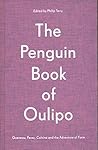
 The Penguin Book of Oulipo: Queneau, Perec, Calvino and the Adventure of Form by Philip Terry
My rating: 4 of 5 stars
Call it a failing on my part, but I rarely read anything out loud to my wife. We've read a couple of books together (out loud, that his), most notably Wodehouse's The Code of the Woosters. But our reading tastes are fairly dissimilar. So, if I read something out loud to my wife, I must think it among the cream of the crop of literary highpoints. Enter the poem "Black Bird" from Georges Perec's A Void (a book which I must read). It's a take on Poe's "The Raven," a cover, of sorts, in a twisted way that shows Perec's ability to manipulate the classic while maintaining the same meter and rhyme, but imparting entirely his own stamp on it. It's not an ode, it's not a spoof, it's not a mere homage, it is its own work, unmistakenly Perec's, but unmistakenly modeled after Poe's great work. Oh, and did I mention that in the original French it is done while completely omitting the letter "e"?
Perec's work and the work of other Oulipo illuminaries, such as Italo Calvino (one of my favorite writers of all time), Raymon Queneau, Jacques Roubaud, and Harry Mathews, is put alongside works catagorized as "Noulipo" (much more contemporary works than the original flood of Oulipo from the 1960s and '70s), and works categorized as "Anticipatory Plagiarism," which are anachronistic works that play with some of the same experimental forms/games as the Oulipo group, but were present in the literary lexicon long before the Oulipo group's formation in 1960.
What is Oulipo, you ask? Well, for a good definition, you'll need to read Philip Terry's amazing introduction. TLDR version is that Oulipo was a movement by a group of writers who took some surrealist and dadaist ideas on how to restructure existing ideas on how literature "ought" to be produced, and codified them, while inventing many of their own, using artificial literary constraints to experiment with form, language, and even meaning. The appendix lists and defines 62 such constraints, such at "n+7", "Reassemblage", "Melting Snowball," "Ekphrasotranslation," and "Bifurcation". Go explore. You'll find a few of these "out there". But if you want the most comprehensive overview of the subject, buy the book.
Some of the works herein you will find relatively "mild". For example, Perec's "The Winter Journey" is a false history of a false book, along the lines of Borges. It is masterfully written, and "recounts" the discovery of a book (entitled The Winter Journey), which contains the poetic and prose writings of an extremely obscure author whose work was plagiarized by practically every poet and some novelists from the symbolist era through the fin-de-siecle. Just a marvelous story.
Then, you might encounter something a little more challenging: Harry Mathews' "Their Words, For You" is a kaleidoscopic mishmash of aphorisms, proverbs, and just plain trite sayings. It's a mess. It's fascinating. I don't understand it; yet I am enamored of it, like an addictive fictional hard drug. More than anything, I want to know how he put it together. It's an ostentatious feat, bold and even provocative. I am impressed.
And, of course, you will find some works bordering on the ridiculous, just by the very nature of the experiment(s) being undertaken. Some of the entries are tedious, some are brilliant, some are both. All of them are worth your attention.
View all my reviews
If you like my writing and want to help my creative endeavors, please ko-fi me at https://ko-fi.com/forrestaguirre. Every little bit is seen and appreciated! Thank you!

No comments:
Post a Comment