Monday, August 17, 2026

A Forest with its Mouth Open Wide & Other Stories


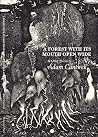
A Forest with its Mouth Open Wide & Other StoriesA Forest with its Mouth Open Wide & Other Stories by Adam S. Cantwell
My rating: 5 of 5 stars

Full disclosure: Adam Cantwell and I are what was historically-termed "pen pals". Or at least we've written a few letters to each other. If you can't handle the fact that this review is likely biased by our correspondence, then maybe you should just bugger off. I like Adam. And I like his writing. There, I said it.

In my miserable berth I grew deathly ill. The cold and torpor drew what was left of me to my low-lying parts; here my pain and ennui sloshed and settled and was distilled. The whispering proximity of the lethal sea called these dregs down ever further, and day after day my spirit seeped through tar and pitch and blackly down.

My liquid remains decanted through desert voids of seawater. It was an alien medium, primal, its essence was not the tang that clings to the red flesh of salmon or the morning chill borne on the fog but the dead-cold and salt of bones and freezing stars. My nothing-substance popped and dispersed, particles radiant from the dumb core, shreds of lost desire given over to huge black currents.


This quote, from the opening story "Orphans on Granite Tides" should give you a notion of the solace and comfort you'll find within the pages of A Forest with its Mouth Open Wide & Other Stories, i.e., none. I've earlier reviewed this story (I have the original publication from Les Editions de L'Oubli (aka Mount Abraxas Press), though this is the revised text as it originally appeared in Bastards of the Absolute , which I have not read. I don't know what the exact revisions are, but this version seems a hint darker than the Mount Abraxas version. Maybe I'll ask him in my next letter. I seem to owe him one, especially since his last mailing was a short stack of vinyl records from his musical projects Spaceboy and Villains.

The second story, "Black Chroma," is set in what seems to be a post-apocalypse, though it may be the structure of the narrator's mind that is collapsing (this may be the case with many of the narrators in this volume), rather than civilization. Paranoia and agoraphobia combine to expose (him?) to the bright pinpoint lights of the cosmos, a nakedness only occulted by self-burial.

Profoundly existential, yet hopelessly defiant (I am reminded of one of my favorite poems, William Ernest Henley's Invictus ), "The Chamber in the Universe" examines monuments, devotion, power, hope, and death. The temple representing as empty vessel exposing the hollowness of existence, while being the instrument by which the common-builder nudges the cosmos, even a particle's-width; one of the most human of desires: to matter, even when nothing matters. To make one's mark forever in the void.

"The European Monster Part Two" is dark and obtuse, much like the philosophy of Emil Cioran, the inferred inspiration for the story (first published in a volume of stories dedicated to the Romanian philosopher). Here the narrator finds himself in a labyrinthine situation, becoming a part of a (political? criminal?) machine at the heart of which is the titular monster, perhaps a modern Minotaur.

"Torso in Shadow" puts the baffled and baffling narrator in the subways beneath NYC, which may or may not be disintegrating above. Surely it is convulsing, socially or physically. Amidst these convulsions, in the underground, the narrator meets a woman. Perhaps this is Adam and Eve witnessing the birthing pains of a new world. Difficult to tell. But the attempt must be made. An ouroboros of a story, eating itself.

Originally written for a tribute anthology to Borges, "The Bow, the Arm, the Arrow" echoes the Argentine writer's sometimes-journalistic style, but with a tonal nod to Millhauser, as well. The story reminds me of a long-form vlog I recently watched about the composer Penderecki (a favorite of mine), but with the narrator experimenting with literature, rather than music. Sometimes experiments go wrong.

The titular story in the volume actually appeared alongside one of my own stories in the Mount Abraxas anthology Frostsigils , an homage to Paysage d'Hiver. As one would expect, it is dark, downright Gothic, and one can feel the cold sink into one's bones while reading. It's all about atmosphere, and it delivers that in shadowed robes with the deep moaning toll of an immense black iron bell.

With "Vod the Wrecker," I again find myself as "TOC mates" with Adam in the Raphus Press anthology Ghost Trains. But where I treated the train in question as a haunting presence, here, Vod is the brooding master, a near-god, over the twisted metal entrails of what was once the most powerful force in America. Vod destroys, remakes, and rides the bones of the ur-train like a pyrrhic steed, into oblivion.


In the amber-filtered urine-gray aged-out green glass of insulators, crystallizing dumbly over centuries, he saw an enviable solitude and immobility. The enamel of insignia and livery, some burned to peacock craquelure; the bent-blue of sulking steel glazed over with a million dullnesses of black and charcoal.


Transformation of the individual and of the world are the subject of "The Oligomancer". Here a migrant child of an itinerant oil-platform worker watches the world turn inside out from a privileged (so to speak) observation point on the derelict platform. A slowly unfolding apocalypse gives indicators from the horizon about the collapse of the outside world, which can't help but affect his own inner world. Again, the line between psychic and physical reality is not only blurred, it is completely shattered.

And, finally, "The Hag, the Cutthroat, the Amputee" is the musing of a being who, like Charon of Greek myth, ferries the dead across to their final destination, particularly those whose demise is caused by war. He(?) is very adamant to note that he is not Charon, and his thoughts regarding the dead make it clear that he does not share the detached observations of his more famous counterpart.

Those are the stories and my skewed observations of them. You want objectivity? Good luck finding it in this universe. But I will end by deferring to one of the great nihilists of our age, Thomas Ligotti, who stated, quite correctly:

The stories of Adam Cantwell's . . . could be fairly equated with the works of Kafka or Borges if their prose were not so luxuriant and surprising at every turn.

I have nothing more to add.


View all my reviews

____________________

If you like my writing and want to help my creative endeavors, please ko-fi me at https://ko-fi.com/forrestaguirre. Every little bit is seen and appreciated! Thank you!

Thursday, August 13, 2026

The Silver Surfer: Parable


The Silver Surfer #1 "Parable" Part 1 of 2 by Stan Lee and Moebius by Stan Lee
My rating: 4 of 5 stars

[This review is for both volumes of the mini-series combined]

I've been a Silver Surfer stan (pun intended) since the early '70s when I first encountered the character on the news-stan(d) - okay, I'll stop.

I had spotted "Parable" when it was first published, but I was out of high school and trying to be "cool" by ignoring comics at the time. What an idiot I was. A few years later, I realized the error of my ways and got back into comics but had lost track of this mini-series until a few years ago. I'm not quite sure how that happened. Moebius is one of my favorite artists and The Silver Surfer is one of my favorite Marvel characters.

In this treatment, the art, as one would expect, is absolutely amazing. Moebius' Galactus, sans-crackle, would still warm Jack Kirby's heart, I would think. I wonder if anyone interviewed him about this miniseries before he passed away? One is quite curious what his thoughts would be. And Moebius' style lends itself to the sleek action sequences one would expect in such a tale.

But the action only catches the eye. It's the philosophy and psychology underneath it all that holds the reader's attention. The writing is not perfect, by any means - at times it sounds like it's trying too hard to be "wise" and "insightful," which lends a sort of hokeyness to some of the dialogue, sometimes to the point where it is downright painful. But if one can look beyond the treacle, there are some solid pearls of wisdom and insights into human psychology that would explain the current socio-political mess we are in. This miniseries was so prescient it could have been written today, this very hour, without skipping a beat. And I fear that it will always be applicable, no matter what happens in the political landscape. It is a parable that sees beyond its years, a sort of cosmic-action scripture, if you will. It is so accurate that it's scary. I'm afraid that Norrin Radd's near-nihilism is very, very close to a bigger truth, and we can't handle that truth.

View all my reviews


____________________

If you like my writing and want to help my creative endeavors, please ko-fi me at https://ko-fi.com/forrestaguirre. Every little bit is seen and appreciated! Thank you!

Thursday, August 6, 2026

Protection & Property: Apotropaic Markings on Rural Andorran Buildings


Protection & Property: Apotropaic Markings on Rural Andorran BuildingsProtection & Property: Apotropaic Markings on Rural Andorran Buildings by Martin Locker
My rating: 4 of 5 stars

Why, you might ask, would I read this book; a dry, academic monograph about carved markings on doors in rural Andorra? Well, because, reasons:

1. I love Martin Locker's fiction and I admire his brain, so I thought, why not?
2. My adopted ancestry (my father was adopted by a Basque immigrant married to a Swedish immigrant) is from the Pyrenees Mountains, straight west of Andorra.
3. I minored in historical archaeology as an undergrad, so I have some intellectual interest in the field. I *almost* went to graduate school for historical archaeology, but instead opted for African history.
4. I love supporting small presses.
5. Martin is a penpal of mine. So, forget about objectivity - alright, I'll try my best.

As one would expect with an archaeological monograph, this is not edge-of-the-seat reading. However, as a writer, it did spur some ideas that I've noted and will likely use or integrate into my fiction, as occasion arises. But outside of its utility, it's the principal of the thing that drives me.

I just recently celebrated a birthday. I am no longer young, though I don't really feel all that old, either. I suppose over five and a half decades treading on this planet qualifies one for "middle" age, maybe a shade over that. I am, however, "old skool". Yes, I can do technology - I use it all the time in my work, even including using AI to do some of the dirty work for me (crunching numbers, creating graphs, and collating results, for example - I'm a procurement manager for the North American division of a very large German company, if you must know). But in my personal life, on my own time, I have made a concerted effort to digitally minimize, simplify, and go analog whenever possible.

Part of that is nostalgia, I admit. I was a child of the '80s, so the internet and smart phones came about when I was an adult. Now, pardon me for sounding like an old man when I say I miss the simplicity of those days. "Things" were slower and less complex (whatever you think about the Large Hadron Collider shutdown. Less convenient, for sure, but us Gen-Xr's kind of pride ourselves on having done hard things and suffering some character-building cuts and bruises along the way.

What does this have to do with Locker's book? One thing: This book is a record of the last gasps of a dying life, that of rural peoples living in the mountains carving pentagrams and crosses, stars and flowers, into their doors and nailing Izard feet and eagle skulls to their entrances in order to avoid curses, witches, and otherwordly entities. Call it folk magic or superstition or what have you, there's something totally metal about having a pentagram carved in your door with an eagle skull nailed underneath it, I don't care how old you are!

So, after a long cataloging of some frankly boring stuff, the concluding chapter lays it all out: this is a record of a world that will quickly be lost as people replace old doors (some possibly dating back centuries) with new, modern doors. It's a snapshot of cultural time. And the older I get, the more valuable I find these things.

Indulge me and let me share an example. Back in the '80s, of course we had video game arcades. Yes, some of us had an Atari 2600 at home (who can forget Pitfall?), but for most, going to the arcade was the place to not only play a wide variety of games, but to meet friends and . . . deal drugs?

Yep. A lot of them. Dime bag for a roll of quarters, and everyone knew about it. You could tell who had something to sell because they were walking around with pockets absolutely full of rolls of quarters, I kid you not. There was an entire underground economy. Yeah, that dude doing edibles while playing on his Switch - his grandfather was doing that a loooong time ago. And when I tell people who didn't live in the 80s about that, they are, to a man (or woman), surprised. Those of us who hung out at the arcades and were a part of that economy? We know how it worked. And it worked. There was a brisk trade that kept both video arcades and dope dealers working. A closed-loop economy right under everyone's noses. I wish someone would do their PhD thesis in sociology and economics on the subject. Fascinating stuff and I saw it with my own two eyes. Heck, I was a participant. I do find it funny that the beginning of the War on Drugs (thanks, Nancy Reagan) and the end of the video arcade (deferring to home consoles) coincided so strongly. Correlation isn't causation, I get that, but what a strange tangling of timelines.

Fifty years from now, no one is going to know this fact, this thing that was such a part of many teenager's lives in the early- to mid-80s. Worth knowing? Maybe not. But that piece of cultural history will be lost in obscurity, overshadowed by the Cold War, Reaganomics, New Wave Music, Cabbage Patch Kids, and Princess Di.

At least Locker gives us something worthy of deeper study. This is the handbook for this historic-archaeological micro-niche. And that's something worth preserving.

View all my reviews

____________________

If you like my writing and want to help my creative endeavors, please ko-fi me at https://ko-fi.com/forrestaguirre. Every little bit is seen and appreciated! Thank you!