Tuesday, May 31, 2022

The Exalted and the Abased


The Exalted and the AbasedThe Exalted and the Abased by Damian Murphy
My rating: 5 of 5 stars

I’ve run out of superlatives.

If I haven’t convinced you of the brilliance of Damian Murphy’s writings in my reviews of Psalms of the Magistrate, The Star of Gnosia, The Academy Outside of Ingolstadt, Abyssinia, and The Acephalic Imperial, I’ll never convince you of anything. If any of these have convinced you in the least bit, read on . . .

While all of the stories in The Exalted and the Abased contain the signature elements of Murphy’s work: transgressions of rulesets, enigmatic processes, systemic bureaucracy (that may or may not exhibit “mystical” qualities), and so forth; (these are to be expected) there is a deeper feel to these elements, a moral (amoral?) dimension that, while not absent from Murphy’s earlier works, seems to be much more explicit in this volume. This hews closer to an esoteric primer than a work of fiction. Perhaps a series of parables? Because nothing is given outright. There is still a work for the reader to do, if they wish to reach for and possibly seize the reward.

Not every quest results in a treasure, not every question leads to an answer, and not every prophecy fully foretells the future. Such are the vagaries of "The Ivory Sovereign". Here, meanings are hinted at, but obfuscated. Potentialities arise, then, just as quickly, fade away. Revelations are not heralded by a resounding "yes" or "no". There is still much divining to do. The mystery-qua-mystery is everything.

Three of my favorite writers - Borges, Calvino, and Kafka - came to mind as I read "The Notary". Needless to say, this surreal, ever so slightly spry story caught and kept my attention. I don't want to give details on which aspects of the story seemed redolent of which author. That would take your fun out of reading it. Discover for yourself!

Amorality, gamesmanship, and a strong dose of trickery in pursuit of a higher knowledge, a higher being, are woven throughout Murphy's work. These tropes come to the forefront in "The Hieromantic Mirror," a longish (novella? I haven't counted words) piece that lauds the breaking of rules and the breaking of barriers. Here, the unknown becomes known through focus and determination. Will is everything.

Some of the most rewarding experiences are those in which you don't know the rules of the game, but find yourself in the middle of the action anyway. You might even be the focus against which the rules seem arrayed, so you push against them, carefully, at first, sometimes getting away with it, sometimes being censured. And sometimes you win when you lose. Such is the experience in the titular story.

"An Incident in the House of Destiny" reflects on chance versus destiny and which subsumes which. This is personified in two characters and idolized in two houses (which are more akin to temples). An incident is examined, but one isn't completely clear regarding the dominance of destiny over chance or vice-versa. Readers aren't to reach a conclusion, but are forced to contemplate and think, finding answers themselves.

The Exalted and the Abased is a challenging work, yes. But the best rewards are reserved for those who pass the toughest challenges. One doesn’t just read this book, one engages with it. One works (and does a Working, or several Workings) as one reads. It’s not for the faint of heart. Those who persevere through force of will, intelligence, dedicated practice, and a bit of whimsy will understand The Understanding.

View all my reviews
__________

If you like my writing and want to help out, ko-fi me at https://ko-fi.com/forrestaguirre. Every little bit is seen and appreciated! Thank you!


Monday, May 30, 2022

Khazad-dûm, outgunned in Traveller, and 5E

 Trigger Warning: If you looooove D&D 5E, you're probably not going to like this post. I mean, you do you, man. Whatever gets you to the table is great for you. But you're likely not going to like this post.

Events in original version of The Fellowship of the Ring are admittedly different than the movie; in some ways vastly different, in other ways more subtle. The scene in Moria at the Bridge of Khazad-dûm is no exception. The movie, of course, compresses time and does not allow for the same explication that the book provides. Be that as it may, one thing is common: the Fellowship are pursued by orcs. Lots of orcs. In the movie version, they all flee once the Balrog appears, in the book version, they move clear out of the way, but do not flee altogether. They watch, along with the Fellowship, as Gandalf declares his title, gives his command, and seals his own fate.

But the thing I'd like to emphasize here is the sheer number of orcs. I'm sure some enterprising nerd with all kinds of time on their hands has already figured out exactly how many orcs appear in the movie scene. Hundreds, to be sure. The book doesn't elaborate, but states that when they begin to fight their way out of the Chamber of Records "how many there were the Company could not count". I'm guessing they weren't stopping to count. Even with the power that the Fellowship represented, with one of the most powerful wizards of Middle-Earth (not even a human - people forget that Gandalf was, essentially, a demi-god), a Ranger of renown (who wants to guess at Aragorn's level as a ranger? 10th? 12th?), a great warrior in Boromir, a heroic dwarf and elf, and a smattering of halflings (they might be bordering on 2nd level at this point . . . mmmmmmaybe); even with all this firepower, what was Gandalf's reaction? "Fly!"

Remember, this was before the Balrog showed up. With so many orcs giving chase (Okay, they had a cave troll and a big chieftain orc - who doesn't even get a mention in the movie), the leader of this very capable group of adventurers felt it best to just get the heck out of there!

Back in 1983 (I only remember because I watched the Twilight Zone movie on HBO at the Recreation Center right before the game I'm about to tell you about), I played a game of Traveller run by an older gentleman whose name I can't remember. He would run games (D&D and Traveller, mostly, though I only got in on a few of his games) for us kids (I was 13 or 14 at the time - most of the others were a year or two younger than me). In this game, I had a character with a leadership skill of 5, which is absolutely ludicrous. I rolled him up openly and honestly using Mercenary, Traveller Book 4. This guy legit had Leadership - 5. Unfortunately, as a 14 year old kid, I did not.

The scenario was a ticket to assist in training and acting as "observers" (read: people who shoot guns at other people for money) on a backwater planet that was trying to establish its hegemony against, you guessed it, the Imperium. We had visions of glory and took a good part of the session planning the tactics and training the group of rebels in how to fight using guerilla tactics, for the most part. My Leadership score gave us some hints as to how to better prosecute our battle plan, though the GM left it mostly up to us to plan and execute the plan. 

Things started out great. We took out an APC using, of all things, cow manure (flushing the soldiers out and gunning them down, then taking the APC for our own use). Then, we downed an Air Raft and were able to repair it enough for our use. We had a few successful strikes against the local Imperial garrison, wiping out several platoons of surprised low-ranking Imperial navy personnel.

Then the Imperium got serious. They brought in the Marines in a trio of ships boats from ships that were orbiting the planet. And . . . a meson accelerator.

Oops.

Seeing our trainees being needled like swiss cheese with gauss rifles and watching the meson accelerator disintegrate an entire village (and surrounding environs), we felt it wisest to flee.

But it was too late at that point. We had picked our fight. And the fight picked us. Or, rather, the ravens picked our bones clean. It was an utter disaster.

And I'll never forget it. We were devastated that we had been so callously and easily wiped out by the Imperial Marines. But we were elated to be a part of that story, even if the Imperium's data logs would register perhaps one sentence on the incident. We had made history.

Since that time, I've not been afraid to die in an RPG. I've lost countless characters in a number of different games. I'm kind of proud of those graveyards and even more proud of the few characters who made it through adventuring to live to a ripe old age. Okay, one of them was artificially-aged by a ghost, but that's beside the point. 

But I do still get a thrill when my party is outnumbered. Especially when it's *really* outnumbered. These situations can combine the best of hack 'n' slash, puzzle solving (aka: strategy), and roleplaying. Which is more exciting: a group of adventurers ganging up on a big baddie and using their various skills and powers to defeat a single monstrous foe, or having to puzzle out a way to get away when faced with hundreds of little baddies? I can go either way, to be honest. But the prospect of dying at the hands of hundreds of kobolds is, somehow, more terrifying than facing Lolth and knowing you are going to be toast, in all likelihood. I think it boild down to statistics. When my analytical mind boils the situation down, I'm faced with a 5% chance every time one of those little critters attacks that it's going to be a critical hit. And in the games I play (and run), the critical hits tables are absolutely ruthless

Same with that Traveller game. When it dawned on us that those three long cylinders dropping from the skies were filled with Imperial Marines (using Gauss Guns, no less) and a Meson Accelerator. Well, we knew the jig was up. And yet, being early teens, we fought on. Stupid. Just plain stupid. We should have fled. We might have had a chance to escape. Or at least to be captured by Imperial authorities and be "re-educated," if the local noble was feeling in a generous mood. Being stuck in that situation could have forced into some great roleplaying. Alas, we were young and inexperienced. But we learned from it.

Now, full disclosure: I have not played 5e yet. It's been out how many years? I dunno. Many. I have plenty to keep my plate full between my regular AD&D 2e game, my semi-regular DCC game, and any games I might randomly run once in a while (usually DCC, MCC, Traveller, Delta Green, or Call of Cthulhu). Plus with all the con games I play in (I usually try to get at least one DCC game, one CoC game, one EPT game, one miniatures game, and one game I've never played before) I really have no need to play 5e. Yeah, it's what all the cool kids are doing, but I never was a cool kid, ESPECIALLY when I was young and into gaming, when mentioning that you played D&D was liable to get you taped to a locker room pillar and have the entire football team punch you in the arms - yeah, that happened to me. Tell me all about bullying . . . 

Anyway, I haven't played 5e, so shoot me. I have lots of friends who have, and they are still cool people. So I've got nothing against others playing 5e. Whatever makes the hobby grow, I'm cool with it, honestly. But I've learned enough about 5e that I can say that I have intentionally avoided 5e. At last Garycon, I sat down to the table thinking I was playing Mothership, when the GM said "we'll be playing a 5th edition version of this scenario". Thankfully, two other players spoke before I did, saying that they came to this session intentionally to learn Mothership. I'd played Mothership a few times before, and that's what I was looking for, too. So I threw in my 2 cents, as well. The GM graciously switched gears and we played using the Mothership rules. Phew! That was a close one!

My two big problems with 5e, and I'm speaking from a stance of relative ignorance here, I admit are: 1) the fact that you have to try really, really hard to die in 5e, from everything I've heard from people who play the game and 2) Challenge Ratings for monsters facilitate this, more-or-less guaranteeing a "balanced" encounter where the difficulty of defeating the monsters is commensurate with the power of the PC party. This is purely a preference. If you play that way, I'm not knocking you. You do you, man. But as for me and my house, we will face enemies that are well beyond our power to defeat and, usually, we will die.

Now is the part where you type up comments telling me I'm sociopathic (if you've ever met me, you'll now how far from the truth that is) and that I'm a boomer (false: my parents were boomers. I'm as Gen-X as they come and I've got the credentials to prove it). But what I'd really like to know are: have you ever faced overwhelming odds, in terms of sheer numbers, as a player? Or have you thrown impossible odds at your players as a DM? And most importantly, how did you handle it? Has it ever gone horribly wrong (for the players, not for the characters)? And what are some of the best solutions you've seen come out of those situations?

__________

If you like my writing and want to help out, ko-fi me at https://ko-fi.com/forrestaguirre. Every little bit is seen and appreciated! Thank you!


Monday, May 23, 2022

Wherein I Lament the Loss of G+

While reading a post from the excellent RPG blog "Rise Up Comus," I was struck by the following paragraph from Josh:


having a game based on a my own post is enormously flattering. But beyond that, I love how design in the OSR space is often translatory. That is, one writer creates an idea, two authors iterate on it, a fourth author unifies the disparate iterations, etc. I find that fascinating. My post was a response to another blog post, and Ray Otus carries the torch even further than I did. Wonderful.


And while I own an original art piece from Ray and think he's fantastic, I saw something beyond this simple, yet profound paragraph. This got me thinking about why I miss the old Google+ RPG communities so much. It wasn't just having a listening voice, it was the spontaneous bursts of creativity that blossomed out of the simplest comment. It was really more about collaboration than camaraderie. THAT is what I miss in most social media. G+ had just the right amount of mental creative space to collaborate. Twitter doesn't have the characters to do it. Facebook is much more concerned with the social aspect of gaming, I find (with lots of inside jokes, etc.). Instagram has a similar problem to Twitter in that few people will take the time to read a longer post when there are so many pretty pictures and reels flying around. Mewe devolved into an unregulated morass; at least it did to me. And don't even get me started on TicToc. 

Part of the problem may be too many choices. We're spread too thin to effectively and consistently work together to create synergy on our RPG projects. Divided, we fall.

Blogs probably come the closest to the functional space of G+, but jumping from blog to blog is cumbersome (though, I admit, I kind of enjoy the cumbersome aspect in some ways. It *feels* more analog to me, even though it isn't). For some reason, G+, by it's nature, fostered the action of picking up where someone else left off and running with the ball, so to speak. Many really great RPG materials came out at that time as a result. And while there continue to be great materials coming out, there hasn't been such an outpouring of creative, collaborative spirit since. There was a certain ease of use and fluidity to G+ that I just don't see anywhere else. I also feel like there was a great deal of balkanization that happened when G+ gave up the ghost. In our mad dash to find a substitute, we all sort of ended up scattered into online pockets here and there, a little fearful to reach out again, maybe, for fear of being so disappointed again. That loss took a serious and very real emotional toll on a lot of us.

I feel like conventions are the best places to pick up the pieces and maybe reconstruct something of that feeling of common creative push in person, but we need something else to foster ongoing work like this. 

Or maybe I'm just turning into a bitter old man. 

Please, prove me wrong.

__________

If you like my writing and want to help out, ko-fi me at https://ko-fi.com/forrestaguirre. Every little bit is seen and appreciated! Thank you!


Saturday, May 7, 2022

Oculus Praedecessoris Out Now!

2026 Edit: These stories are now going to be collected in Censure, through Zagava Books, along with 11 other tales, 4 of them previously unpublished.

Edit: I have sold out of all my personal copies of Oculus (save one, and I'm keeping that one). Thanks to those who jumped in so quickly! I do have a few other titles of mine for sale, but they are going fast!

__________

My newest fiction collection is out! Oculus Praededecessoris features stories three stories and one novella of weird "ancestral" origin (define that as you will - one of them has hauntological elements, if that gives any indicator) in a beautiful artifact as only Mount Abraxas Press can deliver. Stories included are:

"Gemini"

'Liminal Slip"

"Obverse Reverse"

"The Simulacra"

It's a cloth-bound hardcover, with silk ribbon, and several pieces of art by legendary dark surreal artist Roj Friborg. It is a part of the new Mount Abraxas series "Seance in the Grey Garden," of which I am absolutely thrilled to be a part! Only 103 copies are printed, of which I have a few. If you're interested in buying one (or if you're interested in buying some of my other Mount Abraxas releases, including my collection The Varvaros Ascensions), please contact me directly at F_o_r_r_e_s_t_J_A_g_u_i_r_r_e_@_G_m_a_i_l_._c_o_m (remove the underscores) and I will get you pricing information. They are not cheap! But you'll get your moneys' worth, guaranteed. These books are collector's items that appreciate in value rather quickly and you won't see them re-released in a later edition from Mount Abraxas. 

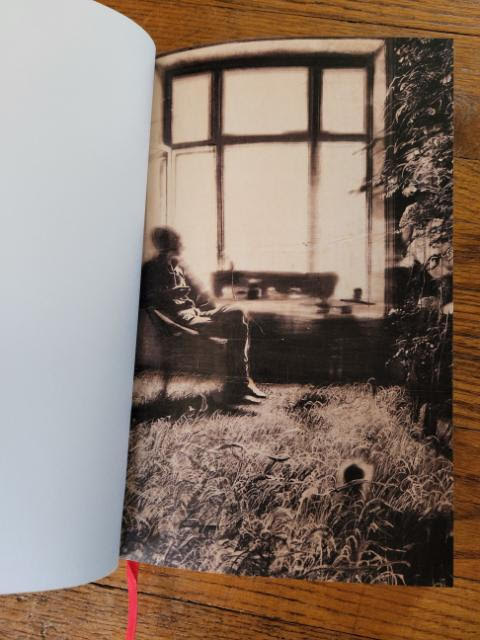
I am using all money raised this way toward buying myself a (rather expensive) typewriter. I've only got a few copies, so first come, first-served! Here are some photos showing the book, cover, and artwork:


Cover


End Papers


Pre-title page


Title Page


Internal Page 


______________

If you like my writing and want to help out, ko-fi me at https://ko-fi.com/forrestaguirre. Every little bit is seen and appreciated! Thank you!

Friday, April 29, 2022

My Mind on My Money and My Money on My Mind*

I'm not poor. I'm not rich. I'm squarely in the American middle class, when it comes to my day-job income. For many years, though, we were living super-tight on our budget. Filling the tank with gas was a necessity, but it bordered on a luxury. We rarely went out for entertainment and we often had to tell the kids "no" when they asked for stuff that their friends might have just taken for granted. 

As a result, I get skittish about spending large amounts of money. I have an allowance each month that I can spend on whatever I like (a luxury, I know) that falls in the middle of the two-digit range. If I want to buy something for myself that costs $100, I'm going to have to wait a couple of months, maybe a little more. I'm not bitter about it, in fact, I think it's a very good practice (obviously, I've been living it for many years now), but when it comes to a big personal purchase, I have to bide my time and *really* discipline myself not to spend that money, but, rather, save it up for the big purchase. I can supplement that allowance with sales of my RPG materials, and I've buckled and started a ko-fi. Occasionally, I will sell stuff on Ebay or sell a short story to help with funding, or even sell some of my books direct to readers (which I actually love to do . . . until I run out of sellable copies!) but when I want to buy something significant, I really have to think about it and I really have to choose wisely. 

Often my money goes, as you can imagine, into books, whether fiction or roleplaying books. I'm pretty picky about both. And, lately, I've bought more music in physical formats. Again, though, I am very finicky about my purchases. I really don't make "impulse" buys. I just don't operate that way. This is one reason I love Goodreads so much: when I see a cover I love or hear about a potentially cool book, I go to Goodreads and try to read a few reviews from people whose opinions I respect. This hasn't always saved me from unfortunate purchases, but it's done a pretty good job of making me think through by book-buying choices. 

Not long ago, I wrote a post about downsizing and upscaling my collection of . . ., well, stuff. My sentiments then still apply now, and probably even more so.

I've decided what I want from this.

Well, at least a few things:

1. A typewriter. An honest to goodness old-fashioned non-electric manual typewriter. Why? Maybe I hate myself, I don't know. Seriously, I am a kinesthetic and visual learner and writer. I always hand-write my first drafts. I can be as sloppy as I need to or want to, with no regard to anything except my ability to spew forth thoughts on paper. Then I edit as I'm typing into the computer. But what if I wanted to do a more careful edit? I think that typing on a typewriter will cause me to actually physically stop and think more, to focus. At least that's what I remember from typing as a kid (before home PCs were readily available). If you made a mistake, you had to get out corrector tape and fix it, which was a royal pain in the butt. Just like Goodreads reviews cause me to stop and think about what I'm buying, this should help me to stop and think about what I'm writing. I have several typewriters that I could live with , but there's one in particular that is *VERY* expensive and that I am absolutely lusting after. I'm not going to jinx things by linking to it, or even to the site it's being sold at because, like Highlander, there can be only one. Well, there really is only one. It will cost more than my computer. A lot more, in fact. There's only one out there (I think it's a custom job), but I really, really want that typewriter. I need to save up for this one first, which is going to mean no buying new books or LPs for a year or more. I'm hoping that no one else snatches it up in the meantime. And, no, I'm not interested in using credit to buy it. I've been in credit trouble before and, never again. This one I'll just have to scrimp and save for, and I'm willing to do it. Besides, this dovetails nicely with my desire to have more analog in my life and my desire to re-read many of the books I already own (c.f., my post on downsizing and upscaling - link above). Again, if you want to help, here's my ko-fi link, or if you want to buy a copy of my novel Heraclix and Pomp, comment below.

2. A new LP player. I love my old record player, the one I rediscovered after my parents died. But this old machine is about to give up the ghost itself. I'll probably buy something in the cheap range, so far as stereo systems go, but something that I can trust to play well and last, as well. Probably something along the lines of the 1 by one stereo system. Simple, but elegant, and hopefully built to last. 

3. This one might just seem silly, but I have an antiqued mirror that I love. By antiqued, I mean burned, abused, acid-etched, artificially aged. I love it. I want another. maybe two more. This will be the least expensive of my buys and also the most frivolous. But I just love the one I have and want to surround myself with more of them. There's something darkly beautiful about the odd distortion they give to everything caught in their reflective rays. Logically speaking, I should buy these first because they are the cheapest of the three things I am saving for, but who said I play by logic? No, really, I need to discipline myself to get that typewriter (presuming it doesn't sell to someone with similar tastes and more money than me).

And there you have it, all my most recent money-grubbing desires. Now that I've committed this on the blog, I feel a stronger resolve to carry through with it (barring some financial emergency, of course). 

Wish me luck! Or, better yet, buy me a ko-fi!

*Apologies to Snoop D-o-g-g, but the song I'm referring to in the title of this post is this version (which I'm guessing Snoop appreciates in his own smoove way). 

________________________

If you like my writing and want to help my creative endeavors, ko-fi me at https://ko-fi.com/forrestaguirre. Every little bit is seen and appreciated! Thank you!

Tuesday, April 26, 2022

Bitter Distillations: An Anthology of Poisonous Tales


Bitter Distillations: An Anthology of Poisonous TalesBitter Distillations: An Anthology of Poisonous Tales by Mark Beech
My rating: 4 of 5 stars

Anthologies are a hard sell. Meaning they hardly sell. I know a bit about this, having edited several volumes myself. Heck, I even won an award for editing one, a long time ago. Note that it's been a long time since I've edited a fiction anthology. I love short fiction, but editing a short fiction anthology is hard work, if you're doing it right. And it's often thankless. I remember speaking with author Stepan Chapman years ago about editing anthologies and his comment was "something for everybody to hate"! Truth.

A great anthology is one in which the whole is greater than the sum of its parts. A careful balance has to be maintained for this to work. A theme needs to be strong, but not overwhelming. And there needs to be a variety of voices, but not so varied that they all become a choir of chaos.

Bitter Distillations: An Anthology of Poisonous Tales is an anthology that could easily fall out of balance in this regard. But it largely (though not completely) succeeds. Mark Beech, the editor, thankfully took a broad approach to the theme, though there is a preponderance of stories about "poison gardens". Of course, it might be difficult to winnow down the the absolute best stories about poison gardens, but that is an editor's job - to build a collection, then hack it down to the best of the best.

The presentation is nothing short of amazing. This is a book you want to have in your collection to show off to your friends. It is beautiful, well-built, and smartly-designed. This is typical of Egaeus Press books. You know you're getting a quality artifact when buying an Egaeus volume.

Some of the stories herein are outstanding. I guessed this would be the case after looking at the table of contents. Many of my favorite contemporary authors had stories in here, and they did not disappoint. There were other authors unknown to me (which is, actually, something I always look for in an anthology - including "unknown" authors was something I prided myself on while editing), some of whose stories succeeded, some of whose didn't quite. If you're on Goodreads, you'll note I gave the anthology a four-star rating. Not because most of the stories were four-star stories, but because many were five-star stories, and a not-insignificant amount were three-star stories. With that, here are my notes on the stories:

"A Night at the Ministry" is as crisp and decadent as one should expect from
Putting the "decay" back in "decadence," the story "The Blissful Tinctires," by Jonathan Wood, marries the grinding post-grandeur of Peake's novels or Wilde's Dorian Gray with the banality of Great War England (and France, for a critical few short moments). It is a grueling, lustrous, dirty, pathetic, and triumphal read, all at once. This is Wood at his hollow, beautiful finest, mixing glory and defeat. It's a tricky story, one that you think you have figured out in the split-second before you figure out you were completely (and delightfully) wrong. I like being tricked in this way.

"Delightful" isn't the first word one would use for a story about poisoning, but Rose Biggin's "The Tartest of Flavours" is light-hearted. This tale, set in the universe of Alice in wonderland (in a slightly different guise) is, shall we say, "frivolous"? I didn't dislike it, but, at times, it seemed to be trying too hard to be cute (in a grim sort of way). Still a nice change of pace, but the weakest story to this point of the book.

Timothy Jarvis' "The Devil's Snare" is everything I would expect from his pen: carefully-crafted mythic storytelling with a limning of dry-humor and dark beauty. What I was not expecting was the ending. In hindsight, I should have seen it coming - but should the townsfolk. Alas, they are in for a big surprise. I love the mix of rather ordinary people moved to extraordinary visions here.

Rosanne Rabinowitz hits a simultaneously melancholic and celebratory mood here with "The Poison Girls". It's a long story, grazing over many years, and the main character, Marla is a complex and interesting person. The story blurs the line between the nostalgic and the imaginal, "breaking" chronological constraints in an emotionally-satisfying story of joy and grief, healing and pain. Beautiful.

I greatly enjoyed "The Invisible Worm" by Ron Weighell (if one can call cringing discomfort brought on by masterful writing "enjoyment"), but I fail to see how it fits, thematically, with the rest of the volume. I suppose it is, loosely speaking, a "poisonous" tale, but it involves no poisonous substance outside of religious fanaticism. Still, it's a great story, though it reads like an introduction to a novel.

A nice, evocative poem with a deeper story between the lines in "Chatterton, Euston, 2018" by Nina Antonia.

"Out at the Shillingate Isles" is a tragic story of a socially-rejected woman named Gert making a living in a harbor fishing village. She meets a new friend, "Low-key," who has compassion for her and her plight. He has a flair for performing strange tricks of magic. They go together on a scheme to give Gert the upper hand against her enemies, and things seem to be going great. Seem to. Four stars to Lisa L. Hannett.

When George Berguño is at the top of his game - and he is at the top of his game in "The Other Prague" - there are very few who can match his writerly voice. Calvino, Borges, Schwob . . . he stands in good company. And this story is polysemic, not content to settle on one meaning . . . or the other. All is one. And none is all.

I don't know that I've read Sheryl Humphrey's work before, but if "The Jewelled Necropolis" is an indicator of the quality of her writing, I will read her work again. This is part of the joy of reading an anthology: discovering a new (to me) author whose work I can continue to explore. I love the framing piece of an anonymous manuscript found as a result of the Federal Writer's Project, and the way Humphrey leverages it is more than just clever. It's a dreamlike tale of searching and finding a glimmer of paradise.

"Not to be Taken," by Kathleen Jennings begs the question "who is who's victim"? Or, more properly "who is the real perpetrator"? It's a story of disturbed individuals who happen to meet and orbit around each other, further disturbing the universe around them. It's a touching piece, in Its own perverse way, with very distant echoes from the decadent tradition. Four stars.

With a writerly voice reminiscent of Sarban, yet with a cuttingly-clever humor very unlike the staid Sarban, Louis Marvick, in his uniquely Marvickian way, immerses the reader in a sea of poisonous plants with "The Garden of Dr Montorio". But he takes it a step further, not only trapping the protagonist in a presumably lethal maze, but by trapping readers in a deadly story within a story. Marvick continues to amaze.

I've been effusive in my praise of Stephen J. Clark's writing. "Of Mandrake and Henbane" does nothing to quell my enthusiasm. Here the triple goddess of Maiden, Mother, and Crone are tied to The Green Man (under a slightly different guise) by a "sacred unguent" that binds them all together. This is a beautiful story of loam, love, and loathing that blossoms under Clark's deft pen.

There's a kernel of what could be a good story in Joseph Dawson's "Beyond Seeing," but it appears to me that this is a rough draft in need of serious revision. I was willing to cut some slack, but with an awkward writerly voice that is too terse and too verbose in all the wrong places, I had little patience with such a predictable plot. This is harsh, but the anthology would have been stronger without this story.

For some reason, I sometimes greatly enjoy stories that obliquely or peripherally toy with the theme of an anthology (though I do like some connection). Such is the case with Yarrow Paisley's excellent "I in the Eye". Poison plays a part, but only a small part in the larger narrative of dissociation with self and family. The writing here is fantastic, and this is one of the darkest stories in the volume. Five stars.

Jason E. Rfe's "Canned Heat" was quaint, in a disturbing way. It feels like there could have been so much more to this story; should have been more. It felt like a pedestrian effort to me.

Alison Littlewood's "Words" is a weak story, strongly told. But I'm afraid that the eloquence, in this case, doesn't outweigh the inevitability of the plot. There may be something to "tried and true" stories (I'm certain I've written a few myself), but when one can determine what's to happen when one is only a quarter of the way through the story, no amount of good writing can save it, ultimately (and unfortunately).

The tone of Carina Bissett's story "An Embrace of Poisonous Intent" is strikingly different from the rest of the book. This is high sorcerous fantasy replete with unicorns and griffins. The mythic element here is powerful, and the story excellent. It stands on its own strength, meaning it contrasts, somewhat jarringly, with the rest of the volume. But I can't fault the story itself. Viva la difference!

So overall, an excellent anthology. It has it's weaknesses, but every anthology does. The strongest stories (Murphy, Wood, Jarvis, Berguño, Humphrey, Marvick, Clark, Paisley) will infiltrate your veins and seize your brain, just as one would expect from the theme. Cheers and bottoms up!

View all my reviews

__________

If you like my writing and want to help out, ko-fi me at https://ko-fi.com/forrestaguirre. Every little bit is seen and appreciated! Thank you!


Wednesday, April 20, 2022

Reading: The Longue Durée

 Admittedly, I am not using the term "long durée" as Fernand Braudel did. I'm coopting the term and twisting it to my own ends (as any good author and historian will do), redefining and, more importantly for the present post, re-scaling it to reflect my love of reading and the puissance of certain texts in my mind (and sometimes my life, truth be told, as I have taken life lessons from some of these works). 

In a previous post, I had mentioned my goal of reading what is on my shelves currently, then re-reading some works alongside one another for the purposes of cranial cross-pollination, if you will. I think that many synergies lurk within certain pairings of books (or even triads) that multiply and expand single ideas with one another to create thought structures that are more than the sum of their parts. This is one thing I miss about graduate school (probably the thing I miss about graduate school): being able to devote time to a syllabus of study that allows me, in a concentrated amount of time, to bash ideas up against each other to see what sticks and what structures emerge from the "chaos". This might explain why I like some of the music I like.

But I'm not here to write about music. I want to write about reading, if only briefly. 

I read extensively, in a fairly broad range of styles, genres, and topics. I love reading. But, to be honest, I love reading writing that makes me have to meditate, to contemplate. If I'm not reaching for a dictionary, at least occasionally, I am usually dis-satisfied. I read to both be entertained and to learn. I read to stoke the fires of my own imagination and creativity. I read for the magic of it all. 

Currently, on Goodreads (still my favorite social media and maybe, someday, my only social media), I show 1035 books read. This is probably a hundred or more too short, as I can't remember or record all the books I enjoyed as a young person. These are books I've read through in all but a handful of cases (where my loathing for the work in question was so strong that I had to record that I hated it). I supposed that the works I did hate served some sort of utilitarian purpose, even if it was simply to hone my disdain for certain styles of writing or, more properly, to sharpen my sense of righteous indignation towards writers who "cheated" me with a dis-satisfactory bait-and-switch or Deus ex Machina

Other works, however, stuck with me. Even if they didn't strike me as I finished them, they haunted me, over time. I could not get them out of my head. When I have an idle moment and can think upon things, these books come back into my mind, unbidden. They are alive in my mind, as it were. They have an enduring presence that I cannot shake. They may not be my favorite works - indeed some of them I found excruciating to read (I'm looking at you, Joyce) - but they have stuck with me and they just won't get out of my head. This is what I mean by The Longue Durée. These works have impressed me in the long term enough that they crowd the literary memory spaces of my brain. For whatever reason, to me, they are important and lasting. When my thoughts fall slack to their lowest ebb, these are the books that seem to almost accidentally slip into my head. They form the base of my intellect; they are the undergirding to how I think

This list could be very, very long, but I'm trying to keep it very short for the sake of brevity and concision. I am inevitably excluding a lot of important books and I will, no doubt, regret the inevitable omissions. In passing, I note how few of these books are actually fiction (which I write). In all honesty, there is little fiction that sticks in my mind enough to be considered Longue Durée, so if you see a fictional work below, do note that it must have made a huge impression on me. Again, I cannot necessarily pinpoint exactly why that is. But here is my very short list, which I will amend after my grand experiment of re-reading concludes (hopefully in early to mid-2023) - in no particular order:


Hamlet's Mill, Giorgio de Santillana

Enchanted Night, Steven Millhauser

Searching for Memory Daniel L. Schacter

The Roots of Civilization: the Cognitive Beginnings of Man's First Art, Symbol and Notation, Alexander Marshack

Three Novels by Samuel Beckett: Molloy, Malone Dies, The Unnamable, Samuel Beckett

The Voice of the Air, John Howard

Ulysses, James Joyce

Hierarchy Theory: A Vision, Vocabulary, and Epistemology, Valerie Ahl

Six Memos for the Next Millenium, Italo Calvino

Irrational Man: A Study in Existential Philosophy, William Barrett

Stealing Cthulhu, Graham Walmsley

Sub Rosa, Robert Aickman

The White Goddess, Robert Graves

The Academy Outside of Ingolstadt, Damian Murphy


What are your Longue Durée books? Post them in the comments!


If you'd like to lend a hand to my creative endeavors, here's your chance


________________________

If you like my writing and want to help out, ko-fi me at https://ko-fi.com/forrestaguirre. Every little bit is seen and appreciated! Thank you!