Saturday, March 19, 2022

(h)Auororæ


hAurorae. The recalling or the retelling of the many Pasts made Present & Whole again.hAurorae. The recalling or the retelling of the many Pasts made Present & Whole again. by Gabriel McCaughry
My rating: 4 of 5 stars

(h)Auroræ is many things: A work of art, of poesis, of philosophy. Above all, it is a work of meditation. Another reviewer compared the book to the ouroboros, and this is a wise assessment. Reading from cover to cover is only the first way one might read this work. One might also begin with the "Glossary & Allegories" section near the end of the book, then jump to . . . wherever page feels right. This is ameditative work to be savored. "Powering through" this work(ing) dissipates Power. The author notes several times that these are, essentially, his notes for what he has found empowering and enlightening. He draws from several traditions in his search for gnosis, so there really is an entry point for just about anyone wanting to explore (h)Auroræ. It is as eclectic as it is esoteric, and that is a good thing.

McCaughty is best when he relies on the art of wordsmithing to overlay the artifice of philosophy. I'd much rather revel in his work than wade through it. When the open page can breathe and when compacted allusive poetry can convey as much as a block of text, why have the block of text? Let the words and art soar! Make their magic manifest!

Not surprisingly, the essay regarding the art in this book by Jose Gabriel Alegria Sabogal provides a grand key to this work:

More than once, I have dreamed of discovering strange books full of mysterious emblems. After these dreams, I felt I recognized the images as being the Aurora Consurgens . Later, I also found that Jung had almost identical dreams, and that he devoted 16 years of work to his Liber Novus . His drawing entitled 'Systema mundi totius' was the inspiration for the central circular piece in the present work. Borges's notion of a circular book in his tale 'The Library of Babel' inspired the work's overall structure and the format. Ultimately, the goal is to create that once-dreamed book, which, as a circle, may be read in all possible directions.

So, start wherever you think is best. Return when you need to. The door to the labyrinth is always open, one eternal round.

__________

If you like my writing and want to help out, ko-fi me at https://ko-fi.com/forrestaguirre. Every little bit is seen and appreciated! Thank you!


View all my reviews

Sunday, March 13, 2022

Herald of the Hidden


Herald of the Hidden & Other StoriesHerald of the Hidden & Other Stories by Mark Valentine
My rating: 4 of 5 stars

"Four stars?!?" you scream.

I know, I know, it's Mark frickin' Valentine!

And I love Mark Valentine's work. Love, love, absolutely love.

But everyone has to start somewhere, right? And this is what we have here: several early tales, more raw, more . . . "cheeky" is the word that comes to mind. Does this mean that it's bad? No, not at all. It's excellent. But when comparing these tales to his more mature work, one must consider that what we see in the voice of such masterpieces as The Collected Connoisseur took years to hone and perfect. Here, we see a younger Valentine, obviously incredibly gifted, finding his way, showing "flashes" as they say in the sports world, but lacking the full consistency of later work. I understand that completists will give these stories the same sort of reverence that one holds for a black metal band's "demo" tapes - a sort of worship of the raw, the untamed, the under-produced - and I can surely appreciate that sentiment. But once one has read his later work, it becomes clear that these were early tales, for the most part. One must note that certain of these stories were, of his own admittance, published in low-circulation zines back in the '80s, a sort of literary-weird samizdat that evokes the punk and metal zines of the same period.

Speaking of metal, maybe it's because I'd been listening to Watain and Cult of Fire while reading, but Ralph Tylor, lead protagonist of "St Michael & All Angels" struck me as The Connoisseur dressed in a denim jacket, black jeans, and high tops. That picture is probably all wrong, but it's how I pictured him and I'm sticking with it. Tyler is just the sort of person I loved to hang out with as a teen - smart, a bit bookish, interested in the outré, but also a bit . . . metal. This probably has to do with my teenage years spent in England breaking into haunted medieval priories and such (usually to drink and make out with girls - as one does as a teen. Or at least I did.) while absorbing as much metal and punk as I could. I see a little bit of myself in Ralph Tyler. Maybe more than just a little bit.

The second story, "The Folly," was anything but. A clever tale with a moralistic streak, it will appeal to many a vegetarian, and cause horror in the hunter. This furthered my feeling that Ralph Tyler is a less refined and less controlled individual than The Connoisseur. A sort of Hardy Boy to the Sherlock, all of which is meant as a compliment to the writing.

Ralph Tyler differs from The Connoisseur remarkably in one way, as evinced in "Madberry Hill": he is not above rank deception and might (and does) willingly endanger others to sate his curiosity about the supernatural. I had earlier thought that Tyler might be a rougher version of The Connoisseur, and, after reading this tale, I'm convinced of it. Ah, the recklessness of youth! Slap a patched denim battle jacket on that young man!

"The Ash Track" struck me on a couple of different emotional levels. First, the story itself, which I won't spoil, is melancholy and poignant, thick with pathos. Secondly, it takes place, partially, in Bedford, which is the city I lived closest to while living in the UK, so there's some emotional resonance there for me. Who knows? I might have walked the Ash Track myself, given my many ramblings about the countryside?

"The Grave of Anir" is an unsurprising story, but satisfying. The ending is something straight out of the M.R. James playbook. A nice Arthurian mystery that may or may not be a ghost story. You decide.

I loved the gothic and morose "William Sorrell Requests . . ." a great deal. The dreary funerary atmosphere lends the perfect backdrop to a story of either mass hysteria, possession, or communal guilt. Or, perhaps none of these. But then, maybe all of them. Only William Sorrell knows for sure, and dead men tell no tales, as they say. Brilliantly gray and sodden, this story sticks in the brain.

"The Hermit's House" is a little more straightforward than most of the stories in this volume. Make no mistake, it is firmly in "the Weird," but the resolution is fairly straightforward. A simple plot, but written so well (as Valentine always writes) that it can't just be dismissed as a "minor" story. Valentine's pen lends weight to what might otherwise be a flighty, ephemeral tale.

"Herald of the Hidden" is the closest I think I've seen Mark Valentine get to "cosmic horror," though of a decidedly English variety, meaning that those horrors are rooted deeply in the history, nay, pre-history of Avalon. Here is a glimpse (and we almost see altogether too much) of what came before, of what lurks in the hills and dales among the trees. It's a wonderful sort of departure from his "typical" work.

Valentine takes a shot at colonialism, by way of Ralph Tyler, in "Heritage of Fire". I honestly thought the esoteric investigator was going to meet his end here, but then who would explain the cultural implications of English development in the denouement, had he died? Someone has to bring bad news to capitalist developers, I suppose.

The Almanac" was one of my favorite stories of this volume (though not the favorite - see below). It shows a growing maturity in Valentine's writing, something that would later manifest in The Connoisseur stories. The unresolved mystery adds to the weirdness, taking it a notch further than those clearly-explained revelations of earlier tales. There's an abstract quality to it that I love about Valentine's work, that I consider his "signature". It's difficult to explain, as it seems so ephemeral. Maybe that's all that needs to be said.

"The Guardians of the Guest Room" is a ghost story proper, something that would have been right at home in the four-color horror comics of the pre-code era, but with a step up in eloquence. I'd be curious to see this one illustrated in that old, '50s graphic style. Valentine would have at least one customer for this grisly comic; namely, me.

Words are important, even critical. But Valentine's tale of crucial misunderstanding in "Go to the West," which could have become a mere trifle of a story, something that any child could write, is instead transformed by the last sentence. Oh, those words are so critical. You must understand. You absolutely must! Be careful with your signs and wonders, seekers of gnosis!

Tree Worship" is a mythic idyll of understated tone, but brilliant atmosphere, a good story to read as winter turns to spring. It is a thread of pagan Genius Loci only briefly interrupted by modern intrusion, a suburban hiccup preceded and followed by the long, steady breathing of the land itself.
Odd. Though one of the earliest stories in the volume, chronologically-speaking, "Woken by Candlelight" reads like Valentine's later, more mature works: subtlety of mood, languid action, an emergent realization of wisdom in the form of a mystical revelation. This beautiful tale is a herald of things to come in Valentine's poetry, the Connoisseur, and The Nightfarers. Definitely re-readable. The best story in this volume and one worthy of any weird-best-of collections. You need to read this tale!

In a village with little secrets running about, that crazy old lady might not be so crazy after all. Maybe she sees things as they really are and, if so, she'll fit right in with those that know "Their Special Glee". It's a story of folk and horror, of a sort, but of a sort that never confronts one directly as so much folk-horror does, but nips at the heels and toes. Clever and sly in little ways, I loved this understated tale.

In the end, I'm conflicted. On one hand, I want to recommend this to anyone who hasn't read Valentine's work, but that's not the way I encountered his work. I was thrown in the deep end with The Nightfarers, and I've not been the same reader (and indeed not the same writer) ever since. I suppose everyone needs to travel their own path, but in the end, I think that most would agree (and those that disagree are, well, just plain wrong) that Mark Valentine is one of the greatest living writers of weird fiction in practice today. So, however you choose to do it, start reading Valentine's work (I've included lots of links to reviews of some of his other books in this review). If you start here, fine. If you end here, fine. Valentine's weird fiction is a sort of ouroboros of excellence. You can't go wrong, wherever you begin.

View all my reviews
__________

If you like my writing and want to help out, ko-fi me at https://ko-fi.com/forrestaguirre. Every little bit is seen and appreciated! Thank you!


Thursday, February 24, 2022

Downsize, Upscale?

 My oldest son is a Spartan. He does very much with very little. I've often said that if I were to have to survive an apocalypse, I'd want him by my side. He's incredibly resourceful, loves to learn new things, and is excellent at figuring out how things work. All of my kids share that trait to one extent or another, but my oldest son . . . well, he's a Spartan in all the good ways.

When he was young, we were a resource-poor family. I was an undergrad when he was born, but when he was a toddler and young child, I was either in graduate school or had just dropped out. We didn't have much at all. I recall one month where, for several weeks, we subsisted mostly on beans and rice, because that's what we had. I'm guessing that those formative years of "want" were what spurred him to make do. 

Now I'm older and more financially secure. We live comfortably in the middle class, pretty much right in the middle, if I understand American salaries correctly. We have what we need and a good amount of what we want. Well, maybe not a "good" amount. Sometimes, when I'm not struggling with having been brought up in the '70s and '80s, when conspicuous consumption became a reachable norm for the middle class, I think I have just a little too much. But just a little.

I think back to times when I had less. And, without growing sentimental or nostalgic, I think I can say that I was only slightly less content than I am now. Any discontent back then really arose from not having enough to meet all of my family's needs, having to go into debt to survive - you know. You know. If you've never been there, well, don't say so because I have a hard time respecting people who haven't gone through hard times, whether financially, emotionally, or with health issues. I like fighters who've had to fight.

But I look around me and I think that maybe I've become a bit too spoiled. 

For example: Books. As you can tell, I review a lot of books. And I own physical copies of almost all the books I own. I think I've actually reviewed a digital book maybe three times? The other book reviews here (and there are a few) were all from physical books - probably 90% owned by me (the other 10% would be library books I borrowed). Now, I have a wishlist of books. But it's only 20 books long at any given time. I use Goodreads to maintain my list. But I do not allow myself more than 20 books on my "to be read" shelf. Otherwise, I just have a long list of books I'm never actually going to read. Besides, forcing myself to only have 20 on the list makes me REALLY think about what I want to read. 

And yet, I think I have more than I need. 

I've promised myself to re-read some of those books. And I have a nascent plan to read some of them in close proximity to each other to see what that does to my brain and my creativity. For example, I want to re-read Robert Graves The White Goddess at the same time I re-read Hamlet's Mill (which I have not reviewed here yet). These books are thematically similar-ish, but far enough apart to cause some fruitful cognitive dissonance, to trick the brain into seeing new patterns and angles heretofore unforeseen, in this case involving themes of myth and myth-creation.

Other groups of books I plan on re-reading together:

Piranesi + The City of Dreaming Books (I haven't reviewed the latter, but I feel that the tone in both of these books is very similar, at least in the corners of my memory they are - we shall see)

Lost Knowledge of the Imagination + The Secret Life of Puppets + Hieroglyphics + The Spectacle of the Void (I almost think this could be a bibliography for an undergraduate college class on . . . what, exactly?)

Swann's Way + Finnegan's Wake (neither of which I have read in full. This pairing might kill me.)

etc.

You get the idea . . . 

In order to keep my focus, I'm going to have to resist the temptation to buy new books. And I still plan on keeping my "to be read list" down to 20 books and no more. 

So my tentative plan is this: I will read the books I physically have and not order new books. When i have read through all the books I physically have now, I will concentrate on re-reading books in the combinations I've listed above and a few others. I think I might try this (deep breath) for . . . a year? I honestly don't know if I can make it. But I have to try.

Extending this further, I will try to forbear from buying (even deeper breath) new roleplaying supplements or games. And new vinyl records.

Do I just hate myself? Maybe. But I also think that if I hold off on those things and use what I already have, a few things will (hopefully) happen.

1. I will learn to more fully appreciate what I already have.

2. I will utilize what I have in new ways, especially as I "use" the media vis-a-vis each other to explore new brain spaces.

3. I will be forced to create more. If I want something new to read, I'll need to write it myself. If I want a new game or adventure to play, I'll need to make it myself. If I want new music - well, that one's easier because of bandcamp and youtube, but really, I'm hoping to force myself to pick up that darned guitar and play it more often.

4. I will save my monthly allowance that I would normally spend on books, games, and vinyl and save up to buy myself some things I've promised myself I would get but never have: a working old timey typewriter, for instance. Or a *decent* phonograph (do they even call them that anymore?) and speakers, along with some wishlist vinyl. 

5. As part of this effort, I will sell some or give away the books I feel I don't really need anymore. And I've got some knicknacks and gewgaws that I thought were a great idea at the time that I can sell on Ebay and maybe save even more for a final splurge at the end of this exercise.

It's going to be my turn to be the Spartan. We'll see how I fare.

__________

If you like my writing and want to help out, ko-fi me at https://ko-fi.com/forrestaguirre. Every little bit is seen and appreciated! Thank you!

Saturday, February 5, 2022

Pollen: A Novel in Black and White


Pollen: A Novel in Black and WhitePollen: A Novel in Black and White by Beresford Egan
My rating: 5 of 5 stars

Pollen is a novel, a work of art, really, from the delicious prose to the lavish black and white illustrations by the author and artist Beresford Egan, to the stunning presentation by publisher Sidereal Press - a novel that unfolds in so many ways, revealing itself in a long, slow burn that takes the reader by surprise, in time, like a frog discovering it's being boiled after having hopped into a nice cool pan of water on a heretofore unlit stove. That's not to say that there is any degree of deus ex machina here, no, not at all! There is a natural progression of attitudes and events, but they are handled so deftly that one realizes what is happening and damns their lack of foresight, only right before the consequences strike.

The narrative mostly centers around the actions of one Lancelot Daurimer, "man of the world" as they say, a dilettante, a scoundrel, an aesthete. At times, one sees aspects of Wodehouse's Bertie Wooster, at others, Huysman's Essientes, and others, Wilde's Dorian Gray. And yet, he is his own man, a man who changes throughout the novel while, in the end, remaining very much himself. Lance Daurimer is one of the most compelling characters I've read in many, many years. He reflects us at our cruelest, our most irresponsible . . . and our most repentant and most vulnerable. For me, this carried a strong emotional resonance with my own life and the changes I have undergone through the years. In some ways (but, thankfully, not all), I am Lance Daurimer. I understand that this novel is semi-autobiographical for Beresford Egan, and one can tell that the depths of pain and self-loathing that are laid out on the page come from the author's personal experience. Egan was exorcising some demons here, but it never feels self-indulgent.

It is clearly evident that Egan paid careful attention to his text while writing and editing it. For example, the banter between Lance Daurimer and Vernon Batty is quite good. It feels natural, but on very close examination, you can see the grammatical and metaphorical craftsmanship with which it was created. I wish we had more dialogue like this in more (post?)modern literature. Dialogue can be witty and baroque and yet still feel natural if the characters participating in it are both cynical and humorous. Egan rides the razor's edge between the decadents and the modern without missing a step. though it was written in the 1930s, it feels like it is bridging the gap between the 1880s and the 1920s. But it does so without self-awareness; fluidly.

For all its cynical humor and wit, this book is definitely not a comedy. Even if it was to take a strong turn into comedic channels and stay there till the end, the laughter would always be echoed by a sense of sorrow and loss. The pain here is quite real, as we learn in the conversation between Daurimer and his father. The dialogue here is brilliant, even in its own darkness. Pollen is complex and requires something on the part of the reader: the ability to unpack and examine the growth of character (not just Daurimer's, it should be noted). Though it reads smoothly, it is not an "easy" read. One might be forgiven for thinking the book is much less than it is if the reader doesn't read the book to the end. This is one that rewards the reader who sticks it out to the end, not because of any surprise ending, but because at the end of it all, the reader can look back and fully appreciate what Egan has built here in all of it's elegance and depravity.

While there really is no "weird" or "fantastical" element, Daurimer has a daytime vision in which he sees "Lucifera," the feminine aspect of the devil himself. What decadent-leaning novel would be complete without a hallucinatory manifestation of Lucifer's feminine aspect? It goes with the territory, N'est ce Pas?

Egan's illustrations are possibly the "weirdest" feature of the book. One should probably expect this from the same author who drew illustrations for one of the more beutiful presentations of Baudelaire's Fleurs du Mal. Most of it would be considered quite risque in 1930s England, though Egan eschews pornography, per se, in the concluding essay "Black and White Art - What Is It?" which Sidereal rightfully saw fit to include after the book's conclusion. This essay actually tells quite a bit about what Egan was trying to do with Pollen without referring to Pollen at all. It was not to take sides with good or evil at all, but to side only with Art, erasing the man-made lines between "good" and "evil". In this novel, he has quite definitely succeeded.

View all my reviews
__________

If you like my writing and want to help out, ko-fi me at https://ko-fi.com/forrestaguirre. Every little bit is seen and appreciated! Thank you!


Sunday, January 23, 2022

Four Color Fear: Forgotten Horror Comics of the 1950s


Four Color Fear: Forgotten Horror Comics of the 1950sFour Color Fear: Forgotten Horror Comics of the 1950s by Greg Sadowski
My rating: 4 of 5 stars

Last summer, while on a trip to see family out west, we stopped in Denver and my wife humored me by letting me spend some time at Mile High Comics. That was a lifelong dream, truth be told. I had known about Mile High since seeing their advertisements in old Marvel comics when I was a kid. I have to say: it did not disappoint. I was able to flesh out a good deal of my Grimjack collection, I picked up one issue of Savage Sword of Conan, the issue that probably corrupted me into who I am today, and pick up a couple of other goodies along the way. Most of all, I think I realized how many thousands of dollars worth of comics that my mom gave to the thrift store when we moved from Italy to Minnesota. It had to happen, and at 9 years old, I couldn't really fight it, but . . . ugh.

One of my favorite comics as a kid was Weird War . It was the closest thing to a horror comic that my mom would let me buy. Of course, those issues of Savage Sword of Conan (which my mom did let me buy, for some unknowable reason) sat on the magazine rack right alongside Eerie and Creepy in the old Stars and Stripes Bookstore. But mom would have none of those in the house.

Well, I've got my own house now. And mom is probably turning over in her grave as I'm typing this. Sorry, Mom.

Sorry/not sorry.

To make up for lost childhood time, I bought Four Color Fear. While visiting Mile High, I realized how bloody expensive, how . . . terrifyingly expensive old horror comics can be. Honestly, I was stunned. Apparently these are extremely rare. I'm guessing the 1954 Comics Code has something to do with this. Look it up - I'll spare you the details - but suffice it to say that Mom wasn't the only person opposed to horrific comics. Now, however, we live in a more tolerant age, thankfully. So something like Four Color Fear can be obtained without fear of censorship by the Comics Code Authority . . . or Mom.

The book presents several stories from a wide variety of comic's publishers not named "EC". You'll find some surprising names in here: Harry Harrison, for instance. Or Frank Frazetta. Yes, that Frank Frazetta (as if there could be any other). Quality varies wildly. Most of the stories are schlock horror with highly-predictable "plots," the proverbial stupid people doing stupid things and being killed, eaten, etc., and horrible (and yet not horrifying) dialogue.

But there are several exceptions, some real gems.

"Nightmare" might be one of the best. A weird fiction writer is out of ideas for his horror stories, which are not gruesome enough, according to his editor. So fate provides ideas, with a couple of unexpected twists. This was great!

What's the comic book equivalent to good cinematography? Is it called good "storyboarding". Whatever it is, it's excellent in "Dust to Dust". A (very) mildly surprise ending helps this one along. Still missing that certain something that would make it a truly great story, but it's good.

"Green Horror" is one of the stupidest, wackiest . . . and BEST stories in this collection! This story of a jealous cactus (yes, you read that correctly) doesn't flinch - it takes its campiness with deadly seriousness. This is one of those tales told in a treehouse by 10 year olds (Sandlot-style) with flashlights under the chin. It's so utterly ridiculous and over the top that it works!

"Colorama" is just the sort of weird horror I came looking for in this volume. I wish most of the stories were this strange. The comic medium is used to great effect here, leveraging the inherent power of images on a page to drive home the horror in a way that only a comic book can. It's polychromatic meta-horror . . . until it's not! And when it's not, well, that's when you need to start to worry.

"The Man Who Outdistanced Death" is an original story of mythic proportions that I really liked. Rod Serling would have been proud to have written this tale about distance running and longevity. If all the stories were of this quality, this would be a five star book, no question. Unfortunately . . . the other stories can't quite keep up.

(see what I did there?)

I wouldn't call "Art for Death's Sake" super-original, but it stands out from most of the other stories here for its subject matter and twisted ending. Some of the panels are beautiful and almost expressionistic, which fits, thematically, with the story.

"Here Today" is a unique, capital "W" Weird story. The plot is simple, but so bizarre that this tale seems ahead of its time. Another Twilight Zone-esque offering. One wonders how much Rod Serling read these comics as a kid! Or as an adult, for that matter.

"The Wall of Flesh" was predictable, to say the least, but the unique premise and use of a flesh wall absorbing its victim, superimposed over the image of a clock was absolute brilliance. Time is running out, indeed. If only 1950s plots weren't so dumb and predictable, this would have been something rather masterful. Still, it sets a high aesthetic standard for horror comics.

"Reefer Madness" meets a hybrid between a flying squirrel and The Creature from the Black Lagoon in "Nightmare World". The only thing terrifying about this story is its predictability. But the art is distinct, I have to give it that.

If Thomas Ligotti, Robert Crumb, and, I dunno, Philip K. Dick, maybe? If these three got together and wrote a horror comic, it might be "What Happens at 8:30 PM". This one is very different than the rest and shows the breadth of horror comics in the 1950's. Not all of them were cookie cutter. I'd like more oddballs like this in Four Color Fear.

In the center of the book is a series of glossy comic covers from an incredible variety of comics that I'll never be able to afford. And after all the gore is done, the editor, Greg Sadowski, includes an admirable, well-researched essay with commentary on every one of the comic stories included in the book. The commentary centers mostly on the creative process and the comings and goings of various artists and writers - there appeared to be a LOT of fluidity from company to company - giving a sort of historiography of the horror comic creative scene before the code became law. The glossy covers and commentary make the book a "whole" artifact, very similar to a museum catalog. You might say that Sadowski's editorials really . . . flesh things out?

View all my reviews

__________

If you like my writing and want to help out, ko-fi me at https://ko-fi.com/forrestaguirre. Every little bit is seen and appreciated! Thank you!

The Immortality Key: Uncovering the Secret History of the Religion With No Name


The Immortality Key: Uncovering the Secret History of the Religion with No NameThe Immortality Key: Uncovering the Secret History of the Religion with No Name by Brian C. Muraresku
My rating: 4 of 5 stars

At the risk of sounding like a 1950's B-horror movie title, I was a teenage drug-fiend. I was 12 or 13, I can't quite remember, when I started experimenting with pot, speed, cocaine, opium, depressants, and, of course, one of the most insidious drugs of all, alcohol. By the time I was 18, I had pumped enough chemicals in my body for a lifetime, so when I came about one judge's signature away form a term in federal prison, I quit. Cold turkey. Everything. And I've been clean since.

One thing I never tried was psychedelics. The war on drugs and the (now comical) portrayal of psychedelic's use on '70s and '80s television frankly scared me away from them. I "knew" that PCP made people think they could fly and LSD could make you crazy forever. I'd been brainwashed really good. Thanks, Nancy.

Fast forward several decades. I have a much more "measured" view of drug and alcohol use. There are plenty of people out there who can safely and responsibly use drugs and alcohol without becoming an addict, like I did. And I realize now that medications have their place and can really benefit people's lives. Then again, as an aside, I think there should be MUCH stiffer penalties for drunk driving, but that's a rant for a different time. And I avoid alcohol like the plague. I know that its no good for me and I'm not good with it.

Now I've done a fair amount of research into psychedelics, mostly being interested in micro-dosing after having listened to a couple of podcasts that touched on the subject. Pretty soon, I started seeing articles popping up here and there - my UW alumni magazine, for instance, or Discover Magazine - about the efficacy of psychedelic treatments for PTSD, in particular, and in easing the fears and worries of terminal cancer patients. It's been a bit of a revelation, so much so that I think we might be on the edge of a revolution in medicine.

I was discussing this with my oldest son this past Thanksgiving as he was visiting from grad school. He told me about a podcast interview regarding this very subject . . . well, sort of. I asked for a link and took some time to listen to Lex Fridman's interview of author Brian Muraresku about his new book The Immortality Key. After listening to that, I put the book on my Christmas wish list, and my son obliged. I raised that boy (well, he's a man now) right.

The general premise of Muraresku's thesis is this: There is a possibility, a strong possibility, backed by some thin threads of evidence, that the history of psychedelics in societal use may be the backbone of the history of religion, particularly sacramental religions like the cult of Dionysus or even Christianity.

Of course, he's crazy, right?

I don't think so.

That's not to say that I'm fully convinced. The evidence is oftentimes tentative, with much more research needing to be done. Or it's based on what I will call "negative historiography," the notion that a certain things absence from the historical record proves its existence by the very void created in the process of the intentional removal of such evidence by the winners of history; in this case, the Catholic Church.

But that's not to say I'm not fully convinced, either. I'm taking a tentative lean towards believing Muraresku's thesis, partly because he acknowledges, in the end, that this is a work-in-progress. I will say, though, that some evidentiary gaps that are "leaped" in the middle of the text, are later given some logical breathing room, some more critical looks, in the afterword.

My biggest issue with the book is connecting the dots from the Dionysian cultic use of psychedelics in the Middle East to the early Christian house churches of Anatolia. In the midst of the presentation of evidence, Muraresku's arguments sound like they apply to all of Christianity, even if he doesn't explicitly say so. But later he acknowledges that it may have been only a very small part of the initial Christian movement across the Mediterranean. The evidence is scant, but Muraresku's eagerness to get the point across makes his arguments sound like there is tacit proof that the use of psychedelics in the early Christian sacrament was a given. Over-enthusiasm sometimes clouds the argument. A little more restraint might have gone a great way in easing me into accepting the trail of evidence more readily.

Time will tell if archaeobotanical and archaeochemical analysis can fill the gaps. I sincerely hope they do. Because what Muraresku is talking about here is not a bunch of stoners sitting in the basement with a bong listening to Phish. He's talking about humans finding real meaning in the psychedelic experience. He's talking about "dying before you die," which has an absolutely profound effect on those who experience it - he goes over this extensively. He's talking about experiential religion, the type of real life events that can make real life changes in the way people view themselves, each other, nature, and reality, seeing the cosmos, the earth, and all humans anew. There is an optimism here that "the religion with no name" can bring some fundamental changes to the whole of the human race, Aldous Huxley's dream come true.

And he might just be right.

Time will tell.

View all my reviews

Saturday, January 15, 2022

The Lich Keep Getting Licher

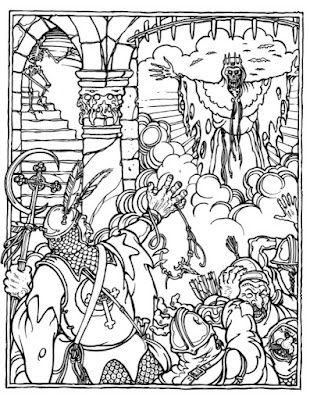
 I've been in love with Liches since 1979. It was this picture, from the Official Advanced Dungeons and Dragons Coloring Album that caught my eye. 


It was love at first sight. And I was reunited with this, my first undead crush, a few years back. Curiosity got the best of me in the years between, and I . . . um . . . got to know others: Vecna, Vlaakith, and Acererak, to name a few. I learned to love them for who they were (and eternally are). Don't judge. There's nothing worse than Lich-shaming . . . 

But I sometimes grow weary of the old story: crazed mage/priest decides to seek eternal life through elaborate and expensive magic rituals that cause them to become even more crazed (and undead). You know all the tropes. Here, I'd like to propose a few alternate ideas for how certain ex-people (and ex-non-people) became liches. You can figure out how their powers manifest, stat them out, etc. These are just ideas of origin-stories, if you will. Consider this a surprise gift to kick-start your imagination, your campaign, or whatever. The details are all up to you.


Variant Liches:

  1. A young boy with an oversized nose wishes upon a star. That star happens to be a manifestation of Orcus (a gleam in his eye, to be exact). The boy gets his wish and lives forever in undeath. Orcus even gives him a pet, a sentient cricket wearing a tuxedo and top-hat whose initials are the same as one very famous religious figure. The cricket is not as nice as he seems. And the boy . . . well, let's just say he's not like all the other boys.
  2. A young maiden waits for the perfect lover. She is saving her love for them. She has been searching for a long, long time. She is . . . er, charming. Nearly irresistible. This would explain the dense pile of bones in her cottage's basement. Who knows? Maybe you are The One. She's going to do everything she can to find out. She keeps searching for a heart of gold, and she's not getting old.
  3. Fido has been waiting for his master to come home. But the master of the castle will not be returning. So the dog waits. And waits. And waits. Visitors come, but not his master. And the visitors never seem to leave. At least Fido has a good supply of bones to gnaw on. He's been thinking, lately, that maybe he should leave the castle and go hunting for his master, come what may.
  4. A certain merchant wants nothing more than to keep the wheels of commerce turning. And he does. He's been in business longer than he can remember, going from city to city in his horse-drawn wagon. He's gone through a lot of horses . . . He's a powerful trader, buy low, sell high, or sometimes don't sell at all. He admits to keeping a few things he's bought (though, again, he can't remember how long ago he bought them). There's that silver amulet with a certain aura. And the colorful scrolls he reads nightly before going to bed. The gold ring he bought from a gravedigger. And that strange mummified hand with the sigils tattooed in the palm. These are things he will never sell. Never.

If you'd like to support me in continuing to provide free stupid content like this, you can do eeeet here!

____________________

If you like my writing and want to help my creative endeavors, ko-fi me at https://ko-fi.com/forrestaguirre. Every little bit is seen and appreciated! Thank you!