Showing posts with label Editing. Show all posts

Monday, May 26, 2025

The Creative Act: A Way of Being


The Creative Act: A Way of BeingThe Creative Act: A Way of Being by Rick Rubin
My rating: 5 of 5 stars

I studiously avoided reading reviews of this book until I was done because I (correctly) predicted there would be those who praised it as a new book of holy scripture and those who would utterly trash the work as thin and inconsequential. Neither of those two camps is right. And while I do not condone tossing a book before you've given it a fair chance (though I have utterly given up on a book or two, opinions will differ on what a fair chance is. I can see the naysayers who feel that the book is a bunch of twitter quotes strung together, and I can even see why people who went into it not expecting a philosophically-oriented book would be turned off to it (though why you would think that a book about creativity would NOT have a philosophical orientation is beyond me). That said, I lean towards the cult of those who sing this books praises. I'm not all-in drinking the Kool-Aid, but I am at the edge of the clearing watching everyone line up, considering.

If one reads the book to the end, one finds the admission:

You are you.
The work is the work.
Each person in the audience is themselves. Uniquely so.
none of it can truly be understood, let alone distilled to simple equations or common language.


And herein lies the heart of the matter. Creativity is very difficult to pin down. There are exceptions and contradictions. What works one time doesn't work the next. That's the whole point of creativity. If you're looking for an end-all-be-all truth, study Accounting. Paint-by-numbers is not creativity, and it never was. It's good practice, and one can learn principles from it, but the true teachers in creative acts are experience, intuition, and failure.

Rubin does, however, share practical ways of thinking/being for those who might be struggling through the creative process. He also shares ways to ensure that you are creating good art when you think you've got a finished product. Any writer who's been writing for a while will tell you that the most difficult part of writing is editing. And if they don't, you can bet that their work shows it. I can categorically state that my early work, even those for which I was paid good money, could stand another edit. Or two. Or ten. Here Rubin doesn't spare the rod, but reminds us of our responsibility to create the best work we can, while giving us some tools to work with.

Now many of these tools come in the last third of the book, but if one doesn't buy into the foundational principles (remember that old concept of "willing suspension of disbelief"?), then the latter parts of the book are going to be far less impactful. No, you don't have to drink all the Kool-Aid, but you have to be willing to read and observe with an open mind. If you can't at least accept, theoretically, that "art is our portal to the unseen world," then this book is not for you. But if you'll give that thought a serious chance, the rest of the book will make sense to you. Again, if you want paint-by-numbers-so-you-can-monetize-everything-with-high-productivity, you need to look elsewhere.

If you're onboard with exercising a little faith, you'll be able to grok the book. The practicum really starts with the chapter on "Seeds," about a third of the way in. From here to the end, I've marked so many passages and taken so many notes that I won't take the time to put them all (if any) into this review. I've begun marking it up (in pencil - yes, I write in my books) with marginal notes, much like the ancient rabbinical scholars used to litter a verse of scripture with their annotations. As a result, this book has become highly personal to me and will continue to do so as I revisit it. It serves as a mirror to my own creative process, revealing all of its beauty and flaws. I will gaze into this book many times in the future both for inspiration and for practical solutions when I'm stuck (and there are many methods given for how to become un-stuck in the last third of the book).

I have a handful of reference books that I keep "hot at hand" in my writing area. An old Roget's Thesaurus, Tim D. White's Human Osteology, Francis D.K. Ching's A Visual Dictionary of Architecture, and now: Rick Rubin's The Creative Act: A Way of Being.

View all my reviews

____________________

If you like my writing and want to help my creative endeavors, ko-fi me at https://ko-fi.com/forrestaguirre. Every little bit is seen and appreciated! Thank you!

Friday, April 18, 2025

Ossuary of Dreams: Twenty-Five Tales of German Horror and Weird Fiction


Ossuary of Dreams: Twenty-Five Tales of German Horror and Weird FictionOssuary of Dreams: Twenty-Five Tales of German Horror and Weird Fiction by Robert Grains
My rating: 2 of 5 stars

My kids are great. They're all adults now, so to call them "kids" feels a little disingenuous. But my kids are great (and my wife and grandkids, too, I must add).

"So why," you are likely asking yourself "are you leading off a review of a collection of weird horror fiction with 'My kids are great'."? Well, here's the deal. At around Christmas time, I do a bunch of massaging to my Amazon wishlist. Before you go ballistic, I try to order my books direct from publishers or, even better, directly from authors, so get off your high-horse for a second. I keep that Amazon wishlist to help my kids with Christmas shopping for dear old dad. One of the biggest issues with this is a recency-bias. If I see something new and shiny and it's getting near Christmas, I add it to my wishlist.

Such was the case with Ossuary of Dreams. I don't remember why I added it to my list last minute, but I did. Maybe it was the cool title or the even cooler font on the cover (no seriously, I live that font), or maybe I read a review about it that impressed me . . . I don't know. But, added it, I did.

So, this might be a sort of apologia to my daughter, who bought me the book. Kiddo, I really do appreciate the gift. It means a lot to me . . .

But I gotta give this one two stars.

The collection had its high points.

I found "A Walk in the Morning" to be a highly effective story.

There are echoes of Dhalgren in Grains hurtling-toward-the-collapse story "Our City at Night," but with a strong injection of occult forces. Here, I found that I prefer Grains at longer word counts. It gives his voice needed breathing space and makes the flourishes more emphatic and impactful.

I rather liked the unfolding-apocalypse (with a dream-time glimpse into the pyrrhic acknowledgment of respect to the lone survivor, imparted by the new God of this world) portrayed in "The Golden Age". I, for one, embrace the arrival of our robot overlords. This was an effective story, paced perfectly, with an air of reverent restraint that fit the tale to a tee. Well-played, not-quite-terminator.

"The Portraits of the Baron," the second-longest work in this collection, was, admittedly, very enjoyable. I loved the deep dives of esotericism here and the ending, while predictable, was satisfactory and held an ironic twist. This is the strongest work in the book.

"Metamorphosis" is an apocalyptic horror story somewhere between Clark Ashton Smith and China Mieville, wherein the narrator embraces the inevitability of change on the cosmic level, accepting fate with a philosophically stoic attitude that masks the shock of an undeserved fate of extreme horror.

So, there was something to like the collection. But, as Stepan Chapman used to say, there's also "something for everyone to hate".

I didn't hate most of the other stories. They ranged from "meh" to "I want to lem this book," but few of them went to the extreme of me wanting to do physical harm to the actual object. I reserve most of that hatred for one book in particular, which I'd like to see burned off the face of literary history. So, I didn't hate any of them that much. But there were some in there that I just kind of wanted to punch in the mouth.

I think that there are two fundamental problems, for me, with the work. First, the absolute fascination, nay, worship of overwrought and just plain faulty description drove me batty.

For example:

. . . a rumbling like from a squadron of unleashed poltergeists in the entablature.

This phrase has so many problems, I can't even begin to enumerate them. Well, maybe I can, but I really don't want to. Suffice it to say that I have more questions than answers about what is happening here.

Unfortunately, this was not an isolated incident.

Secondly, the overuse and downright abuse of adverbs had my inner editor clawing at my innards the whole way through. I honestly wanted to scream at times. Instead, I sighed heavily (I wince at having used an adverb here - is there no escape?!?) so I wouldn't wake up my wife. the "ly" ending now makes me twitch whenever I see it, like an abused puppy. It's going to take a while before I can see it without twitching.

Finally, I think that while the translation is mostly very good, you can also tell, in places, that it is a translation. I speak conversational German, and I know how convoluted German sentences can get. I don't envy anyone translating such a work of purple prose from German to English. The effort was good, but it is inevitable that there are some hiccups, and given the often awkward phraseology, they really show.

Had this been my first weird fiction rodeo, and had I read this, say, thirty years ago, I might have felt differently. But I can't, in good conscience, say anything beyond "it was ok," hence the two stars.

As always, your mileage may vary.

View all my reviews

____________________

If you like my writing and want to help my creative endeavors, ko-fi me at https://ko-fi.com/forrestaguirre. Every little bit is seen and appreciated! Thank you!

Sunday, November 24, 2024

Appendix N: The Eldritch Roots of Dungeons and Dragons


Appendix N: The Eldritch Roots of Dungeons and DragonsAppendix N: The Eldritch Roots of Dungeons and Dragons by Peter Bebergal
My rating: 5 of 5 stars

First off, thanks to Peter Bebergal, editor, who graciously sent me a review copy of this book. I've long admired Peter's work and he is definitely one of the better human beings on the planet. That said, I've been careful to keep a critical eye on the ball here.

The question to be answered is: Did the book hit its mark? Of course, the answer depends, in part, on the audience. For me, a reader, a writer, an editor, and a long-time gamer, the answer is yes, with some slight caveats. They will be registered in the reviews of the stories themselves, below.

Those who have been playing D&D for some time (I've been playing since 1979) and those who have read extensively in the fantasy genre will, likely, approach with caution. All of us old-skool gamers have read Gary Gygax's "Appendix N" from the first edition of the Dungeon Master's Guide (still, as far as I am concerned, one of the best helter-skelter amalgamations of gaming tools and even some gaming wisdom - though the absolute best guide on how to run a game is found in the Call of Cthulhu 7th edition Keeper Rulebook: Chapter 10). We all know about it, but how many of us have read those works in their entirety? Not me! That might have something to do with a lazy streak, because digging up all those titles is a lot like real work, especially with some of the older, more obscure works.

So, here, Bebergal has done the work for you, and then some. Okay, not every work is collected here (that would take entire volumes), but he has picked out some of the best short work mentioned in Appendix N, and mingled in some pieces not specifically mentioned, but that may have influenced the game, and definitely have influenced players and dungeon masters for decades. But you won't find many direct corollaries with D&D spells, monsters, classes, magic items, or dungeons. No, outside of a few notable exceptions (all noted in the Introduction or Afterword), you'll have to extrapolate from the material provided - you'll have to use your imagination! After all, TSR, the founding company for D&D and many other tabletop roleplaying gems, told you right up front that these are "Products of your Imagination" all the way back in 1983. So, get with it! Get reading and get imagining!

Here's what you have to look forward to:

Right as I started reading this book, my next turn on the Play By Mail game Hyborian War arrived. I read the report on how my Darfarian armies and heroes were doing (not well, honestly - and since then, things have gotten worse). Then I read Lin Carter's "How Sargoth Lay Siege to Zaremm" and I couldn't differentiate between the two. I count that as a very good thing. I can use a lot more epic sword and sorcery on that scale (and yet, in such a short story) in my life.

"The Tale of Hauk," by Poul Anderson: Viking undead undead undead undead. Three stars. The epic "poetic" language came across stilted to me. Even ten-year-old-OMG-I'm-new-to-D&D-and-everything-is-so-awesome Forrest would have balked at the choppy only halfway-historically-accurate prose. What can I say? I was a jaded snob at a very young age. I blame Lewis Carroll. So, not bad, not great. But do not let this stop you from reading more of Anderson's work. He really is an excellent writer!

I've read my share of Leiber's Fafhrd and Gray Mouser tales, but not "The Jewels in the Forest," until now. These are not mere Murder Hobos, but people with real emotion. I could have used these role models in my early TTRPG days (I started when I was 9): Adventurers, but not sociopaths. It's the humanity of the two that I love. There is some genuine pathos here, and Bebergal has slipped other stories into this volume with more emotional impact than you might expect ("Tower of Darkness" and "Black Gods Kiss" most especially). But the pulp-action adventure and mystery here is also up front and real.

Clark Ashton Smith's "Empire of the Necromancers" may be the absolute highpoint of grimdark sword and sorcery (with an emphasis on the sorcery, though swords are utilized). It's difficult to find a darker story, where the level of vengeance would make Poe pale and Evenson blush. The voice is Dunsanian, but a Dunsany gone horribly wrong, which makes this tale horribly right. Machen might have loved this.

I've read "Turjin of Miir" before, but this reread did not tarnish the experience at all. On the contrary, now, more than ever, I can see the subtle genius of Jack Vance's work. There's a cleverness that never becomes self-seeing, a burbling sense of unaware-of-itself humor and a phantasmagoric atmosphere that's weird enough, but not crazy

I have to admit that I haven't read much Tanith Lee. But after the outstanding "A Hero at the Gates," I want more. Cyrion, the protagonist, uses his keen power of observation and quick decision making with even more skill than he shows as a swordsman. Steel may finish the deal, but the critical analysis is made in the hero's head long before a blade is unsheathed. A fantastic character study. In my mind, I couldn't help but picture Erol Otus' D&D character Valerius as I read.

I've read and enjoyed Howard's "Tower of the Elephant" thrice before, and I know why it was contained in the current volume. Still, it's not without it's faults, and I would like to have seen some other Conan story, maybe "Rogues in the House," which, to me, is more of a D&D adventurer's tale. Still, the volume would be incomplete without "Tower," I think, at least for someone new to Sword and Sorcery. So, it's really a must-have. Shame that another Conan piece couldn't have been squeezed in.

Poetry? In Sword & Sorcery? Well, of course. What do you think the old epics were? Here, in Saberhagen's "The Song of Swords," poesis and evocative epic storytelling meld perfectly. This would make any bard proud.

I've had the chance to talk with Michael Moorcock a few times on the phone, while co-editing the Leviathan 3 anthology with Jeff Vandermeer. Mike is a scholar and a gentleman, and I enjoyed some long conversations with him about the writer's craft and his time working with Blue Oyster Cult and Hawkwind. One wonders how he could create such an anti-hero as Elric, but when you read carefully, you realize that Elric might have been a "good man" once. But his world, as shown in "The Dreaming City" is broken. The dream has shattered, and so, the man, who is a shell of his former self, driven by his evil sword.

"The Doom That Came to Sarnath" is one of those tales in which a deep lore is established. Here Lovecraft paints the picture of a lost city saturated by a long-duree history of corruption and fear. Just the sort of place adventurers might go to seek treasure, and just the sort of place where they might meet their own doom!

David Madison's "Tower of Darkness" is amazing. The protagonists, Diana and Marcus, are thoroughly-realized characters that might have been every bit as well-written as Fafhrd and Gray Mouser, had Madison not died an untimely death at age 27. I want to read more of his work. Much more. Absolutely fantastic fantastical work, and such a loss to the world of Sword and Sorcery.

I've often mused on where Gygax found his monsters. I think that Manly Wade Wellman's "Straggler from Atlantis" might be a source for what later became the gelatinous cube (I'm certain his ochre jelly came from Hiero's Journey). Regardless, Wellman crafts a good tale of sword sorcery, and even a crashed flying saucer here. Expedition to the Barrier Peaks , anyone?

Margaret St. Clair's "The Man Who Sold Rope to the Gnoles" holds no surprises, nor does it need to. This is one of those rare stories where you can sense what's coming, what is almost inevitable, but it is so cleverly written that you gladly come along for the ride. This was a joy to read, alas for Mortensen, and the ending was a delightful (for us, not for the salespoerson) cherry on top. I loved this little story.

I've ,read my fair share of Ramsey Campbell's work, especially his Cthulhu mythos fiction. I didn't quite know what to think when I saw that his story "The Pit of Wings" appeared in this collection. Now I see that it's a brilliant mix of Sword & Sorcery and outright horror; exactly the type of game I like to run! If you've ever worried about stirges, don't read this story. Oh, and stirges are one of my favorite things to throw at a party of adventurers!

I will run out of words before I can explain how absolutely marvelous C.L. Moore's "Black God's Kiss" is. Jirel of Joiry is so well-realized in this one story that I immediately ran off to find more of Moore's work. She is a complex character who encounters turns of emotion and morality that reflect an inner reality absent in most Sword and Sorcery. And Moore's Hell is truly a Hell; terrible, yet beautiful. The image of a herd of fleet-footed blind white horses stampeding through hell will probably never leave me:

As the last one of all swept by her, sweat-crusted and staggering, she saw him toss his head high, spattering foam, and whinny shrilly to the stars. And it seemed to her that the sound was strangely articulate. Almost she heard the echoes of a name - "Julienne! Julienne!" - in that high, despairing sound. And the incongruity of it, the bitter despair, clutched at her heart so sharply that for the third time that night she knew the sting of tears.

"The Fortress Unconquerable, Save for Sacnoth" is everything you'd expect from Lord Dunsany. I have to admit that his penchant for hyperbole in all of his stories is simultaneously endearing and annoying. But he wrote in a epic mythological register, so it's to be expected. Still a great story, especially if you haven't read Dunsany before. Plenty of inspiration here for dungeoneers old and young, though! Note that Stormbringer isn't the only great sword of fantasy fiction. I'm going to venture a guess that Gygax took his idea (or was it Arneson's?) for intelligent swords both from Moorcock and from Dunsany.

I have heard A. Merritt's "The People of the Pit" as a great exemplar of pulp weird fiction. That may be true, but the telling of the tale felt off to me. The mimicry of Lovecraft's prose wore thin, and the high vocabulary of a character that clearly wouldn't use it was also a hindrance, throwing me out of my willing suspension of disbelief. So, it might be iconic, but it isn't particularly good. Didn't hate it, didn't love it.

As much a morality tale as an adventure tale, "Legacy from Sorn Fen," by Andre Norton is told in a register one step down from Dunsany's high flights. This suits the story more, with a grit that will appeal to most gaming tables. The biggest takeaway is to be careful what you wish for. Anyone who has been playing D&D long enough realizes the potential pitfalls of fulfilled desires. "Is that what you really want?"

Following these prose pieces are two comics. The first one is "Crom the Barbarian," a comic from 1950 that reads and looks like, well, a comic from 1950, with all that implies. The plotline definitely informed that of a certain '80s movie staring Arnold Schwarzenegger.

The final piece is "Sword of Dragonus," from 1971, three years before the appearance of the epic black-and-white adult comic series The Savage Sword of Conan. I have a special place in my own Appendix N for Savage Sword. This is where I cut my teeth on sword and sorcery fantasy. While living at San Vito AFB, Italy, my parents dropped me off one night at the base day care so they could go watch Superman. I was 7 or 8 years old. Someone, probably some half-drunk airman, had left a copy of Savage Sword in among the kids books and comics that people had donated to the child care. It was there I read my first Savage Sword story, The Slithering Shadow. I had no idea why the women hardly wore any clothes, but I didn't really care. I was all about the swords and monsters! Thankfully, the guy running the Stars and Stripes Bookstore on base thought I was just buying comics when I bought my own issues of Savage Sword. This was what set me on the path that prepared me for my encounter with D&D about a year later. But that's a different story.

In summation: I'm impressed by the breadth of the collection. The varied tones and excellent writing make this not just a book about stories for gamers, it is a collection of good to outstanding writing in and of itself. What ties it all together is the imagination and the potential for collaborative imagining, riffing off the themes, characters, settings, plots, monsters, and, of course swords (lest we forget them). The book itself is an experience that rewards both the non-gaming reader and the long-time gamers.

I can't end without noting that though this copy is a paperback, there is fold-out endpapers that are - you nerds guessed it - an old blue dungeon map! Would you expect anything less from Strange Attractor Press? If not, you obviously haven't read enough of their books. So, intrepid adventurer, start here!

____________

Note: I would be remiss if I didn't mention my own, personal Appendix N. There's some overlap here. The Venn Diagram does cross in a few places, but it's obvious that old E. Gary and I might take an oblique view of each other. No worries, there's room under the TTRPG umbrella for just about anyone!


View all my reviews

________________________

If you like my writing, ko-fi me at https://ko-fi.com/forrestaguirre. Every little bit is seen and appreciated! Thank you!

Sunday, June 12, 2022

Welcome to the Machine: Olivetti Lexicon 80, 1948

 I learned to type when typing wasn't cool. Before home PCs were ubiquitous. I don't even remember why I took that typing class in high school. I had no goals at that point in my life (outside of scoring the next bowl, getting enough money to go to the arcade, record, and comic book store, and making sure I had time to play D&D). The teacher was the football coach, so I had absolutely no desire to be "in" with him. Besides, he seemed like he really didn't want to be there. I suppose there were a lot of girls in that class, which I saw as a bonus. But as for aspirations to use typing - nothing . . . at that time. Still, I learned. 

Then, I grew up. When PCs became readily available, I was ahead of the curve of many of my friends, who had to hunt and peck and learn the keyboard. Some still do. Old dogs, new tricks. 

And I discovered that I loved to write. I also discovered that I am a primarily visual learner, and secondarily (a close second, if I'm honest) a kinesthetic learner. When I seriously started writing (back in 2000 or so), I found that I liked writing best with a pen and paper. That hasn't changed. I always do my first drafts by hand, then type the results into the computer, editing as I go.

But keying stories into the computer has its drawbacks. With ottokorrekt, one becomes less cognizant of errors. And word processing programs have only recently developed the AI to catch "their" versus "there," "two" versus "too," and so forth. And, honestly, AI still misses many of the subtleties of the English language. It's better, but it's not perfect. Yet we rely on it like it is perfect. I'd say in reading any published book (my own included), I find such subtle errors almost every time. 

Another issue for writers is that the computer is an amazing tool for research. Perhaps too amazing. As this article points out, the computer is a distraction factory. It draws the writer away from actually writing. And if a writer isn't writing are they actually a writer? Don't get me wrong, I use online resources to research as much as anybody else. But to me, writing is a drug. Why do I so often interrupt my ecstatic, sublime experience? Writing with pen on paper is a rushing start to that sublimity. And, of course, one must edit. Most of the work of writing is editing. But if I go to type in my hand-written notes, editing as I go, and am distracted by all the bells and whistles of the computer, I short-circuit the experience. 

So, I'm trying an experiment. It's an expensive experiment. I won't say exactly how much I spent on my typewriter, but let's just say it was slightly less than . . . my computer. To be fair, I bought my computer many years ago. Nevertheless, I sold many books in order to buy this old piece of technology built in 1948. My hypothesis is that having to carefully key in my words will: 1) Slow down my editing process to ensure I'm using the exact right words, 2) extend the sublime experience of writing by forcing my brain to slow down and be in the moment in order to think about needed turns of phrase, added layers of poetic flavor, or to recognize and remove un-needed dross and clunky phrasing, and 3) give a more kinesthetic experience than the chiclet PC keyboard could ever give. 

Will this slow me down as a writer? Absolutely. I'd pose a question in retort: Is that a bad thing? My experience says "no". Quite the contrary. 

There's a bit of a philosophical agenda here, on my part, as well. I've been intentionally limiting my time on social media. Each day I get 30 minutes each on Reddit, Twitter, and Instagram. And I am going to bring that down to 20 minutes each over the course of the next few weeks. I hardly spend any time on Facebook anymore, and that's by design. I recently watched the excellent Netflix documentary The Social Dilemma. It gave me pause to think about things I had suspected, but never knew explicitly: the Attention Economy, the way in which we are being manipulated by social media, and the way it affects our real-world behavior. It didn't terrify me enough to shut of all social media. I think social media has it's place. But boy have I rethought how I use social media or, more importantly, how social media uses me. This isn't new. I've been working on reducing my social media use for nearly two years now (thank you, Covid). I've read books on the subject. I've taken a few social media fasts, where I didn't use social media at all for weeks at a time, and I've assessed the benefits for myself

An unseen side-benefit of saving for this typewriter was that I was able to put into action my plan to downsize and upscale. This is a continual effort that has a long way to go, but this is a good start to show that I can do this thing! Given that my mom was a hoarder and my mom and dad both bought into the middle-class 1970s - '80s materialist dream (and that I was raised in this environment), being able to make such a fundamental change to attitude was not a given. It's good to have some success in this regard. It emboldens me for the future.

In essence, I want my life back. My analog life. I want more time doing the physical act of writing, I want more time to read physical books (sorry e-book readers, no offense to you, but give me a nice hardback or a ragged, nicotine-stained paperback every day of the week), I want time to sit down and practice my guitar, I want more time at the gaming table, I want more time to blog, I want to do more jigsaw puzzles, I want to be fully focused on my travels, I want to spend more time listening intently to music, like I did when I was a kid. I need to carve out this space in my life, and I'm doing it! The typewriter is one of many tools to help achieve these goals. 

When I took that typewriting class back in high school, I didn't have any goals to speak of. Now, though, that class is allowing me to pursue goals I never knew I had. Way to go, pot-smoking, metalhead, long-haired, spiked wristband-wearing young Forrest. You've come full circle on a more-fulfilling life. You rule. 

Am I leaving the digital world altogether? Heck no. But I'm making a more conscientious choice as to how I interact with that world. I want the best of both worlds!

One final note: This typewriter requires attention. I bought it refurbished, but it needs internal cleaning and maintenance. I sat down for a couple of hours last night, put on some good Fado, and got into the guts of the thing to give the basket a good cleaning. I've got more to do, especially on the bottom. And while you might think this is a distraction from writing, it's quite the opposite. There's something about that repetitive, careful action that drones me into the writing zone where I can think about my characters, my plots, my story. Of course, I keep a pen and composition book handy to write down the things that need writing down. All the time, I know I'm prepping this beautiful machine to take and transform the input that I give it, body and soul!

And for those who have read to the end, the curious, here are a few photos of this beautiful Olivetti Lexicon 80, 1948:


__________

If you like my writing and want to lend your support, ko-fi me at https://ko-fi.com/forrestaguirre. Every little bit is seen and appreciated! Thank you!


Saturday, April 2, 2022

A Winter in Chains


A Winter of Chains (Beyond Barlow #3)A Winter of Chains by Jason R. Koivu


(Disclaimer: I edited this, so I'll forego the star rating. You can probably guess what I would rate it, anyway, seeing that I edited it. Duh.)

A Winter of Chains is every bit as grueling a journey as one would expect from the title. This is the third in the "Beyond Barlow" series, and it presents a depth of emotional connection that is often missing from "sword and sorcery". Now, I must state that you will find few swords and little sorcery in this volume. Ford Barlow, the "hero" of the novel, is a seriously-flawed, yet so humn human being. You will likely see something of yourself in Ford's stumbling, bungling attempts to return to freedom from a state of utter subservience. As I said, this is a grueling journey. Ford is used and abused by others, makes critical mistakes in dealing with people and situations, is embarrassed, scared, and experiences cases of imposter syndrome that will make you squirm in discomfort, because you've "been there". This is where you will connect with Ford Barlow. One cannot read of his (mis)adventures without finding sympathy and possibly even empathy for him.

But Ford is not hopeless. Not by a long shot. If Ford has anything, it's just enough courage to hope and, even more importantly, vast reserves of perseverance. He is stubborn and impatient, and these become, in the end, both his worst curses and his greatest assets. He is subjected to one suffering after another. At times, one wonders why he carries on. But he seeks, above all else, freedom.

In his quest for freedom, Ford endures captivity, shame, bitter cold, frustration, abandonment, betrayal, embarrassment, hunger, and more. Yet, he perseveres. He conquers himself, but also learns the power of forgiveness, trust, and friendship in a way, again, much more deeply than one feels (or doesn't feel) in sword and sorcery.

That is not to say that Koivu has missed any beats of the genre. There is plenty of intrigue in a detailed and internally-consistent fantastical setting quite unlike many other fantasy settings. We experience Ford Barlow's world from the trenches and are exposed to cultures and places that seem fantastical even to Ford himself. Koivu is an able historian and an able anthropologist, but avoids the academic tone of the professor. Rather, this is a working-man's view of the world, which is appropriate, given both Ford's personality and experiences. Because of the way he makes do in the world, we get to see the unveiling of this rich world in a way that feels natural and surprising.

Even though we are led on a strange, exceedingly-difficult journey through a world with cultures and peoples that will seem bizarre to us, we connect with Ford Barlow on a deep-seated, human level, in ways that you won't soon forget. This novel will impress upon your heart and mind in powerful ways and leave its mark.

Recommended.

View all my reviews

__________

If you like my writing and want to help out, ko-fi me at https://ko-fi.com/forrestaguirre. Every little bit is seen and appreciated! Thank you!

Saturday, January 8, 2022

Writer's Hideaway, Redux

 Several years ago, I wrote a post on my "Writer's Hideaway". Since that time, well, a lot has happened, not the least of which is a move from Madison, Wisconsin to Janesville, Wisconsin, at the height of the pandemic. This was to cut the commute from Madison to my then-new job in Whitewater in half. Very long story short, after having a house in Delevan fall through on us (a dream house, in many ways - that one still hurts), we found a place in Janesville, which has its benefits (living a mile away from my grandkids, for example). 

One big benefit was being able to move out of my basement writing cave in Madison to a much less dank writing area here in Janesville, up on the second floor. I've moved up in the world, as they say. So, as I did then, I thought I'd do a mini-tour now that I'm mostly settled in there after a year and a half. Your interest may vary, but this is my little microcosmic world where I can immerse myself in the imagination and bleed my ideas onto the page. Not that all my writing takes place here - I will write anywhere and everywhere when the mood strikes. I keep a little notebook and pens with me wherever I go just for such occasions. But when I want to dig deep and experience the ritual magic that is the writing exercise, this is my holy-of-holies.


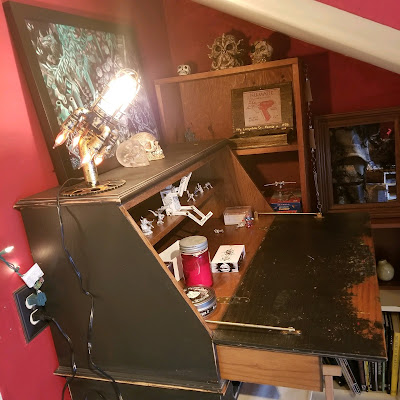
We'll start at one of two desks. In all honesty, I don't use this desk much. Once in a while, when the mood strikes. It's nice to have options, I suppose. The rocket lamp in the photo obscures the original painting I bought, which is one of two covers for The Umerican Survival Guide. This is the original oil painting of the "Delve" cover, and it's a beaut. You'll also see some of my unpainted miniatures (mainly Call of Cthulhu nasties and martians), a candle, my deck of Moebius trading cards, a can of Crazy Aaron's Thinking Putty (magnetic version) for meditative purposes, and my tarot deck by Micah Ulrich (which gets a lot of use in my writing, believe it or not). There are some skulls and spaceships back there (dunno if you can see my space battleship Yamato or not), and probably lots of other inspirational knicknacks I'm forgetting because I'm not in that room at this moment.


You can probably see why I don't often write here. This used to be an attic, and the ceiling is very low here, even for a shorter than average guy like me. It's cozy.

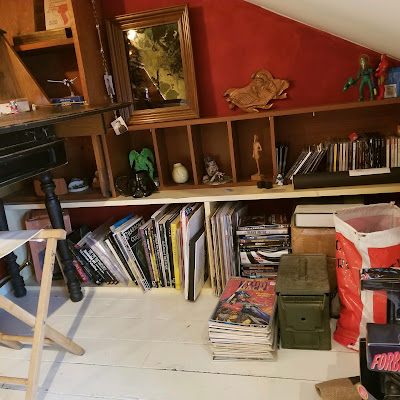
Here you can see my collection of art books, my very small (and very particular) vinyl collection, my very small and very particular stack of DVDs, my very small and very particular stack of CDs, my collection of Grimjack comic books (No, I don't have all of them. If you have some you want to sell, message me!), and sundry other knicknacks, some of which are original art made by me or my kids or my wife's students (when she taught - she's happily retired now). Also, a chain of pictures of my kids from when they were much younger, and an antiqued mirror, which I should buy more of . . . The antiqued mirror plays tricks and causes illusions and visions that I use in my writing; a sort of hallucinogenic scrying stone. To the right, outside of the picture, are a couple boxes of my novel Heraclix and Pomp (softcover and hardcover). If you're interested in getting a signed copy from me, message me. 


Turning clockwise, you'll see my shelf containing two rayguns, an incense burner hand-carved by famed Poppet artist Lisa Snellings, and a ceramic piece of a face I did in high school (I'm still pretty proud of that guy). Some books, of course - too many to list here - are under that. And at the bottom, a print by Valin Mattheis (who also did the cover art for my book The Varvaros Ascensions). 


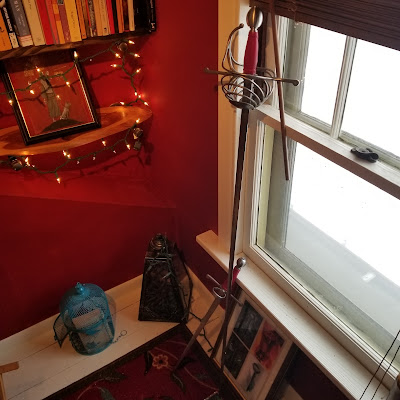
Just below that is "sword corner" where I keep my Darkwood armory rapier and dagger. There's also a lantern there and a birdcage containing a paperback copy of Edgar Allen Poe's The Raven, along with over a dozen origami ravens a friend made for me. They are hard to keep fed, but I am rather fond of them.


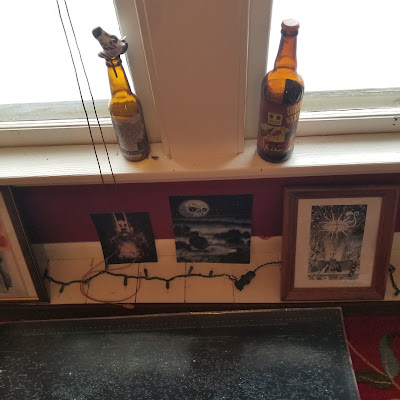
Looking to the right of sword corner, I have couple of bottles sitting on the window sill over some art. I don't drink, but the bottle on the left was a homebrew rootbeer with the Heraclix and Pomp cover on it that my agent brewed up years ago for the H&P release party. Next to that is an empty bottle of a beer concocted by the band Droids Attack. I used to work with Brad, the lead singer, and he gave me this. If you're into heavy music, definitely check them out!


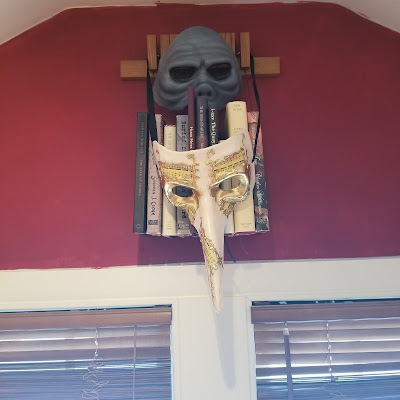
Looming above this is a wall-mounted book hanger loden with some of my favorite books. A venetian mask and the face of one of the doctors from the Twilight Zone episode "Eye of the Beholder" keep vigilant watch - except on Halloween when one or both of them attach themselves to my face. 


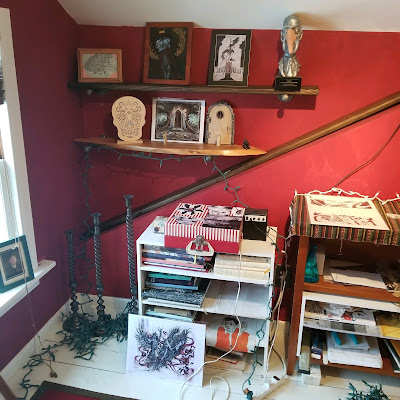
Lots of art in this next area. A picture of my wife on the left windowsill keeps me in line(!), while candles, bookshelves, and my old record player (more on that in a moment) underlie shelve containing a drawing by myself, more Valin Mattheis art, my World Fantasy Award 2003 trophy (replete with pinocchio nose on Lovecraft's face), a piece of art by my friend and artist Doug Kovacs, a day of the dead color-shifting lamp thingy, a faerie door made by an old co-worker, a couple pieces of statuary by Green Man Gate Keeper, and a bronze piece of an astronaut reading a book I bought from Vince Villafranca


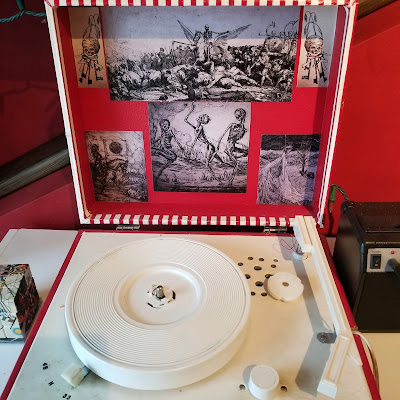
Now, forgive an aging man as he grows nostalgic. After my parents died, I was going through their stuff and found my old record player. I'd listened to records on this thing from about 1979 to the late '80s, when I left home. Because of the nature of that departure (long story), I didn't take this with me. Besides, I had another stereo that went with me then (and was subsequently stolen from storage in the early '90s). But this machine, along with a really crappy cassette player/radio/boombox, was the machine on which my love of music was forged. I'm guessing that the first record I played on here was my 45 RPM of The Hobbit, you know the one, with the Glenn Yarbrough song and all?

So, when I found this in my parent's house, I honestly cried. I had so many memories, so many hours tied up in this thing. I can't overstate its importance in forming my life. It really is that meaningful. 

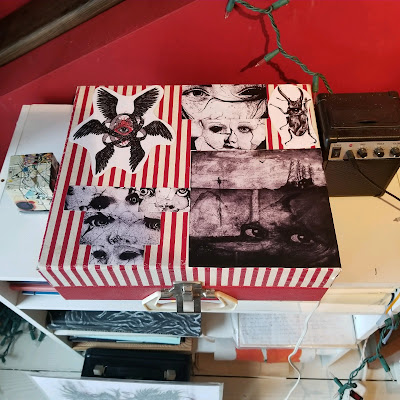
But it needed an update! So, I learned to do decoupage, found some awesome dark imagery, and redecorated it. I might do some more work on it, who knows? And since vinyl is now back in style, I've picked up a few select records to play on it, crappy, scratchy audio and all. A few weeks ago, I spent hours just listening to some of these records and watching the disks spin. I had forgotten how much of a calming meditative exercise that can be (even when listening to heavy music). That's some inexpensive therapy there!

Incidentally, if I used your art on my decoupage, I'm not making any money off it. Nor am I making any money off this blog. Please don't sue me, okay? Thanks.


Now, on to the writing corner. Let's see there's another original piece of Doug Kovacs' art (from The Cthulhu Alphabet - you'll see the printed version in the book at 3:46 on the video I've linked), a sculpture one of my sons made, some medieval coins (yes, genuine), and an original piece from Valin Mattheis that I bought just a few months ago. The boxes are a box of old Analog magazines I need to read through (there's a writing notebook and a handwritten letter that Rikki Ducornet sent me years ago, when we were in correspondence), and a box of slides from my parents with a slide viewer atop that. Then a tube of handmade marbled bookend paper that I'm saving for a project. There's an edison lamp, another piece of original art on the wall (can't remember the artists name - something Jamaica, I think), a wooden kaleidoscope-lens thingy, and a four foot high glass vase/beaker filled with Christmas lights. Then there is my writing desk. My actual writing desk.


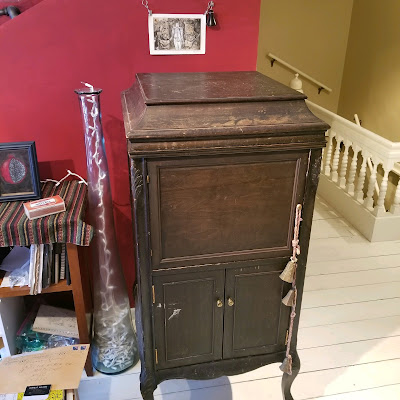
Yes it's an old gramophone case. Someone had put it out on a curb in Madison and I knocked and asked if it was really available. They said yes and I stuffed that puppy in my car ASAP!!! All the guts are missing. You can't play records on this. But the case is solid and complete. I have no idea why they put it out on the curb, but I'm not asking. This is the perfect standing desk for writing. And under the hood . . . 

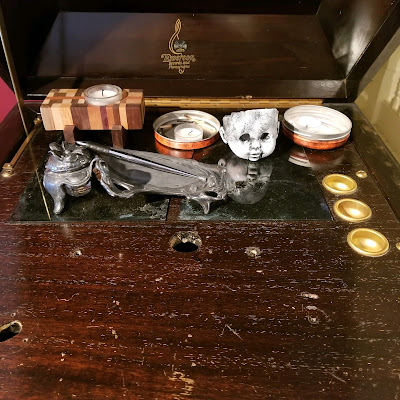
This is what faces me when I'm ready to write. Lots of candles, including a creepy baby doll candle holder (I need more of those), a cool wooden candle holder my wife bought for me, and a couple old Reuzel cans that make handy candle holders that reflect a lot of light. Then there's the inkewell/penholder of art nouveau design (I have no idea if it's actually from that era, but I wouldn't doubt it, given the style and craftsmanship). Oh, and there are a couple shards of antiqued/distressed mirror under that, as well. in the cabinet underneath are plenty of cheap composition books, some pens, some incense - you know, all the necessities of writing.

And there you have it: my new writing area. Now that I've gone on an on about it, I'm going to stop writing about writing and actually do some . . . writing!

_________________________________
If you like my writing and want to help my creative endeavors, ko-fi me at https://ko-fi.com/forrestaguirre. Every little bit is seen and appreciated! Thank you!!


Monday, June 14, 2021

Sacrum Regnum II


Sacrum Regnum IISacrum Regnum II by Daniel Corrick
My rating: 5 of 5 stars

After being entirely blown away by Sacrum Regnum I, I was excited, but a touch guarded, when approaching this second volume in the series. While I saw a lot of names that I normally love, I was wary of the sequel, worried that it would either fall flat or "jump the shark".

My fears were completely unfounded. This second volume absolutely lives up to the promise of the first. My only disappointment is that a volume three was never compiled.

But why focus on what might have been, when we can focus on what is? And this volume is absolutely brilliant! By that, I don't mean bright and shiny, oh no, this volume is dark, in places very dark. I mean smart, intelligent, dignified, and, dare I say it: literary? It is, with the first volume, a Symbolist master stroke, and a worthy bow to the Symbolist and Decadent literature of the past, without being enslaved to it.

My praise for Sacrum Regnum II does not, however, mean that I felt entirely comfortable with it. Not by a long shot.

For example, I feel, as the kids say these days, "seen" after reading John Howard's tale of a slightly neurotic numismatist, "Into An Empire". Yes, I saw myself in the protagonist on several levels. John, how did you get into my head? This hits too close to home for this mildly neurotic wannabe numismatist. I even restrict myself to pre-1776 Germanic state silver coins in a similar manner to the story's main character, Payton. Seriously, I feel naked before your pen. That is to say, I could completely immerse myself in Payton.

Next, "The Human Cosmos" is Charles Wilkinson at his best. Strong echoes of Italo Calvino ring throughout, and that is some of the highest praise I can give a story. An ambiguous story (in the best way possible) of fabulism that ends poised on the knifes' edge of dark and light. I am reminded of my favorite quote by Calvino: I am a Saturn who dreams of being a Mercury, and everything I write reflects these two impulses. Wilkinson hits both sides of that balance at the same time.

Colin Insole's "Dreams from the Apple Orchards" (which I have read before) is an excellent example of psychogeography, where the landscape itself pulses with the negative energy of those who lived their before. The setting is the character, the setting that has seen so much of corruption and baleful intent. A thin veneer separates the trappings of civilization from the base layer of chaos beneath.

I had wanted to read Thomas Strømsholt's fiction before, but this was my first chance to do so. "Szépassony-völgy" packs an unexpected gut punch. Strømsholt layers a seed of utterly mindless random brutality under a veneer of mythic legend and romantic nostalgia and longing for past love. The contrast is striking and invokes a strong existential response in the reader, leaving one's head reeling. Powerful.

An entire section about author Quentin S. Crisp, replete with an interview with the author and a piece of short fiction, entitled Crispiana opens a window into the brain of the author, at least what he's willing and able to share about his brain. An interesting peek at an author whose work I quite like. As with the first volume of Sacrum Regnum, I love the collection of fiction, non-fiction, poetics, and reviews. An eclectic selection, but with it's own firm voice.

The Poetics section in this volume contains work by Mark Valentine, Loha Connell, and Bethany van Rijswijk, along with a translation of Stefan Grabinski's "Red Magda".

Ah, kids. Can't live with them, can't bury a fire hatchet in their forehead when they are possessed by fiery arson demons without feeling some degree of guilt. Watcha gonna do with "Red Magna"? This brilliant (pardon the pun) translation will lodge itself in your brain, just like an axe. The effect is no less painful. I did warn that some of these works go to very dark places.

Mark Valentine turns his always-keen critical eye on novelist Claude Houghton in his article "The Stranger Who Opens the Door - The Novels of Claude Houghton". As is usual, the reader is sent off scurrying to find the work of another forgotten author. Valentine is an archaeologist of literary treasures that need to again see the light of day. This essay is no exception!

Martin Echter's essay on the aesthetic principles espoused and practiced by Hanns Heinz Ewers is an exemplary examination of not only the writer's oeuvre, but of the undergirding philosophy that drove Ewers' work. A marvelous examination of an incredibly underrated author.

I had read, with interest, Mark Valentine's essay on Mary Butts from his collection Haunted by Books, whom I had not heard of to that point, with interest. Now, with Nigel Jackson's essay "Obscene Ikons: Desacralization & Counter-Tradition in the Work of Mary Butts," I have felt compelled to add her complete short fiction to my To-Be-Read list. For those who know me well, you know I don't add things to my TBR list lightly. I curate it a great deal (and am often chided for how few books I have on my TBR list on Goodreads). So, yes, I expect something special from Mary Butts' work.

. . . and the review of Georg Trakl's The Last Gold of Expired Stars in the book review section cements my decision to buy that book, as well. Thankfully, it was already on my TBR list.

There is some high praise for The Ten Dictates of Alfred Tessler by D.P. Watt. But isn't Watt always deserving of high praise? Yes. Absolutely.

A critically-constructive eye is placed upon Alex Miles' debut weird fiction collection The Glory and the Splendour. I haven't read said collection, but the assessment here seems fair, yet firm: there's potential here, but it needs work. It's strangely refreshing to see a review that is measured and doesn't overstate the work being reviewed, but sees raw potential.

Another balanced, insightful review, this time of Quentin S. Crisp's All God's Angels, Beware! clearly explains what it is that makes Crisp's work tick. I have yet to see a clearer explanation of how he does what he does when he writes. It is unique, quirky, weird, and charming at the same time. It has heart and this essay shows how and why this is done. An important essay on Crisp's fiction, to say the least!

When I read through the list of forthcoming books here, I am reminded of how good of a year 2013 was for literary fiction of the sort that I love. Halcyon days, to be sure. Hopefully, they'll return. In some small way that's happening, but we need an updated equivalent to Sacrum Regnum or an outright resurrection of the same to really seal the deal, as far as I'm concerned. Where is our Sacrum Regnum? And here I go again, pining for the past by longing for the future. I'm tempted to try to make it happen myself. It's been a while since I've edited . . . hmm . . .

View all my reviews

__________

If you like my writing and want to help out, ko-fi me at https://ko-fi.com/forrestaguirre. Every little bit is seen and appreciated! Thank you!

Thursday, August 6, 2020

Leviathan 4 Hardcovers

In my move, I have discovered a box of Leviathan 4 anthologies in hardcover. Leviathan 4 followed the World Fantasy Award-winning Leviathan 3 anthology. These are going minimally for about $15 + shipping a piece new on the Amazon 2nd hand market. I'll let mine go for $12 a piece and pick up media mail shipping in the Continental USA. And, if you like, I 'll sign it, since I edited it. Great stories by Jay Lake, Stepan Chapman, Michael Cisco, Ben Peek, Catherine Kasper, KJ Bishop, Darla Beasley, Ursula Pflug, and Tim Jarvis. This is a showcase of the weird and fantastical, all about cities. Ping me and get a copy - I really want these to get out of my writing area so I have more room to create new stuff! Let me know if you want yours signed. And would you just look at that cover art? Rowr!

710737

Wednesday, July 4, 2018

The Children of Gla'aki: A Tribute to Ramsey Campbell's Great Old One

The Children of Gla'aki: A Tribute to Ramsey Campbell's Great Old OneThe Children of Gla'aki: A Tribute to Ramsey Campbell's Great Old One by Brian M. Sammons
My rating: 3 of 5 stars

When I began this book, I took the following note: "On a bit of a Lovecraftian kick, but it will soon pass. I won't say I'm burning out on it, but I'm . . . more wary than I was in the past."

After reading this volume, maybe I'm leaning more toward the burnout stage. A few stories herein have kept me from the brink of just saying "Quatsch" to everything with the descriptor of "Lovecraftian". But there was a fair amount of dreck. On average, was it worth reading? Yes. The really great stories in here are really great. Perhaps you need the bad to highlight the good, like a diamond atop mud. But having to clean off all the muck is getting old. Perhaps I had high hopes, because I enjoyed Ramsey Campbell's The Inhabitant of the Lake & Other Unwelcome Tenants, despite his self-reproachment for the immaturity of some of the stories. Maybe that's the problem - writers taking cues from an unstable source. Some of these writers were able to fashion gems, others cheap baubles, still others, broken, useless shards.

Nick Mamatas's "Country Mouse, City Mouse" was, as I expect from Mamatas, well-written and dipped its toes in explorations of tolerance and diversity. It expands the "universe" of Campbell's work by extending its reach. But I didn't find it all that horrific, outside of the fatalism expressed at the end. Three stars to this tale.

John Goodrich's "Tribute Band" isn't the sort of story I normally like. But what should have been a hackneyed story of rock and roll gone wrong was actually really enjoyable. It's a little "cute" and somewhat predictable, but the voice is distinctive and likable. The balance between folksy structure and challenging vocabulary is excellent. I just plain found myself drawn in. Three stars. Better than I would have guessed!

Robert M. Price's "In Search of Lake Monsters" is as pulpy as they come, with all the trappings one would expect. Then again, it had all the trappings one would expect . . . Still, I enjoyed it a lot. Four stars full of guilty pleasure. Sometimes you just can't really explain why you like a story, you just do. That's the case here.

While Pete Rawlik's "The Collection of Gibson Flynn" has an intriguing twist ending, the buildup paid so much homage to Lovecraftiana that it read like one giant inside joke, a pastiche of itself, mythos masturbation. The ending saves it from the realms of hackneyed mediocrity, but only just. Three stars, barely.

Outside of the intriguing title, W. H. Pugmire's "The Secret Painting of Thomas Cartwright" was uninspired and not nearly as intriguing as the title. Two forgetful stars.

Edward Morri's"I Want to Break Free" is a lesson in tension: the push me, pull me between cosmic forces and self-will, the intestines of genius and insanity, even the fence-hopping from pop culture references to literary stylistics. This story has VOICE. Punch. Chutzpah. Up to this point, the best story in the anthology, and it's not even close. I want to read more Morris! Five stars.

I'm admittedly out of touch with the weird fiction world. So this was the first Scott R. Jones story I've ever read. I am impressed. "The Spike" is a deep exploration of the alien-ness of, not Gla'aki, but a piece of Gla'aki. It's like Roadside Picnic but with the horror turned up to eleven. The writing is sparse, punchy, yet descriptive. Five stars.

I am certain that Thana Niveau must have better work than "The Dawning of His Dreams," given her publication history. This . . . I don't know what to call it, a story, I guess, did absolutely nothing for me. It's a hot mess. As an editor, I would likely throw this thing across the room. One star, because it was written. That's the best I can do.

William Meikle's "The Lakeside Cottages" featured a narrator that was too clever and self-aware by half. It read like a Call of Cthulhu session with a narrator who seemed to possess great knowledge of the Old Ones, which might be great for a recurring character, like an occult investigator, but didn't work in this one shot. Still, okay. Three stars for the three eyes of Gla'aki.

I have high expectations for Orrin Grey's fiction, and "Invaders of Glaaki" didn't disappoint. Yes, I'm a sucker for '80s nostalgia, and this story is full of it. But it takes things in a horrific direction. Imagine The Last Starfighter meets cosmic horror. I am not a big fan of second-person viewpoint, but it kind of worked for the story. I enjoyed this. Four stars.

Sorry, but Tom Lynch's "Scion of Chaahk" is a Campbell pastiche while Campbell is pastiching Lovecraft. I . . . just . . . can't . . . Maybe I'm just done with pulpy mythos fiction? Two stars.

Konstantine Paradias' "Cult of Panacea" is everything that Niveau's earlier story could have been. Yes, it's a history, but its presentation in the context of the story makes sense and forms a bleak, resigned picture of what it means to be a cultist of Gla'aki in the far-future wake of Earth's decrepitude and demise. It's rare to find a science fiction horror piece like this. It held my interest well. Four stars.

I think it's time to admit to myself that I do NOT like mythos pastiches, especially those that are trying to be funny, but are not very funny. Josh Reynolds' "Squatters Rights" just hit all the wrong buttons for me. I'm becoming leery of these Cosmic Horror Mythos-inspired anthologies. I'll finish this one. There have been some great stories here. But not this one. Two stars and my tastes are a-changin'.

Lee Clark Zumpe shows considerable writing skill through most of "Beneath Cayuga's Churning Waves," then ends flat. The ending was a disappointing deus-ex-machina, which could have been the ending to just about any detective thriller. It was as generic an ending as I could think of, like something right out of a "You Too Can Write Detective Stories" formula book. The story is still worthy of four stars, but the ending felt so tacked on that it doesn't deserve a fifth.

Despite a number of poor stories in here, some shine. Tim Waggoner's "Nature of Water" is one such. Simultaneously flipping the horror on its head and embracing it, this is a tale of horrific redemption. What could have easily been revenge schlock, Waggoner turns into an emotionally meaningful, yet terrifying end, deftly avoiding the obvious. Wonderfully written and full of pathos, I loved this story. Five stars.

That's three reality-show stories now. I'm tired of them. This one, "Night of the Hopfrog" by Tim Curran, claims to be the raw transcript of video for a ghost-hunter style show. But then where is all the parenthetical notation coming from? Who wrote these notes? The story would be more effective without them actually. Even then, with proper editing, I would only give it two stars. I never liked reality TV anyway.

The fiction ends on a strong note with John Langan's "Mirror Fishing," which subsumes Gla'aki in folk tradition that blooms into cosmic horror. The characters are wonderfully complex, from the young Pat to his tutor in the ways of Auld Glaikit, Lisa. The descent into the depths of Gla'aki's fractal-dimensional realm is amazing, and the folksy conceit refreshing. I enjoy those tales where human folk conception maps onto true cosmic horror in a sort of cargo-cult worship of those things that we cannot understand. This is a story that will stick with me for a while. Five stars.

Mathematically, I'm coming in at an average just above three stars. I'm rounding down to an even three, which seems about right. On average, The Children of Gla'aki is . . . average (despite the high praise Campbell heaps on ALL the stories in his afterword). The heights are really high: There are a few truly amazing stories in here. But the depths . . . well, Gla'aki himself will be well fed by some of these stories sinking to the bottom of the lake. I suppose some of the danger in editing such an anthology is that, in order to fill a word count and get readers, you might take a few pedestrian stories from "name" writers. I've never hewed to that philosophy myself, when editing. I only take the stories I love. If they happen to be "name" authors, that's helpful. But I also love giving the underdogs a chance. You have to start somewhere, right? Maybe at the bottom of the lake.

View all my reviews

________________________

If you like my writing and want to help my creative endeavors, ko-fi me at https://ko-fi.com/forrestaguirre. Every little bit is seen and appreciated! Thank you!


Wednesday, May 9, 2018

Looming Low Volume I

Looming Low Volume ILooming Low Volume I by Justin Steele
My rating: 3 of 5 stars

Back in the early 2000s, there was a proliferation of speculative short fiction anthologies, a couple of which I edited. It was a kind of golden age where the internet was available as a tool, but it had not yet been saturated by so much dreck; a time when an author (or editor) still strove to have their work published in hardcopy, but when electronic communication (mostly in the form of message boards) allowed one to get one's name "out there" without having to spend a mint doing it.

When I saw the premise and cover of Looming Low, Volume 1, my heart skipped a beat. Or, rather, my heart hearkened back to those days of yore when Leviathan, Redsine, Polyphony, Flesh & Blood, Earwig Flesh Factory, Indigenous Fiction, and many, many others were within easy reach, if you knew where to look. I knew that Sam Cowan's Dim Shores press had been attracting a bevy of "name" horror authors, as well, so I thought I'd take a chance, albeit a fairly "safe" chance, since I knew that a few of these authors were going to have quality work included.

Story by story, here are my notes:

This is the first story I've ever read by Kurt Fawver. "The Convexity of Our Youth" uses a Millhauserian voice to tell a tale of transformation of children into orange balls. The syntax is satisfying and on the paragraph-level the writing is spectacular. But the story itself just wasn't to my liking. Too bland for such mechanically great writing. Three stars.

A.C. Wise "The Stories We Tell About Ghosts" was overly predictable, some of the kids in the story didn't speak like kids, and the plot was lackluster. The writing was technically sound, but had no real distinctive voice, nothing to set it apart. Two very disappointed stars.

Michael Wehunt's "In Canada" is a disturbing peek into the innocent mind of insanity, especially regarding questions of identity. It's a little predictable, but provides an excellent glimpse into the inner world of one gone mad vis-a-vis an outer world gone mad. Four stars.

As I've come to expect from Brian Evenson, his story "The Second Door" is exceptional. My favorite so far. Mix a vaguely post-apocalyptic setting with a narrator who may be slipping from reality, or, possibly reality is slipping away from him (or, perhaps, this strange reality is very real), then throw in the quandary of a language breakdown, and you've got a recipe for a beautiful disaster. Five stars.

Mill's "The Christiansen Deaths" was pretty standard fare, with an ending paragraph that showed a reaction that just seemed to accept the outre as very matter-of-fact. This lessened the impact of the story greatly. Still, it was well told. Three stars.

Betty Rocksteady's "Dusk Urchin" is a surreal (in the classic sense of the word) horror that relies on the unsteady mind of the main protagonist. The atmosphere is excellent and the fragility of the main character makes for an excellent unreliable narrator. At times the voice felt a little forced, but maybe that was the intent of the author. Four stars.

"The Gin House, 1935," by Livia Llewellyn, is the tale of Lillian, whose life, badly lived, becomes a transformation back into . . . Ah, ah, ah! No spoilers. Five stars for this tricky tale.

"This Unquiet Space" did absolutely nothing for me. Just nothing. Two stars.

Sunny Moraine's "We Grope Together, and Avoid Speech" is a plotless sketch, though sketch isn't the right word - perhaps "tableaux" about walls of mouths. It's as weird as it sounds, and creepy, both because of the delight the narrator takes in the description of these strange . . .entities, and because of the devious invitation at the end, where readers become implied characters in the not-story as the fourth wall itself melts away. Five stars!

"Heirloom," by Brooke Warra, is a morbidly poignant story about twins literally separated at birth. While separated, though, they are never fully apart. And that is the horror of it all. Weird folk horror. Four stars.

There's more than a little absurdism in Lucy A. Snyder's "That Which Doesn't Kill You". But it's not so ridiculous that it strays into pure silliness. Four stars.

Codependence, conspiracy, and slippage between realities dominate Simon Strantzas' outstanding tale "Doused by Night". There is a lot of density to this packed short story, with a whole unseen plot-between-the-lines undergirding the surface plot(s). Five stars.

Kaaron Warren's "We Are All Bone Inside," while well-fleshed out (readers will note the irony of that phrase), didn't do a lot for me. Three stars.

Lisa L. Hannett's "Outside, a Drifter," is not my usual fare. I've never been a huge fan of "body horror," but this story can't be pigeon-holed that easily. It is a strange sort of dark fantasy story about love and sacrifice and business. The folksy cadence of the story is an acquired taste, but I found it satisfying in the end. Four stars.

Lristi DeMeester's "The Small Deaths of Skin and Plastic" was strange and creepy, but lacked substance. Three stars is all I can muster for this story.

Scott Nicolay's "When the Blue Sky Breaks," outside of some clever syntactical moves, was decidedly "meh" for me. A rather weak story with linguistic potential. Two stars.

I admit it: I'm a bit of a prude when it comes to my literature. So I'm not big on erotica or sex scenes. But Craig Laurance Gidney's "Mirror Bias" is so incredibly well-written, I'll give it a pass. A big pass. A five star pass. The writing is exquisitely beautiful. I will be seeking more of Gidney's work, for sure. He is a masterful wordsmith.

"Boisea Trivittata" by Anya Martin was good. But I've seen this trick before. Ann VanderMeer and Jonathan Carroll both did similar things many years ago, and they did it better. It wasn't a bad story, just a tiny, tiny bit hackneyed (although I suppose that using the word "hackneyed" means it's been done many, many times before). If you haven't read VanderMeer's or Carroll's stories, then you might like this better than I did. Three stars.

Michael Cisco's scintillating "Rock N' Roll Death Squad" is a study in ultraviolence that belies the supposed exhiliration of mass murder. It's a bit like seeing A Clockwork Orange from the inside out, but lacking pathos - a horrifying thought indeed! Unfortunately this also means it doesn't really connect enough with the reader on an emotional level, though it explodes in the brain, more jazz than blues. Four stars.

"Alligator Point," by S.P. Miskowski has a cinematic sensibility. I could easily see this turned into a short movie. It's the sort of psychological tension-builder that Hitchcock would have loved. Four stars.

Jeffrey Thomas's "Stranger in the House" delves into the abyss of self-identity and its loss. It's a good story, well-written, but not as impressive as most of Thomas's work. For that, turn to The Endless Fall and other Weird Fictions. I hate to do this, because I really do love most of Thomas's work, but in this case, I can only honestly give three stars.

Christopher Slatsky's "SPARAGMOS" explores the shadows of dementia, family, and corporate evil. It's a disturbing, yet mildly comforting view of a dystopia and the mercy of forgetfulness. Four stars.

Richard Gavin's "Banishments" is an excellent foray into social media deception and its supernatural consequences. A very creepy story, I found myself thumbing back every couple of pages seeking more clarity on what had happened earlier. It might have been the piece-meal way in which I had to read the story (because: life), but it felt a little muddled at the beginning. Still fully worthy of four stars, though!

One of my favorites in this anthology, "The Sound of Black Dissects the Sun," by Michael Griffin is focused on dark ambient music (which I listen to a lot) and the occult. It's a reality-bender with a narrator that I felt some sympathy for, which might say some disagreeable things about me. Flattery aside, the pacing, atmosphere, and voice were just about perfect. The story "fits itself" well. Five stars.

I admit that when I started Nadia Bulkin's "Live Through This," I was underwhelmed, at first. By the end, however, I found myself swept up by this story of communal guilt in the face of the void. This was a long, slow burn sort of story that lasts, with a very satisfying character arc and a sort of folk-horror creepiness throughout, but folk horror from the inside. Well worth the read and well worth five stars.

Gemma Files' "Distant, Dark Places" is everything I expect a Gemma Files story to be: well-researched, with characters exhibiting a range of human emotions, and conspiracy-horror on a cosmic scale. You'll never look at the moon and stars the same way after reading this. Four stars.

On average, that's about three stars. And, though the book came with a beautiful bookmark and cardstock poster of the cover, I'm not inclined to bump it up. Bulkin, Griffin, Gidney, Strantzas, Moraine, Llewellyn, and Evenson have produced some outstanding work here. And many of the other stories might be five-star tales, in another reader's eyes. But the lows were, well, pretty low. And while I'm certain that other readers will look at my own edited anthologies and think that some of my selections were suspect, at best, I have to stick to my guns. Perhaps my taste has changed a little. Or maybe it hasn't changed at all, and it's just been that long since I've seen an outpouring of the sort of thing I love. In any case, I can't let nostalgia blind me.

That said, this anthology has encouraged me to take up editing again. Things are still in the nascent stages, but plans are afoot. Dark, nefarious plans . . .

View all my reviews

________________________

If you like my writing and want to help my creative endeavors, ko-fi me at https://ko-fi.com/forrestaguirre. Every little bit is seen and appreciated! Thank you!