Friday, August 1, 2014

Perdido Street Station

Perdido Street StationPerdido Street Station by China MiƩville
My rating: 4 of 5 stars

I admit to being a bit inured to the "new weird". In fact, I'd say the new weird . . . is getting old. Strangeness for the sake of strangeness has lost a bit of its luster. I've read, and written, plenty of fiction in this vein. That's not to say that it's atrophied in my mind - I still appreciate the bizarre, but some of it has become so self-referential as to be an inadvertent pastiche of itself. The same can be said of the "steampunk" ouvre. I've argued before that the entirety of the steampunk movement is all a bunch of window-dressing with little punk about it. Maybe I'm getting curmudgeonly in my middle age.

But that doesn't mean I can't enjoy great writing. And this is what we have here, a clear case of fantastic writing . . . to a point. There is too much of a good thing. Unlike many people I know, I like to be forced to reach for the dictionary once in a while. In fact, while reading short stories, I tend to prefer those stories that cause me to reach for the dictionary frequently. But I do sometimes grow tired of the overuse of the same uncommon word again and again.

Years ago, I had put together a short story that I was awfully proud of. I asked Jeff VanderMeer, my co-editor on the Leviathan 3 anthology, if he would indulge me and take a pass through the story. It was very early on in my writing career, really one of the first short stories I had ever completed. Jeff was gracious and took a look at it.

I've never seen so much red ink on a page. He might as well have painted it with a broad red brush. Jeff had hacked and slain "my baby," . . . and I am grateful for that, to this day. He did an incredibly thorough job of pointing out the problems with this story, and I used it as a sort of reference text for many years, showing what *not* to do in a short story.

Needless to say, this story has never seen publication.

One thing that stuck out to me, and that I clearly remember (that paper is buried in my personal archives somewhere now), was Jeff's increasing frustration with my use of the word "myriad," which I used . . . well, a myriad of times (not really, but you get the point). Finally, after having marked the appearance of this word (and it's sometimes-improper usage), he wrote "You have got to stop using that word!" And he was right.

China Mieville has much the same problem in Perdido Street Station. Frankly, his fascination with the word "furtive" got in the way of the story. After the first few times, I found myself actually stopping reading whenever I ran into the word. It would cause me to pause and reread the sentence. It grew in my head, unwanted, till I felt it would explode out of my frontal lobe. I found myself hating that word, and several others like it that were misused or downright abused throughout the text. I swear, if I might just cry the next time I read that word.

Now that I've got that off my chest, I can move on . . . I think . . .

Perdido Street Station has as much weird as you'll ever need in a book. There are strange, alien creatures, sentient constructs programmed through the use of punch cards, and humans who have been forcibly reconstructed, or "remade" into bizarre agglomerations of human and animal body parts. The technology of the society is based on the harnessing of steam and thaumaturgic energies, and has a decidedly Victorian "feel" to it.

But as I have argued in the article linked above, there really is nothing "punk" about "steampunk" in it's most popular incarnations today. At least I had not seen much in the way of what *I* consider punk (you can beg to differ - in fact, that would be very "punk" of you) in the steampunk movement, outside of aesthetic considerations and trappings.

Until now.

Yes, Perdido Street Station is rife with the nihilistic attitudes that so many people associate with "being punk". But that's not punk to me, or at least that's not the sum total of punk. To me, punk is anarchic, transgressive, smart, witty, and has a strong bent for "making do" with what's at hand. It was a movement that started primarily among the poor before it was co-opted by society at large. It's not about pink mohawks or leather or sneering Billy Idol wannabes. It's about an attitude.

And this book has attitude.

Say what you will about the mildly convoluted plot, the gratuitous use of Deus ex Machina, the absolutely un-necessary introduction of such un-needed elements as the Handlingers, and multiple infodumps (some of which were, it must be admitted, cleverly-disguised and introduced). Yes, the novel has problems. But despite all that, I have to say that this is the most "punk" of the supposed "steampunk" novels, stories, video-games, and movies, that I've encountered.

The street-level political, nay, anarchical sentiment and actions that set the city of New Crobuzon into chaotic motion, are clearly "punk" in their nature. The transgressive relationship between Isaac and Lin is effective in causing the reader to question, almost from the beginning, the prejudices which exist in each of their own cultures, but which they have left behind. The DIY science by which Isaac discovers the secrets of "Crisis energy," smacks of hard science being done on the back cover of a punk zine. In total, this novel is the first that I've encountered that gives due respect to these truly "punk" notions and attitudes.

And though there are several ways to try to encapsulate what Perdido Street Station *is*, I'd argue that one of the more compelling interpretations of the book is that it is, more than anything else, a Baedeker of the city of New Crobuzon, or, possibly, a Baedeker of China Mieville's brain. In this book, the city itself is a character whose moods and whims affect the characters who live within it. Though they can affect the city in some limited ways, ultimately the city contains them, constrains them, and influences their actions. They can fight against the city, but there are always repercussions for doing so. The characters' environment does not fully form them, but it does inform them.

This is why I rate the book, with all it's warts and scars, as highly as I do. Mieville's imagination is a force to be reckoned with. His political convictions and intellectual strength seep through the work (particularly when he is channeling Hofstadter or making a sidelon homage to Foucault, by naming the mayor "Bentham"). But this cleverness seems perfectly natural, rather than a pretentious showing off. Perdido Street Station is not as pretentious as its more "literary" cousins, but it is witty, in a veiled sort of way. A truly . . . punk sort of way.

View all my reviews

Monday, July 7, 2014

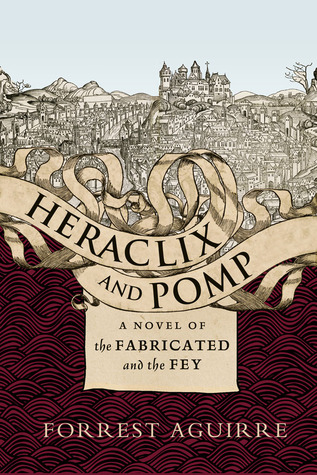
Goodreads Book Giveaway, Heraclix & Pomp!


Goodreads Book Giveaway

Heraclix & Pomp by Forrest Aguirre

Heraclix & Pomp

by Forrest Aguirre

Giveaway ends July 28, 2014.
See the giveaway details at Goodreads.
Enter to win

Noble Knight Games

Sometimes coolness is right under your nose and you don't even know it. Noble Knight Games, in Janesville, WI, is about a half hour south of me. Since I had a fairly lengthy hiatus from gaming right after graduate school, I didn't learn about the shop until a few years ago. I've been meaning to get down there forever, but, you know, it's really easy to just order stuff online.

Mea Culpa.

This is the end of my summer vacation. After traveling out west for a week, I had one extra day in case we ran into any difficulties on the way back. Thankfully, nothing untoward happened, and so I thought to myself: "Self: You need to get down to Noble Knight Games and check it out." And I did.

Great decision.

Now, in the interest of full disclosure, I had business to attend to down there. My novel, Heraclix & Pomp, will be released in October, and I wanted to get down there to give them an Advanced Reading Copy of the book to see if they'd be interested in carrying it. I spoke on the phone with the manager, Rick, who said, essentially, "no promises, but sure, bring it on down". Now I had the impetus and an excuse.

So I drove down, got lost (yeah, in Janesville, I know - I have a penchant for getting lost. It's a gift.), and finally found myself there. Seemed like a pretty big building for a gaming store, compared to other gaming stores I've been in.

As I walked in I stood face-to-face with a suit of platemail which was, thankfully, empty. He had a longsword, I had my keychain pocketknife. Not fair!

After recovering from the shock of seeing a full suit of armor in the entryway, I had two doors to choose from, one right, one left. Like the bungling adventurer I am, I chose the right door, which ended up being the wrong door. If I would have looked, I would have seen cardboard boxes piled up against the right door. I'll never be a good rogue walking into traps like that, I thought. Must be their storeroom.

So I went through the left door . . . and was surprised by how small the footprint was. Granted, they had as much or more out as any other gaming store. But there isn't any game space, which I've grown accustomed to with gaming stores. Not that this is a weakness, mind you - I prefer gaming at home over gaming in a shop. But they had a lot packed into a small space. I had explored Noble Knight's online presence and was aware that they had a lot of used games, minis, etc, but I didn't see a lot of that. Most of the games I saw out were new, with a couple of notable exceptions (like the Lamentations of the Flame Princess Grindhouse Edition box set that stared me in the face).

I was introduced into the office of the manager, Rick, who was gracious and professional. He took the proffered copy of Heraclix & Pomp, then asked that I be sure to remind him about it when it is published. We then chatted a bit about business (something I know a little about), ROI, inventory management, that sort of thing. And then he shocked me by taking me behind the scenes to see that what I thought was a storeroom was actually an entire warehouse filled with games.

Holy crap.

You've never seen so many games in one place.

You haven't.

And that was only one of the warehouses. There was another one down the road that was even bigger.

Rick took me on a little tour of the warehouse attached to the brick and mortar store. There were aisles and aisles of games available. I saw a boxed set Azhanti High Lightning right next to a boxed set Fifth Frontier War for Traveller. I can't tell you how many year's it's been since I've seen Azhanti High Lightning. I almost cried. I also spotted a boxed set of Striker, Gamma World modules, and a smattering of other goodies as we quickly passed through. If I were allowed to loiter, you would find me as a skeleton somewhere in the stacks several months from now. But I knew I was on Rick's timeline, and he had a job to do, so I moved through quickly.

After being stunned by this, he then took me into the backroom to the backroom, which is where all the unsorted games were. There has to be thousands, nay, tens of thousands, of books, boxes, and blister packs in there. He frankly doesn't have time to sort it all. In the first aisle, a couple of things popped out at me. Remember Squad Leader? There were at least three copies within five feet of each other. And I saw the excellent Avalon Hill boardgame of Starship Troopers, which I had played with friends around 30 years ago. The memories just started flooding in.

And that was all from just standing at the corner of the unsorted warehouse. The aisles had to go back 60', and I forget how many there were, maybe ten or so? It was immense. No wonder Rick's behind on sorting.

I thanked Rick for the tour and proceeded to their web-kiosk to pick up a couple of figures for a Weird Western thingy I've been thinking about for a while. I picked up a formless Cthulhoid nasty and wanted to get the Boot Hill six-shooter figures they had, but they were at the other warehouse and the other warehouse employees had already left for the day. So the guy at the desk said he'd have them shipped to me . . . at no extra charge.

You're kidding me, right?

Nope.

That is what I call customer service! I'm impressed. I'm hooked. I'm all in. Noble Knight Games absolutely rocked my world.

Kudos, guys. You freaking rock!

________________________

If you like my writing and want to help out, ko-fi me at https://ko-fi.com/forrestaguirre. Every little bit is seen and appreciated! Thank you!

Monday, June 23, 2014

Dungeon Quest, Vol. 1

Dungeon Quest, Vol. 1Dungeon Quest, Vol. 1 by Joe Daly
My rating: 4 of 5 stars

Beavis and Butthead meet Diablo II, but with brains, in this gonzo-stoner quest starring Millennium Boy, Steve, Lash Penis, and Nerdgirl the Archer. Millennium Boy sets off on an adventure to cure his boredom, while the others join him for no other reason than that they have nothing better to do. Eventually, they find direction from mystic guides and the discovery of portions of artifacts such as the cover dish for the Atlantean Resonator Guitar (found in the sarcophagus of "the infamous pirate, heretic, and sodomite, Mondo Piri") and the Penis Sheath of Disturbance. Hopefully, by now, you've figured out that this book is not for children. If not, put the down the Brometic Pipe of Awareness and the Banky of Swazi Skunk Weed and let *them* do the adventuring. You're probably better off just sitting in your mom's basement playing video games, okay?

View all my reviews

Thursday, June 19, 2014

The ARCs Have Landed!

The ARCs for Heraclix & Pomp are here at Casa del Aguirre. Now, fair warning, the cover for the ARC is a little different than the cover for the finished work. It's a hint of things to come. Think of it as readerly foreplay. I've taken some images, which I'll show below, but keep in mind that I'm still working with a dumb-phone with a crappy camera. The central image of the cover is a little faint in the photos, but, hey, it's faint on the real thing, too. Subtle. Dignified. And stuff. You can preorder the book through your local bookstore or, if you don't have a local bookstore, you can preorder the hardcover for 25% off right now at Amazon. Either way, get your copy! Our release date is now October 14, so there's plenty of time, but the book distribution services really like it when people preorder. Still not sure about this whole thing? Go read an early review of the book here and an interview with yours truly here. If historical fiction and fantasy are your thing, and if you like the writing of Gene Wolfe, I am told that you will really like this book.

Here is the cover:


Sorry for the glare. I'm no photographer!


And here I am, ready to have a look inside:


Note the anticipation!

And here is the . . . WHAT THE. . .?!?!?!?

Oh, heck yeah!! I've got me a collector's item! Sorry, folks, but this copy I'm keeping for my grandkids' college funds! 

Alas, only the title pages, acknowledgements, and copyright page are upside down. Seriously, though. This is cool. And there's only the one! The others are all normal . . . well, as normal as you can get with my fiction. Which makes me . . .

Giddy like a schoolgirl! A schoolgirl wearing a Totenkopf who hasn't shaved for days and whose . . . nevermind . . .

____________________

If you like my writing and want to help my creative endeavors, ko-fi me at https://ko-fi.com/forrestaguirre. Every little bit is seen and appreciated! Thank you!

Tuesday, June 10, 2014

Gƶdel, Escher, Bach: An Eternal Golden Braid

Gƶdel, Escher, Bach: An Eternal Golden BraidGƶdel, Escher, Bach: An Eternal Golden Braid by Douglas R. Hofstadter
My rating: 5 of 5 stars

If I were clever enough, I would write this review as a fugue. This is the formal structure that Hofstadter uses throughout Gƶdel, Escher, Bach. Whether the whole book is a fugue, I'm not smart enough to tell. But the fugue is used as a metaphor for layers of brain activity, thoughts, superimposed over the “hardware” of the brain, the neurons.

In fact, though I would recommend starting at the beginning of the book, I suppose one might begin anywhere and read through and back again, a'la Finnegan's Wake. No, the book isn't designed this way, but considering that I couldn't discern a solid central idea until page 302 of the book, and that this was only one of several theses in the book, I wouldn't be surprised if it proved possible to begin anywhere.

The idea presented there is “To suggest ways of reconciling the software of mind with the hardware of brain is a main goal of this book.”

The question is, does it succeed?

I would argue that it does not.

And it does not matter.

There are some works, such as Giorgio De Santilliana's Hamlet's Mill or Daniel Schacter's Searching for Memory that are so vast and all-encompassing that it is difficult to pin down one central thesis. These are the kind of works that you might not understand in your lifetime, the thoughts of a genius transposed directly to paper that, unless you are an equally-gifted person or a savant, you cannot hope to fully comprehend. Still, the threads and nuggets of gold that are spread throughout make it worth the time spent in the dark mines of incomprehension, if only to find that one fist-sized chunk of precious metal and appreciate its beauty set against the background of your own ignorance.

As far as I can tell, the book is really about intelligence, both human and artificial. Hofstadter does a lot of preliminary work priming the reader's brain with assumptions taken from theoretical mathematics and computer programming. But don't let that scare you off! I'm no math whiz, but I found most of the logical puzzles at least comprehensible after a few careful reads. Hofstadter also gives the occasional exercise, leaving the reader without an answer to his question. Like all good teachers, Hofstadter understands that the students who work things out on their own are the best prepared students. That doesn't meant that you won't understand many of the book's salient points if you can't successfully answer his questions. You can. But in order to understand the finer points, I suppose one would have to have a pretty good grasp on the answers to those questions.

I don't.

And it didn't matter.

What did matter, for me, was having a little bit of a background in the idea of nested hierarchies and a smidgen of knowledge in non-linear dynamics (aka “chaos theory”). For the former, I'd recommend Valerie Ahl's seminal Hierarchy Theory: A Vision, Vocabulary, and Epistemology . For the latter, just do what you were going to do anyway and look it up on Wikipedia. I won't tell anyone.

The idea of nested hierarchies is central to the understanding of what makes human intelligence different from machine intelligence. The short story is this: human thought is structured from the ground up according to the basic laws of physics, in particular, electricity, because it is through electricity that neural networks . . . well, network. The issue is that the layers interceding between neural electrical firings and human thought are tangled. They are explainable, or ought to be explainable, by a series of “tangled” layers that lead up to the higher functioning of thought. Again, this is one of the central points of the book.

And this is the point where Hofstadter utterly fails.

And it doesn't matter.

You see, Hofstadter never convincingly shows those transitional layers between neural activity and thought, though he claims they must be there. He claims that it should be possible to create an Artificial Intelligence (AI) that is every bit as human as human intelligence. The problem is, how do you define human intelligence?

Hofstadter presents the problem like this:

Historically, people have been naĆÆve about what qualities, if mechanized, would undeniably constitute intelligence. Sometimes it seems as though each new step towards AI, rather than producing something which everyone agrees is real intelligence, merely reveals what real intelligence is not. If intelligence involves learning, creativity, emotional responses, a sense of beauty, a sense of self, then there is a long road ahead, and it may be that these will only be realized when we have totally duplicated a living brain.

One of the big issues in identifying whether an AI is actually intelligent is the notion of “slipperiness”. The concept here is that human thoughts can deal in a larger possibility space (my words) than machine “intelligence”. Hofstadter quotes from an article in The New Yorker, in which two statements are made that, while possible, would constitute lunacy on the part of anyone who actually believed them. They are:

If Leonardo da Vinci had been born a female the ceiling of the Sistine Chapel might never have been painted.

And if Michelangelo had been Siamese twins, the work would have been completed in half the time.

Then he points out another sentence that was “printed without blushing”:

I think he [Professor Philipp Frank] would have enjoyed both of these books enormously.

Hofstadter comments: “Now poor Professor Frank is dead; and clearly it is nonsense to suggest that someone could read books written after his death. So why wasn't this serious sentence scoffed at? Somehow, in some difficult-to-pin-down sense, the parameters slipped in this sentence do not violate our sense of 'possibility' as much as in the earlier examples.”

This allowable playfulness is something so complex and multi-layered, that an AI would be hard-pressed to correctly parse an “appropriate” reaction.

This is just one case portraying the difficulty inherent in trying to define and understand intelligence and the connection between brain hardware and mind-thought. The book is rife with them. I'm not convinced that Hofstadter was fully convinced that there will ever be a machine so “intelligent” as to completely mirror human thought.

And, one last time, it doesn't matter.

This book has set me to thinking, thinking hard, about what it means to be human. Not merely as an intellectual exercise, but deep in my emotional breadbasket, if you will, I feel human in a way that I can't explain when I think about the difficulty of trying to translate my hopes, fears, love, creativity, wordplay, happiness, sadness, and ambitions into machine language. There has been a lot of talk lately about “singularity,” that moment when machines become self-aware. I'm beginning to think that it will never happen. And I'm fine with that.

Besides, Hofstadter gives an implicit warning when quoting Marvin Minsky, who said:

When intelligent machines are constructed, we should not be surprised to find them as confused and as stubborn as men in their convictions about mind-matter, consciousness, free will, and the like.

In other words, if we do somehow construct true Artificial Intelligence, with the same capacity for thought and feeling as human beings, whose to say the “person” we create isn't going to turn out to be a real douchebag?

Terminator, anyone?

View all my reviews

________________________

If you like my writing and want to help out, ko-fi me at https://ko-fi.com/forrestaguirre. Every little bit is seen and appreciated! Thank you!

Saturday, June 7, 2014

Authors: This is What a Press Release Looks Like

People keep asking me "So what is Heraclix & Pomp about"? In an effort to not appear to be a bungling idiot, I am posting the press release for the novel, which should clear up any confusion. Of course, I'm always open to questions, if you have them. But I'm no good with "elevator speeches". So here you go!

FOR IMMEDIATE RELEASE

HERACLIX AND POMP by FORREST AGUIRRE coming FALL 2014

Puyallup, WA, June 12th, 2014—Resurrection House, through its Underland Press imprint, is publishing a new novel by Forrest Aguirre as part of its inaugural season. Heraclix and Pomp, Aguirre's first full-­‐length novel, explores the ideas of identity and immortality through the eyes of a man-­‐like golem and a time-­‐bending fairy who can barely grasp the idea of now, much less the dangers of what's to come.

Before being sewn-­‐together, Heraclix was dead—merely a pile of mismatched pieces, collected from the corpses of many troubled men. And Pomp was immortal—at least, so she thought.
That was before her impossible near-­‐murder at the hands of the necromancer, Heraclix's creator. But when playing God, even the smallest error is a gargantuan weakness. When the necromancer makes his, Heraclix and Pomp begin their epic flight.

As they travel from Vienna to Prague to Istanbul and, even, to Hell itself, they struggle to understand who and what they are: who was Heraclix before his death and rebirth? What is mortality, and why does it suddenly concern Pomp? As they journey through an unruly eighteenth century, they discover that the necromancer they thought dead might not be quite so after all. In fact, he may have sealed his immortality at the expense of everyone alive . . .

Heraclix and Pomp is a richly textured and decadent read, filled with Baroque ideology and Byzantine political intrigue. Fans of fantasy and historical fiction alike will revel in Aguirre's layered prose and vivid characterizations. Heraclix and Pomp brings the surreal and the macabre to one of history's most violent eras, and it does so in a voice sure to resonate among this season's best new releases.

Forrest Aguirre's short fiction has appeared in more than sixty venues, including such wide-­‐ ranging magazines and anthologies as Asimov's, Gargoyle, Exquisite Corpse, 3rd Bed, American Letters & Commentary, Notre Dame Review, Polyphony, Diagram, Clockwork Phoenix, and Paper Cities. His work has been honorably mentioned in various Year's Best anthologies and one of his stories was a StorySouth Million Writer's Award notable story. His short fiction has been collected in Fugue XXIX (Raw Dog Screaming Press). His editorial work has been recognized with a World Fantasy Award. He has edited or co-­‐edited Leviathan 3, Leviathan 4, Nine Muses, and Text:UR The New Book of Masks.

Heraclix and Pomp will be available in hardback, ebook, and audio formats at publication. It will be published by Resurrection House, and distributed by PGW.


Resurrection House was formed in 2013 by Mark Teppo, the former CEO of Subutai Corporation, a transmedia company that produced the Foreworld Saga. Resurrection House acquired Underland Press in 2013, which continues to produce superlative fiction at the fringes of genre. Resurrection House believes the death of the physical book has been greatly exaggerated, and seeks to re-­‐ignite a love for text between author and audience.


____________________

If you like my writing and want to help my creative endeavors, ko-fi me at https://ko-fi.com/forrestaguirre. Every little bit is seen and appreciated! Thank you!