Saturday, February 14, 2026

I Foresee the Wild Ahead

 I'm not much of a homeowner. I often ask myself why I even own a home. The neighbors probably do, too. I'm not that guy who manicures his lawn with nail-clippers (those are the people across the street). I wouldn't survive a week in an HOA. Besides, I have no desire to deal with the politics of an HOA. Sounds like my idea of hell. 

I'm lucky enough to have a pretty "cute" home. Kind of a gingerbread bungalow. It needs work, and now that I've finally (after eight years - thank you California legal system) got my deceased parents house off of my hands (and out of the $800/month rent I had to pay to keep it on the trailer park's land), I can focus a little more on the house. Yeah, I know, I'm very, very lucky and privileged to own my own home; I get it. I look at my kids and wonder how they will ever be able to afford a home with the billionaire's cards stacked against them (and the other 98%). But, like I inferred, I am a horrible house manager.

And I really, really, REALLY hate mowing the yard. I mean HATE with a visceral passion. Might have something to do with my upbringing, where military housing is meticulously watched and people are ticketed for the slightest infractions - hey, I just discovered why I hate the idea of an HOA! Cool! Anyway, I hate mowing the yard. It has all kinds of bad associations for me. The only good association I can think of is when I was 12 and I got a walkman and a copy of Black Sabbath's Mob Rules album and listened to that full blast for the first time while mowing my yard. That . . . was cool. 


But back to my hatred: I might have found a solution. I've posted on here a few times about my (nearly daily, on weekdays, at least) wanderings on The Ice Age Trail here in Janesville. The particular stretch that I haunt the most is a restored prairie, replete with native prairie grasses and wildflowers, an incredibly diverse range of birds, one mink, and at least 11 deer, as of my last count (a week and a half ago). All of this in the city

So, I figured, hey, I hate mowing the yard, and I can do with it what I want because: no HOA! I've also seen others do what I'm about to do: plant native Midwest wildflowers and tall grasses. So long as I don't kill them the first year, they're perennials, so they should seed and grow themselves, more or less. No muss, no fuss. Not quite sure what I'm going to do in the fall, though, because I can't burn them down like they do on other prairies. Might burn the house down, which is a neighborly-limiting maneuver. I'll have to figure that one out.


We're going to start small. You can see the little wedge we're targeting in the photo above. We'll be expanding that and creating a sort of triangular lot alongside our house to start with. We've tried and failed a couple of different experiments there (mostly due to critters getting in and eating our squash - too bad I can't fire my .357 within city limits, or there would be a bunch of hollow rabbit and squirrel skins littering my yard), so let's see what we can do here. If it works well, then we'll expand next year. Who knows, there may come a time when I am surrounded by nothing but wildflowers and knee-high native grasses? That can't be all bad. 

____________________

If you like my writing and want to help my creative endeavors, please ko-fi me at https://ko-fi.com/forrestaguirre. Every little bit is seen and appreciated! Thank you!


The Eigengrau Oracle Deck

 Eigengrau n. The dark grey color seen by the eyes in perfect darkness as a result of signals from the optic nerves.

I just received my most recent spontaneous did-not-plan-on-buying-anything-at-all purchase, the Eigengrau Oracle Deck. Whether for Art or for Working, you can't go wrong. This is a beautiful artifact.


You can pick up a copy here. Recommended.

____________________

If you like my writing and want to help my creative endeavors, please ko-fi me at https://ko-fi.com/forrestaguirre. Every little bit is seen and appreciated! Thank you!


Monday, February 9, 2026

A Natural History of Empty Lots


A Natural History of Empty Lots: Field Notes from Urban Edgelands, Back Alleys, and Other Wild PlacesA Natural History of Empty Lots: Field Notes from Urban Edgelands, Back Alleys, and Other Wild Places by Christopher Brown
My rating: 3 of 5 stars

I have a soft spot for books about psychogeography. Having been lucky enough to have been born a world traveler (thanks, Dad), I have a strong sense of place, particularly for places I've "discovered" and wandered through. A lot of those places were (and are) off the beaten path. As a result, I was particularly vulnerable (that's the popular word all the kids are using these days, isn't it?), which, of course, exposes one, makes one maybe a little touchy, when assessing a work like Christopher Brown's A History of Empty Lots: Field Notes from Urban Edgeland, Back Alleys, and Other Wild Places. I saved up for this book, and was ready to really cherish it, give it the benefit of the doubt, you know, be vulnerable.

I'd be lying if I didn't say that things got off to a rough start. I'll be frank, the beginning was downright boring. I even thought about lemming the book. But I love the subject matter enough that I gave it a chance. It felt choppy and poorly written. Only about 80 pages in did I feel like it had gained momentum and a bit of eloquence. I'm not sure where the editing really kicked in - was the first part poorly edited, or later parts well-edited, or did the editors start with an iron fist and let off as the book ran its course? I'll never know. But at some point it felt like two different books. Even 133 pages in, my notes read:

Is this book good, or just nice? I toggle back and forth between opinions on this one. I can't decide if it's "big" or "small," and I frankly only have an ill-conceived hint of a notion about what I even mean by that. It has its moments, but, then again, it has its moments, whatever that means in my intellectually lazy assessment. Maybe this book isn't for me, or I'm not for it?

This didn't bode well.

Thing is, I liked Brown's approach: Not alarmist, but not letting us off the hook for our environmental sins so easily, either. There's a touch of sadness and a touch of hope in those interstitial spaces where wilderness and domesticated spaces meet. I find a particularly wry, grim humor at work when Brown points out that roadkill might be one of the best indicators that wildness persists even in our most urbanized areas.

Really, I think the issue might be a problem with scope. A Natural History of Empty Lots feels most effective when focused on smaller scopes. The lone-standing "Holy Tree" (I'll call it), the lot on which the author carved out his own ecological/familial niche, etc. This reading might be the result of my own experiences exploring, particularly as a child, my own little niches: the Priory at Chicksands, dirty mechanical access tunnels to underground parking at the high-rise apartments where we lived in Brindisi, Italy (I still have nightmares where a hag suddenly appears in front of me in those tunnels, sending a chill up my spine and paralyzing me), the vast water-drainage system I entered (and almost got stuck in) at the bottom of the hill where I lived in Capehart Base Housing in Nebraska, the abandoned (and supposedly haunted) owl-infested Albion school in Idaho where we had a family reunion years ago.


The macro-scale of the book is interesting, to some degree, on a philosophical level, while the micro-scale foci are very interesting at an experiential level. I suppose there's something to be said for having one's own (now internal) experiences evoked by an external source. Maybe that's the trick.

For instance, the subsection "Foraging for Meaning," a list of found and created objects, does more to paint the narrative of the liminal space between civilization and the wild than any narrative. It is merely a list, but to me it seemed something much, much more poignant, showing, rather than telling, revealing meaning without speaking of meaning at all. Just a list of found and curated junk, for the most part. And yet, it seemed profound. Apotheosis in the trash stratum.

View all my reviews

____________________

If you like my writing and want to help my creative endeavors, please ko-fi me at https://ko-fi.com/forrestaguirre. Every little bit is seen and appreciated! Thank you!

Saturday, February 7, 2026

The Slithering Shadow

 Pardon my indulgence while I wax autobiographical. But I think I've puzzled out something about myself that was hidden under the skin for many, many decades. In childhood, one tries to figure out who they are. Later in life, middle age, to be specific, one starts to ask: Well, how did I get here? And since I'm re-analoging my life, I have more time and headspace to think about such things. 

As I've stated many times before, I lived a part of my childhood in Brindisi, Italy. I lived there from 1976 to 1979. It was there that my passion for fantasy and science fiction was born. My father read a lot of science fiction and introduced me to many authors whose work I learned to love. But as far as fantasy, that was mostly something I discovered myself . . . on the magazine shelf of the Stars and Stripes Bookstore at San Vito AFB. 

It will strike the canny reader that it is extremely odd that a child of my age at that time was exposed to something as salacious as The Savage Sword of Conan. Those who are familiar with military life, though, will not be surprised when I say that I first discovered the magazine in a pile of comics at the base childcare facility one night when my parents left me there so they could go on a date to see Superman

As a child, I was an avid comic book reader. From Thor to Metal Men to Archie and Richie Rich, but Savage Sword of Conan was a shock to the system, a revelation. I won't go over what that magazine did to stir my young soul, but in hindsight, with many decades between then and now, I think I've finally discovered exactly why this horrifying, over-eroticized, violent "comic" resonated with me to the point that it set me on a wholly-new intellectual track that led to a lifelong obsession with roleplaying games, fantasy fiction, writing, visual art, and heavy metal, among other things. These obsessions are the reason this blog exists, after all.


The area I lived in while living in Italy is known for its aridity. It's basically an extension of the north African clime, separated from Algeria, Libya, et al, by a mere 87 miles at their closest points (Southern Sicily to Tunisia). Here the days are hot and dry and prickly pear cactus can easily be found along roads both in and out of the city. Near the apartments where we lived, a fig tree spontaneously grew in a ditch, and olive trees were everywhere. The area is known for its olive oil, in fact. There are also artichoke fields like corn fields in the US, spreading through vast expanses. I recall wandering through these fields and stumbling on small, stunted remains of Roman pillars - the artichoke farmers simply worked around them, the fields conforming to the contours of imperial architecture, an unavoidable echo from the time when Cesars ruled the land. 

When I opened the pages of The Slithering Shadow, I was immediately struck by the visuals of the desert. Conan and a buxom woman (they were always buxom, though I had no idea what that word meant at the time) are stranded in the desert and have just run out of water. They set out across the desert looking for water and stumble upon a seemingly-abandoned city.


One of the more commendable cultural norms in Italy is the siesta. Everyone, and I mean almost everyone, sits down and takes a nap in the afternoon. I learned this the hard way when I went across the street to buy candy (a cadbury chocolate egg with a metal soldier inside the egg) one hot afternoon. I approached the shop and saw the proprietor, an ancient lich of a lady, sitting in a wooden chair, back to the wall of the establishement, just to the left of the door. She was sound asleep. So, being young and reckless, I started to walk in, but then her arm shot out like a bolt of lightning, blocking the way. I was stunned, paralyzed, really. I looked at her and she opened one bloodshot eye to look at me and said, simply, but very firmly "NO!". What could I do but back down? I was defeated, and retreated. When I returned, about an hour later, she was quite nice and pleased to sell me a couple of those eggs. But I learned that Italians take their siestas very seriously! If you ever want to rob a bank in Italy, just do it during the siesta, and no one will stop you, I swear.

Given this history, when I progressed through The Slithering Shadow, what did I encounter, but an entire ancient city full of sleepers? 


I will forego spoiling the plot for you from that point. I outlined the plot in more detail in my review of the collected Savage Sword of Conan Volume 2, if you're interested. But I would suggest just getting yourself a copy and reading it yourself. 

These elements alone gave me very personal reasons to be drawn into the story. Again, I didn't realize the causal connections until very recently. I can link the reading of this magazine to the subsequent buying of more Savage Swords, to my later fascination with Dungeons and Dragons, Heavy Metal Magazine (along with the movie and the music), and Epic Illustrated

Also, with hindsight, I look back on that more-or-less innocent child and am grateful for who he was, as well as who he became. Like Conan in the story, I've come up battered and bruised by life, but I've replaced that innocence with stubbornness in hope. 


As Conan states: "You can't fight a devil out of hell . . . and come off with a whole skin . . .!"

But you keep on keeping on. Thanks, Conan!

____________________

If you like my writing and want to help my creative endeavors, ko-fi me at https://ko-fi.com/forrestaguirre. Every little bit is seen and appreciated! Thank you!

Monday, January 26, 2026

Daughters of Apostasy


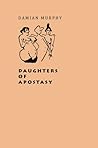
Daughters of ApostasyDaughters of Apostasy by Damian Murphy
My rating: 5 of 5 stars

I don't think of myself as a fan of Damian's work, so much as a devotee. There is something of the sublime that frequently speaks to me from the pages penned by him. Reading Damian's work is not so much a "mystical" experience as a "preparatory" experience, a view of an initiation from afar, full of anticipation. I often ask myself when I read his work "when am I going to become a part of the story, or when is the story going to become a part of me".

Revelatory experiences aside, one must (absolutely must) admire the craft of his work. There is an obvious love of the subject matter, setting, characters, and strange circumstances that the characters often find themselves in. One can almost feel the author feeling his own way through the labyrinthine maze hidden carefully away in his citadel of thoughts. But, reader beware, you are walking alongside a trickster and a thief whose sleight of hand can leave you dazzled by illusion or, even worse, your own delusions.

But you need not fear demons (outside of your inner fiends). You are safe, as you read, even as his characters sometimes are not. You have the luxury, particularly in the present volume, of simple elegance to see you through. I'm referring, of course, to the restrained (yet seemingly decadent, especially for such an inexpensive hardcover limited-edition) eloquence of presentation that Snuggly Books seems particularly skilled at. A salmon-colored cover (at least I believe so - I have hue blindness to some extent, so maybe I'm just seeing it as such) with a simple illustration of three women (two nude, one a spectral figure) on the front by none other than Henri de Toulouse-Lautrec seems hauntingly appropriate for the stories in Daughters of Apostasy, whose main protagonists are women. And what a variety of characters!

As usual, Murphy's vision here is a series of inner visions of cosmic consequence. Trespass becomes initiation into an imaginary city hidden in the bones of the physical world in "The Scourge and the Sanctuary". Christopher Wren collides with Huysman's, but Murphy's work is all and none of these. The key is in the story itself:

The fictions we partake of, as with the fictions we create, bear consequences for each of us that lie beyond the understanding and control even of their authors.

An ever-changing labyrinth of a hotel, spurred in its metamorphoses by seekers of gnosis, is both setting and character in "Permutations of the Citadel". It's a lavish tale full of mystery and misdirection, a lair for tricksters, initiates, and those seeking the other side of the mirror. Add a little playful devilishness and you have what Wes Anderson might be if he was to ever take his subject matter seriously.

"The Salamander Angel" is a journey of several pilgrims into and out of regions beyond the veil of this world. There's a kind of Hegelian dialectic of the divine and the blasphemous, a looping together of heaven and hell through the travels, intentional and accidental, of oneironauts, occultists, and tricksters. The (anti?)heroes charge and stumble their way through "above" and "below" in their epic quests. This is an extremely powerful tale. Handle with care.

"The Book of Alabaster" is a somewhat surprisingly-emotive story that starts by pulling the nostalgia strings (at least for this teen of the '80s) before winding its way into an enfolded reality of simulation. What is reality and, as important, when? Most important of all: the mystery of The Programmers remains, or, as one of my favorite obscure songs from the '80s asks "Who are the unwatched men"?

Oftentimes, the "previously unpublished" story in a collection is the weakest. This is clearly not the case here. If you desire to sup at the table of "The Music of Exile," you'll need to pay for entry; make a sacrifice. The price is well worth it, that I can guarantee. But be prepared to discover what is hidden and then to hide what is discovered. This the initiated know.

View all my reviews

____________________

If you like my writing and want to help my creative endeavors, ko-fi me at https://ko-fi.com/forrestaguirre. Every little bit is seen and appreciated! Thank you!