Showing posts sorted by relevance for query existentialism. Sort by date Show all posts

Monday, September 7, 2015

Irrational Man: A Study in Existential Philosophy

Irrational Man: A Study in Existential PhilosophyIrrational Man: A Study in Existential Philosophy by William Barrett
My rating: 5 of 5 stars

I am not adequate to the task. I look at this . . . monument to Existential philosophy, and I face a void of thought yawning wide in the dark depths beneath my skull. How could I ever capture the thoughts and feelings I experienced while immersed in this sea of emotional and intellectual self-realization? This book is a startling revelation, and I am no prophet. Still, I will try to relate the unrelatable.

Barrett starts with a section entitled "The Present Age," relating the present-history of the Existential movement as it existed in the late 1950s to early 1960s. I have little to say about that, except to point you to an excellent treatment of Chapter 3, on "The Testimony of Modern Art," by the sagacious Glenn Russell. It was, in fact, Glenn's review that pointed me to this profound book.

Section 2, "The Sources of Existentialism in the Western Tradition" is where things really started coming together for me. Here is where one finds the clearest statement about how existentialism differs from all the philosophy (grounded in Plato, more or less) before it:

Plato's is the classic and indeed archetypal expression of a philosophy which we may now call essentialism, which holds that essence is prior in reality to existence. Existentialism, by contrast, is the philosophy that holds existence to be prior to essence.

In other words, we are not dealing here with metaphysics. That doesn't mean that existentialism and belief in a higher being are incompatible - Kierkegaard belies this - but regardless of belief system, the existentialist sees that there is an inevitable end to existence as we know it. In Pascal's words:

When I consider the short duration of my life, swallowed up in the eternity before and after, the little space which I fill, and even can see, engulfed in the infinite immensity of space of which I am ignorant, and which knows me not, I am frighted, and am astonished being here rather than there, why now rather than then.

But please be clear that this is not nihilism we are talking about here. Utter hopelessness is not necessarily the end result of existentialism (though Nietzsche's philosophy prophesied future nihilism, as will be noted later). In fact, it is the realization of the inevitable end that provides us with an appreciation for life. In describing a scene from Dostoevski's The Idiot, Barrett notes that the feelings expressed by Myshkin likely reflect those of Dostoevski himself:

In this story, which describes Dostoevski's own reprieve after he had been condemned to be executed by a firing squad, is the ultimate affirmation: in the face of death life has an absolute value. The meaning of death is precisely its revelation of this value.

In section three, Barrett provides an overview of the four pillar-figures of existentialism: Kierkegaard, Nietzsche, Heidegger, and Sartres. Besides having the most difficult set of philosophic last names to pronounce, these four thinkers put forth complex, nuanced views on being (or, in the case of Heidegger, "Being") that comprise the canon of existentialist thought. Having no desire to rewrite Barrett's book in the for of a book review, I will just note a few items that I found thought-provoking and/or essential to the understanding of what existentialism is or what it is composed of, a 30,000 foot thought map, blurred by the high speed at which I pass overhead.

I was struck, again and again, by the simplicity of argument put forward by everyone except Sartres. Kierkegaard seems to be very much "of the earth" and balks between the lines at the academics, particularly the academic philosophers, who had gone before him. I don't have time to outline all the reasons for his feeling this way, but suffice it to say that his upbringing had much to do with it, as well as the broken heart he suffered when he gave up the opportunity of marriage to a woman named Regina. This choice that he had made comprised his existential crisis. He had given up love . . . for what? Philosophy?

Philosophers before Kierkegaard had speculated about the proposition "I exist," but it was he who observed the crucial fact they had forgotten: namely, that my own existence is not at all a matter of speculation to me, but a reality in which I am personally and passionately involved. I do not find this existence reflected in the mirror of the mind, I encounter it in life; it is my life, a current flowing invisibly around all my mental mirrors. But if existence is not mirrored as a concept in the mind, where then do we really come to grips with it? For Kierkegaard this decisive encounter with the Self lies in the Either/Or choice. When he gave up Regina, thus forever giving up the solaces of ordinary life for which he longed, Kierkegaard was encountering his own existence as a reality more potent and drastic than any concept. And so any man who chooses or is forced to choose decisively - for a lifetime, and therefore for eternity since only one life is given us - experiences his own existence as something beyond the mirror of thought. He encounters the Self that he is not in the detachment of thought, but in the involvement and pathos of choice.

Now, where Kierkegaard was a lover, Nietzsche was a fighter. Perhaps it was the progressive madness that slowly took hold of his mind toward the end of his life, but Nietzsche's thought was not simply that life should be examined through the existentialist lens, but that power, as expressed in his work Will to Power was something to be pursued in the face of the loss of God and the values reinforced by institutions that claim to worship God. In this way, Nietzsche becomes a prophet, in a way, for our day, predicting that future history (that which would come after Nietzsche) would be an ongoing struggle for the new value: Power. The end result of this struggle must inevitably end in hopelessness, which we can term "nihilism":

Power as the pursuit of more power inevitably founders in the void that lies beyond itself. The Will to Power begets the problem of nihilism. Here again Nietzsche stands as the philosopher of the period, for he prophesied remarkably that nihilism would be the shadow, in many guises and forms, that would haunt the twentieth century. Supposing man does not blow himself and his earth to bits, and that he really becomes the master of this planet. What then? He pushes off into interstellar space. And then? Power for power's sake, no matter how far the power is extended, leaves always the dread of the void beyond. The attempt to stand face to face with that void is the problem of nihilism.

Heidegger's existentialism proves to be much less fatalistic. In fact, one might propose that there is such a thing as existential optimism and, if so, Heidegger is its champion. At the least, one must view Heidegger as having a less-stark view of Being than Nietzsche. Rather than viewing the self as a "thing," Heidegger focuses on what it is to "be". This can be a difficult concept, but it is central to Heidegger's philosophy: We must not view our isolated ego as a thing that is within us, which is set up in contrast to the rest of the things in the world. Rather, we should think of ourselves as Being (I am using the verb-as-noun here, not simply the verb and not simply the noun) "spread over a field or region, which is the world of its care or concern." This Being, however, does not negate the self. In fact, Being our actual, true Self is the ultimate goal of anyone faced with the limits of their own mortality. Unfortunately, most of society chooses to bury itself in television, surrogate celebrity life, thrill-seeking, substance abuse, and any other sort of distraction that will numb the Self to the fear of facing its own inevitable annihilation:

Because it is less fearful to be "the One" than to be a Self, the modern world has wonderfully multiplied all the devices of self-evasion.

But, paradoxically, to gain one's Self, one must lose oneself. In this way, the true Self can become connected with Being:

To lose oneself in walking down a country lane is, literally, to lose the self that is split off from nature: to enter the region of Being where subject and object no longer confront each other in murderous division.

This is not to say that the experience of Being an existential person is something that comes on soft clouds on a comfortable spring day. No, it is quite the opposite. It is the prospect of death, the most stark and intimate of ends for each and every person, that opens the door to Being:

Only by taking my death into myself, according to Heidegger, does an authentic existence become possible for me. Touched by this interior angel of death, I cease to be the impersonal and social. One among many, as Ivan Ilyich was, and I am free to become myself. Though terrifying, the taking of death into ourselves is also liberating: it frees us from servitude to the petty cares that threaten to engulf our daily life and thereby opens us to the essential projects by which we can make our lives personally and significantly our own. Heidegger calls this the condition of "freedom-toward-death" or "resoluteness".

Now while the name "Sartres" is that which is most closely associated with existentialism in the eyes of popular culture, I would argue that Sartres was the great pretender. Read his work carefully, and you will see that most of it, at its root, is mimetic: an echo of Kierkegaard, Nietzsche, and even Heidegger. I say "even" because, while Sartres does echo the notion of self posited by Heidegger, he pulls the concept of Being back into the camp of Cartesian dualism from which Heidegger hoped to banish it. Sartres divides being into two kinds: Being-in-itself and Being-for-itself. Being-in-itself re-introduces "thingness" (my own, inadequate term) to the existentialist discussion. Barrett uses the example of a stone: "A stone is a stone; it is what it is; and in being just what it is, no more and no less, the being of the thing always coincides with itself." Being-for-itself is conceptualized as consciousness of being beyond oneself, spatially, temporally, and in the realm of possibilities and potentials.

This notion of the For-itself may seem obscure, but we encounter it on the most ordinary occasions. I have been to a party; I come away, and with a momentary pang of sadness I say, "I am not myself." It is necessary to take this proposition quite literally as something that only man can have the feeling of coming to myself after having lost or estranged me from myself. This is the first and immediate level on which the term yields its meaning. But the next and deeper level of meaning occurs when the feeling of sadness leads me to think in a spirit of self-reproach that I am not myself in a still more fundamental sense: I have not realized so many of the plans or projects that make up my being; I am not myself because I do not measure up to myself. Beneath this level too there is still another and deeper meaning, rooted in the very nature of my being: I am not myself, and I can never be myself, because y being stretching out beyond itself at any given moment exceeds itself. I am always simultaneously more and less than I am.

This passage shows the way in which Barrett has taken some complex ideas and boiled them down to their simple essence existence (!) and made them more easily digestible to the untrained armchair philosopher (I am looking at myself my Self). Barrett's synthesis of the preceding work takes place in his essay "The Place of the Furies," which, outside of some less-accessible appendices, wraps up the book. He notes that while some balk at the idea of irrationality as a viable philosophy, putting the idea of rationality up on an indestructible pedestal to be worshiped as some kind of god, that "despite the increase in the rational ordering of life in modern times, men have not become the least bit more reasonable in the human sense of the word. A perfect rationality might not even be incompatible with psychosis; it might in fact, even lead to the latter." But he does not negate the need for rationality, only that it should be put in its proper place alongside the irrational, both of them acknowledged as necessary to life. But he does warn that, without the irrational, as symbolized by the Greek Furies, humanity will lose the edge necessary to achieve full satisfaction of being.

The Furies are really to be revered and not simply bought off; in fact, they cannot be bought off (not even by our modern tranquilizers and sleeping pills) but are to be placated only through being given their just and due respect. They are the darker side of life, but in their own way as holy as the rest. Indeed, without the there would be no experience of the holy at all. Without the shudder of fear or the trembling of dread man would never be brought to stand face to face with himself or his life; he would only drift aimlessly off into the insubstantial realm of Laputa.

And, in order to remind myself of what I have learned here, I will return to this book again, perhaps many times. This one, while not a life changer per se (thought it would have been, had I read and understood it as a teenager), it is definitely a life informer. I can't fully express the rush of synaptical connections and emotional response that I felt while reading, no, studying this book.

Again, I am totally inadequate to the task.

I am Me!

View all my reviews

________________________

If you like my writing and want to help out, ko-fi me at https://ko-fi.com/forrestaguirre. Every little bit is seen and appreciated! Thank you!

Tuesday, December 5, 2017

Art & Existentialism

Art & ExistentialismArt & Existentialism by Arturo B. Fallico
My rating: 4 of 5 stars

Equal parts frustrating and fascinating. I admit that I am not entirely up to the task of a comprehensive review of the book, and am left with impressions born of a partial understanding. If you want a careful reading of some of the deeper details, check out Glenn Russell's outstanding review.

Much of the book, to be honest, was a grind. The reputation that philosophy has of being just so much navel-gazing is reinforced here in abundance. That's not to say that Fallico's insights are wrong, just that they are very difficult to follow without an extremely slow, highly concentrated read, re-read, re-read, and another re-read. I don't think my brain has been taxed this hard to follow along in a text since I read Hofstadter. Perhaps some more grounding in philosophical literature overall would help. Fallico dearly wants to write this so that anyone can understand, but the very nature of the subject matter - the act of art creation, the art of reaction to art, and the relationship between both and the drive to exist as a being of freedom - mitigate against an easy common understanding.

For example, Fallico states early on:

Only in art do we find experience which endures, not by substitution and displacement, but by the kind of self-identical re-positing which keeps self-identity in being.

At first blush, the thought of art as experience is counter-intuitive. Art is stuff, right? But Fallico makes a careful distinction between the act of art and the art-thing. The artist, during the act of art, experiences being (or existing, hence "existential" experience). But the observer, because of their interaction with the art-thing (which results from the act of art) can have a moment or moments of being as they react to it. And every instance of this individual reaction is unique to the person experiencing it. Furthermore, art critics, who publicly respond to the art-thing, have their own "act of art" (my quotes) when they write or speak their critique. Then further observers down the chain must react to the critique, re-positing both the critique itself and the original object of critique, the art-thing itself.

The art-thing itself, in the existentialist critique, should not be thought of as a representation of anything, but as a presentation. The existent one (the viewer of the art-thing) should not, in Fallico's estimation, worry about what the art is meant to represent, but should only focus on the art-thing itself as an entity unto itself:

The peculiar composure and independence of the art-object come into clearer view when we see that it is in the order of a presentation, rather than a re-presentation. A representation, as the very word seems to say, presupposes another thing, somehow made to reappear under the guise of the art-object. A representation is un-original by definition. The essential characteristic of the art-object is precisely that it is an original - a first presentation of a possibility truly felt and imagined. It can remind us, really, only of itself, even if, in the process, we may remind ourselves of non-aesthetic things and events extraneous to it.

Here begins a sort of philosophical machismo that permeates throughout the work. One wonders if this attitude isn't at the heart of existentialism, but my personal feelings are that a person's realization of their vulnerability to the inevitability of death tends to engender more humility than hubris. Fallico seems to favor the view that a true existentialist faces existential angst with bravado, and that this attitude can be found in art itself:

. . . the order of the art-object is one in which everything is preserved in its being, everything achieves actual presence together with everything else, and everything relates and refers to an existent. Everything in the art-object stands fully realized, unchanging, and in full view. Nothing is inessential, everything is required. A single line, a dab of color, a sound - all are constitutive and uneliminable from the whole. Their relationship to other lines, colors, or sounds as well as to the whole is never one of mere adjacency, correlation, or probability.

This sense of bravado becomes more than a little tedious as one progresses through the book. By the end, the chest thumping gets a little ridiculous. I'll spare you the details, but not without warning you that Fallico's ideal existential man is an intellectual he-man proudly displaying his statuesque breast to the world, defying the cosmos to the bitter end.

One aspect of Art & Existentialism that really spoke to me, was Fallico's acknowledgement that:

. . . art has traditionally come to be associated with beauty. The beautiful, in turn, is associated with whatever pleases and suggests itself as ideal and perfection - and object of desire. Identification of art with the beautiful in this sense has ever been a pervasive error in aesthetics. And this is surprising, considering that so much of the great and respected art in every culture has to do, not with the pleasant and desirable, but with the ugly and the forbidding. Michelangelo's Pieta is not beautiful in the sense that it is pleasurable, nor are Picasso's Guernica or Guitarist. As such, pleasing, desirable, and attractive define the objects and objectives of action, not of aesthetic contemplation. This is not to say that the aesthetic necessarily concerns itself with the unpleasant and the unattractive, of course, but simply that it is utterly indifferent to such categories.

Huzzah! Someone finally said it! Art is not a beauty pageant! I've held to this for a long time. And while one can use the old soft argument that "beauty is in the eye (or ear) of the beholder," that argument is sometimes used as a way for those who have a certain, preconceived notion of what is "good" art to hand-wave the whole question about art that is not beautiful, but worthy of praise (and preservation). I readily admit that much of the music and art I love is considered ugly or awkward or just plain unpleasant by many. But does that mean that it has no worth? I'd argue that sometimes it has more worth because of it's ugliness. Take one of my favorite examples: Penderecki's Threnody for the Victims of Hiroshima, a particularly noisome piece of music. The evocation of feeling as one listens to this piece can be incredibly strong. I remember being literally moved to tears in college while listening to this piece and seriously contemplating what it must have been like to be present for this horrific event: the sounds of the air raid sirens, the droning of a single bomber flying overhead, the concussive blast, the flesh-melting heat, the thousands of structures shattered into splinters and blown to the wind, the roaring fires and burning bodies, the cries and moans of the survivors. Not a pleasant thing. Not beautiful at all. But evocative and, dare I say, necessary? Here, Fallico allows us to embrace the necessity of such a piece.

The fact that Daumier's court scenes, or Goya's prints about the horrors of war are not direct incentives to action (great art never is) must not mislead us into thinking that they have not latent in them the power to remodel human purposing with respect to how humans feel about injustice, or about the obscenity which is war . . . there is not a single work of art, not a single first utterance, which does not, in its own way, present us with at least a possibility of novel outlook and global perspective. What counts here is that this - if it is truly aesthetic, and if we truly are able to enact it - is a concrete and actual possibility, one that is tasted, fused with one's very being in the enactment. No man who really encounters Cezanne's apples ever sees apples again in the same way, just as no man who really reads Sartre's The Wall or CamusThe Stranger can look upon death and our contemporary values as he did before the encounters. It is true that a great majority of gallery- and theater-goers, no less than readers of novels, seem to be little transformed by their experiences - but if they have any ind of aesthetic sensitivity, who can measure the degree of transformation they truly have undergone by such experiences?

View all my reviews

Saturday, August 22, 2015

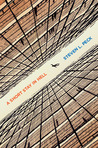
A Short Stay in Hell

A Short Stay in HellA Short Stay in Hell by Steven L. Peck
My rating: 5 of 5 stars

Angst is not a mere intellectual exercise. Existentialism is not just a philosophical movement. Steven L. Peck's A Short Stay in Hell drives this into the heart of the reader like no other existentialist work.

I've been eyeball-deep in readings on existentialism lately (research for a novel and for my own despair edification), including William Barrett's outstanding Irrational Man: A Study in Existential Philosophy and Sartre's play No Exit, among others. But while I've enjoyed Barrett's study, it is just that, a study in existential philosophy. And Sartre's play seems just a touch contrived (I mean just a touch, too - it did not spoil the play).

But this . . . this little novella kicked my emotional depths right in the crotch. What could have been a work buried in academic gymnastics turns the rational boundaries by which one anesthetizes ones real self completely inside out. And it hurts. Oh, Ahura Mazda, it hurts! This is a novella which, if you have ever been in love and have then been involuntarily separated from the one you love, will tear your heart apart! If you are sensitive to the injustice of the world, your short stay in hell with Soren Johannson is going to be rather unpleasant.

This isn't your typical conception of Hell. Hell here is modeled after, or at least pays homage to, Borges' "Library of Babel". And unlike the Christian hell, from which there is no escape (without a guide's help, at least), there is a way out. You merely need to peruse the 7.16^1,297,369 light year wide and deep library and find the one book that contains the complete story of your life, from beginning to end. How long can it take, really? Really . . . wrap your brain around that number. This is the size of the library that contains the books through which you must look to find your escape from Hell. This might take a while.

The upside is that you live forever! And you can never die! Or, rather, you can die, but you always come back the next day. This is not without pain, however, and Johannson experiences pain in spades, especially when he finds himself (view spoiler).

But physical death, painful as it is, is nothing compared to the emotional pain of falling deeply in love and losing your lover (not that hard in a place as vast as this). You know that the one you love is there, somewhere, because they can't die, either. But, once lost, what hope do you have of finding that one person again, really?

"Anticipation is a gift. Perhaps there is none greater. Anticipation is born of hope. Indeed it is hopes finest expression. In hope's loss, however, is the greatest despair."

Taken out of context, this quote seems hyperbolic or even pithy. But in the context of the story, I can think of no more gut-wrenching, heart-twisting distillation of existentialism than this. It physically took my breath away when I read it. I gasped aloud and had to remind myself, for a split second, to breathe. It is that emotionally-charged, and a reminder of angst really feels like. A Short Stay in Hell won't give you the intellectual finesse of an examination such as Barrett's or the breadth of understanding that comes with a critical analysis of the philosophy and its history, but it will plunge you face-first down the heartbreaking abyss of what it means, what it feels like, to lose all hope.

Dante's Inferno (which I love, by the way, so don't take this as too derogatory) is a childrens' amusement park, in comparison. No need to abandon hope while entering Peck's Hell: It will be stripped from you whether you want it to be or not; just give it time. You've got all of eternity. Or, rather, all of eternity has you!

View all my reviews

________________________

If you like my writing and want to help my creative endeavors, ko-fi me at https://ko-fi.com/forrestaguirre. Every little bit is seen and appreciated! Thank you!

Wednesday, July 29, 2015

In Delirium's Circle

In Delirium's CircleIn Delirium's Circle by Stephen J. Clark
My rating: 5 of 5 stars

On the surface of it, this is merely a very creepy tale, extremely well told. But, like the plot itself, this is a multilayered artifact. The cover itself has a beautiful burgundy floral design embossed with a sinuous abstraction of theatrical masks that swirls in a . . . well, a delirious circle. In fact, the novel is illustrated throughout with sinister, ghostly drawings by the author himself, making the artifact a lavish affair worth the high asking-price. The cover is indicative of the story itself - a whirlwind of shadows that leaves the reader wondering who is good and who is evil, or even what is "good" and what is "evil", in the philosophical sense of the words. The effect on me has had one benefit: I've been studying existentialism lately, and this book makes it *really* easy to slip right into existential mode.

But this is so much more than just another straight-faced Ligotti-esque foray into darkness. Stephen J. Clark has crafted some dark playfulness into the text. Take this sentence, for instance:

"In short, the author playfully alluded to the identifiable characteristics of the lives of bookish people as though in essence all are monsters, pariah and exiles."

Clark here gives a sharp elbow to the reader, breaking the fourth wall, while maintaining the character of the book. This sort of metafictional playfulness is not something you'll find in most horror literature, at least not done with this kind of subtlety.

As the borders between dream and reality fray, it's easy to go into a kind of opiate slumber as one is reading. Then, all of a sudden, Clark pulls out a chase scene worthy of Alfred Hitchcock that grabs the reader by the shirt collars and shakes one into wakefulness. It's a sharp slap in the face, but rather than throwing the reader out of their suspension of disbelief, it draws the reader further in, enveloping one just as Mr. Fetch, the main character (or is he, really?) is folded into layers of uncertainty and psychic vertigo.

As Fetch is thrust under the dark, roiling waters of doubt and deceit, he, along with the reader, becomes aware that he is being used by The House of Sleep, a mysterious cabal of . . . well, that is a mystery.

"I was entering another circle, where the world seemed suddenly caught in amber, where the inhabitants of nightmares lingered just out of sight in the wings."

And later . . .

"I had acted as if hypnotized, finding the paint and brush, following the instructions to the letter, all the while with a sense that I was completing an inevitable action. The game played me."

One of the tropes that is hinted at throughout, but never made explicit (nothing is made explicit In Delirium's Circle, which is part of the awful wonder of it all), is the idea that doppelgangers may or may not have replaced one's friends, one's enemies, or one's self, at any time.

"Sooner or later your own shadow will rise up and join you as a guest at your table."

In context, this is one of the most horrifying lines of the book. But I can't, unfortunately, contextualize it without relating the book in its entirety. The haunting effect of this novel is far more than the sum of its parts. Clark and Egaeus Press has created one for the ages, the dark, unsure ages when even solipsism itself must be questioned. Is there really a "self" at all? Mr. Fetch, for one, has his doubts . . . and these doubts are about all that he can claim as his own. All else is distorted by the gyrations of delirium's circle.

View all my reviews

Wednesday, March 20, 2019

Flower Phantoms

Flower PhantomsFlower Phantoms by Ronald Fraser
My rating: 4 of 5 stars

On the strong recommendation of a few people whose literary opinions I highly value, I took a chance with this unknown-to-me author. With an introduction by the highly-reputable scholar of obscure English works, Mark Valentine, I had at least some assurance that the book was likely not going to be awful.

The work starts out, blandly enough, as a sort of domestic story of class, family, and wooing one might expect from an interwar-era work. But a tiny sliver of decadence, a delicate kind of decadence, shows up about a quarter of the way in as Judy, the protagonist, is being, as is her wont, a touch aloof from her soon-to-be-betrothed Roland. Roland, poetic but not terribly sharp, looks into her eyes and states:

"My god, Judy, the human eye is a very terrifying thing. It's so inhuman. There's no soul in it. It's a machine. A lot of cloudy, spongy, extremely queer stuff with a sinister black hole. It's expressionless, when you look close. Laughter, kindness, everything that makes people human. seems to disappear. What a strange and terrible thing mind must be . . ."

Later, we find just what a strange and terrible thing mind is. At least strange and terrible to those who cannot see inside another's mind to understand its workings. This is especially so when that mind does not seem to function "correctly".

And Judy doesn't "function correctly". I like her chutzpah. She is a surprisingly complex figure for a female character written by a man in the 1920's. I had not expected this. In time, the complexity of Judy's malfunctioning thoughts becomes intriguing. I wondered if Judy's quirks were harmless or if there was something seriously deranged in her thinking. My greatest fear, though, was that Judy might become "domesticated" or portrayed as an indecisive ditz. I hoped neither of those things happen. I liked her too much as-is.

Not long ago, someone very, very close to me suffered a bout of temporary psychosis. It was one of the most harrowing experiences of my life, to see this person that I know so well in a state of paranoia and mania. It broke my heart to see this. The person I knew was not the person ranting and raving during that spell. It was sad and terrifying to be a part of that suffering and to see it up close, first hand. I catch myself using the word "crazy" far too often, and I now know that this word has special, specific meaning, and that it has nothing to do with fun and frolic. It has become a slur and a word to be avoided. But years of habit are hard to break, and I still catch myself letting it slip. But I correct myself, out of the deepest respect I hold for this friend.

So, as Judy progresses (or falls?) into a state outside of reality, I asked myself what was happening, partially, I think, as an emotional protection to myself, given what I so recently witnessed. Was Judy suffering from insanity (and note that suffering is the precise word to use when describing what the insane are going through)? Pollen-induced hallucinations? Remote memories of a past life or a soul caught between states of existence? Whatever the source, it was beautiful, sad, and languid.

As the novella progresses, one sees Judy slip more and more away from "reality" to the point where the reader questions what is real and what is not. Despite the sensitivity of the subject matter, the "trippiness" of the second part of the story is a nice contrast to the bland domesticity of the first.

In summation, Flower Phantoms shows a most sympathetic view of madness. This is not what I expected from a piece of writing from this period and definitely not what I expected when I began reading. It is touching, but not maudlin, decadent in its subject matter but more practical in its portrayal, and seething with existentialism but not buried in fatalism. Judy is a complex, if sometimes confused, character: she is broken, but not weak. Confident, but fallible. All in all, a human being.

Each reader will pull something different from this novella, depending on one's experiences (and proximity in time and space to said experiences), but it may just shatter your expectations . . . subtly, without undue fanfare or heroics. An extremely interesting, surprising read.


View all my reviews

________________________

If you like my writing and want to help my creative endeavors, ko-fi me at https://ko-fi.com/forrestaguirre. Every little bit is seen and appreciated! Thank you!
Friday, November 8, 2019

The Great God Pan and Other Horror Stories

The Great God Pan and Other Horror StoriesThe Great God Pan and Other Horror Stories by Arthur Machen
My rating: 5 of 5 stars

I had previously read two stories (novellas, really) in this volume: "The Great God Pan" and "The White People". I liked those stores and was excited to re-read them. And Machen's reputation among horror aficionados whose opinions I appreciate and respect, especially those who favor a more literary style (as I do), gave me confidence that I might enjoy the remaining stories. I seem to recall that Lovecraft lauded Machen's work, as did Stephen King. Those were good indicators from two pretty good writers, as well.

But as I read The Great God Pan and Other Horror Stories, an unanticipated question kept percolating up in my thoughts: When you say "Machen is a great writer," who do you mean? Yes, "Arthur Machen" is the obvious answer. But which one? Which Machen are you referring to? The Arthur Conan Doyle-like page turner of “The Red Hand” (which I wanted to keep calling "The Red Right Hand" - thank you very much, Nick Cave), the writer of “The Monstrance” with powerful echos of M.R. James, the Charles Dickensanian “The Tree of Life,” or the Dunsanian visions of “N”?

Machen is all of these, but with something more, something unique – a subtlety of hand and a careful movement of plot, sweetly lead by his studied use and manipulation of Word and Phrase. I capitalize these, because in Machen’s hands, these elements, these tools, are elevated beyond the banal usage of the terms. They become something special and “new” under his pen (though when one reads his strange mutation of certain terms, one is compelled to say “of course, why did I ever think of this word/phrase in any other way? In any case, I shall never think of it in the same way again!”

For instance, there is this from "The Three Imposters":

". . . I too burned with the lust of the chase, not pausing to consider that I knew not what we were to unshadow."

This is the sort of turn-of-phrase that I love in Machen. And that word: "unshadow," so evocative and full of implication. Given the context of a Russian-doll series of narratives within narratives, the term is especially apropos and lends a certain gravity to the meta-narrative from within the narrative - the meta-narrative "in the shadows" beyond the reader and the explicit words on the page. With one word, Machen pushes us out into the unknown; a sort of literary practical joke aimed at the careful reader.

And these stories do deserve a careful reading. They are not shocking in that Lovecraftian "the entire universe wants to eat us all, oh no, my poor sanity!" way. They are most definitely not the antinatalist murky depths of Thomas Ligotti (though there is a good deal of existentialism throughout these works). They are much more subtle. More careful and deliberate.

But that does not mean they are "straightforward". Far from it! I believe that "The Great God Pan" benefits from what seems like disorganization of thought. Vagaries and jagged connection points lead the reader on a frenetic, dreadful path, allowing each individual to come to their own conclusions, their own "end plot". "The Three Imposters" is mind-blowingly complex. Wheels within wheels, all shot through with decadence and hauntings and rotting bodies and tentacles. It works not because Machen ties off all the ends in a neat little bundle (he does not), but because the readers mind takes the disparate directions and waypoints and makes its own blurred map of what might have happened in the tale. I loved "The White People," but to tell you what it was "about"? Um. No. It's essentially plotless, a labyrinthine meandering through the eyes of a young girl discovering . . . well, she can't tell you all that she's discovered. It's simply not possible. Machen does a wonderful job of using inference and redaction to tease the reader with an intentionally occulted (I use the word exactly) vision of what lies beyond, accessible, but hidden.

You will exit many of these stories in a state of utter confusion, wondering what just hit your brain. But you will feel the impact of something sinister hiding in the veins of the earth or just beyond that hill ahead or in the complex motivations of the seemingly innocent. These stories are insidious!

Even in stories where there is a "traditional" twist ending, there is something in the subtle way that Machen lays his tales out that allows for a "twist" ending that isn't a cheap-shot, like I find in many short stories (especially those written by less-experienced authors). "Ritual," for example, is no exception. It's microfiction, or close to it, so it relies on a twist at the end, but by the time you get there, you're like a frog that's been slowly brought to boil in horror. Your realization comes too late! And even after the twist is revealed, your brain will continue tumbling forward, making suppositions and venturing guesses as to what really happened.

This is what Machen provides, then: a labyrinthine path to uncertainty and, hence, insecurity, where the only thing you are sure of is that you can't trust anything to be what it seems. There is darkness, horror, wonder, and awe, all combined, in this realization; a case study in Schopenhauer's philosophy of Aesthetics and The Sublime. It is a journey worth your while, all the way to the bitter, beautiful end.

View all my reviews

________________________

If you like my writing and want to help my creative endeavors, ko-fi me at https://ko-fi.com/forrestaguirre. Every little bit is seen and appreciated! Thank you!

Thursday, May 28, 2015

Beta Testing the Apocalypse

Beta Testing the ApocalypseBeta Testing the Apocalypse by Tom Kaczynski
My rating: 5 of 5 stars

If Kafka had been born 100 years later and studied architecture, and become a cartoonist, this is what he might have produced. Tom Kaczynski immerses the reader in 21st century angst brought on by gentrification, the commodification of the environment, and the horrors of suburban living (only slightly more terrifying than urban living). This is an angsty collection wherein existentialism bleeds out of the very walls around us. It is also an incredibly smart collection, successfully calling the reader's attention to the ironies and contradictions of modern living, while not being too pedantic about it. Some refer to this as a sidelong segue into science fiction, but it is more a work of magic realism than science fiction. There is a heavy dose of philosophy here, at least implied, particularly something akin to "object oriented" systems in which man's relation to the objects (especially architecture and artificially-controlled spaces) are of paramount importance to one's view of the world. But do please take this last claim with a grain of salt, as I am only very newly-introduced to the "object oriented" philosophy.

One thing that you will see less of in this graphic novel than in other contemporary graphic novels is the hipster aloofness, bordering on amorality, that infects too many comics nowadays. Beta Testing the Apocalypse may be full of angst, but the angst arises because the characters represented actually care about something, unlike those in, say, Clowe's Death Ray or Daly's Dungeon Quest. This is refreshing . . . in an angsty way . . . if such a thing is possible.

Despite my incoherent ramblings, this is a graphic novel that deserves your attention. Like any of the best literature, it will cause you to think, question, reflect on your place in the place in which you live, not in a detached way, but in a way that engages your eyes, mind, and heart. Reading the book, for me, was something approaching a religious experience, and I mean that in all seriousness and reverence. This book deserves to be studied and meditated on, rather than merely read.

You may never look at condos or green-spaces the same way again . . .

View all my reviews

Monday, August 15, 2022

The Ballet of Dr Caligari and Madder Mysteries


The Ballet of Dr Caligari and Madder MysteriesThe Ballet of Dr Caligari and Madder Mysteries by Reggie Oliver
My rating: 4 of 5 stars

With few exceptions, I have come to love the work of Reggie Oliver. While I was lukewarm about Flowers of the Sea , I was head-over-heels about The Complete Symphonies of Adolf Hitler and Other Stories and Mrs. Midnight and Other Stories . I had heard mixed reviews from readers I respect and admire, so I was curious where this volume would fall.

I began with misgivings. While the opening story, "A Donkey at the Mysteries," had some great moments, the ending fell a bit flat for me. I loved the subtext of unknowingly participating in rites one does not understand, but I was hoping for a moment of anagnorises that never materialized. The story had momentum, a series of setups, then . . . nothing. If this was authorial intent, the potential was under-utilized. Perhaps this is because I had read and quite enjoyed Brian C. Murarescu's investigation into ancient Greek and Roman cults of psychedelia(?), The Immortality Key . I had been (pardon the pun - but I am a dad) keyed up for the read, but was disappointed. Not upset. Just disappointed. Have I mentioned I'm a dad?

The second story was a touch better. "The Head" is a double entendre laced with Oliver's bleak humor. It's a strange admixture of sitcom and dread horror that devolves into an absurdist experimentalism. I really do like the two main characters (as much as one can like a madman and a disembodied head), and, as with other works by Oliver, his characters really shine. A worthy story, not his best, but a good read nonetheless.

When I started to figure out the subject matter of the third tale, I was prepared to be really, really disappointed. As a rule, I hate werewolf stories. But I might have to make an exception for "Tawny". I didn't love it, but this English social comedy with a lycanthropic twist was an amusing read.

Then, suddenly, the collection hit its stride. "The Devils Funeral" is peak Oliver. Clergy, madness, corruption, decay, and the near simultaneous death of Dante Gabriel Rossetti and Charles Darwin as a sideshow that leaves lingering questions. The question that keeps being posed is "who is the enemy"? It's a seemingly simple question with a dastardly labyrinth of possible answers and meanings, most of it unanswerable and meaningless. Existentialism reigns above. And, as above, so below.

A sinister comedy, or a comedic tale of horror? "Baskerville's Midgets" displays Oliver's insider's insight into the actor's life beyond the stage. This (and other stories about the intersection of horror and theater) is a story that only Oliver could have written. His background as an actor, playwright, and fiction author find a fitting culmination in this story, which will have you checking under your bed for (?).

Oliver next completes an M.R. James fragment "The Game of Bear". The transition, though carefully documented, would be fairly seamless without the indicator, which only serves to sever the tale in two. Oliver does an admirable job of mimicking James' voice, particularly in the climax of the story. Of course, James did put a strong personal stamp on the structure and tone of the English ghost story, so no surprises here.

"The Final Stage" is an existential tale that only one who has acted onstage can fully appreciate; not only because of the settings and situations, but because of the attitude that one must take to truly become immersed in their characters, not just the willful suspension of disbelieve, but the willful deceit which one must not merely engage in, but wallow in, if one is to be "a brilliant actor". There is a price to pay. But how are the funds exchanged? Does the character take from the actor, or the actor from the character? The economies of "real" life and faux-life are powerfully in play here.

With the introduction of a certain trope about mid-way through the story, I was ready to write off "The Endless Corridor" as just another vampire story. It is not just another vampire story. It is, in fact, much more nuanced and much more sinister than that trope led me to believe. Oliver, with considerable panache, twists the old trope into something entirely new and more horrifying. My trepidation was allayed, but my frisson was piqued.

Oliver continues to unveil the "back" of the theater in his mystery "The Vampyre Trap," an excellent, if old-fashioned tale of jealousy and ambition behind the curtain. One wonders who the actors are and who the characters are, as these roles become muddled. What better place for a murder or three in a place whose sole purpose is deceit and drama? There are strong resonances between this story and "The Final Stage" earlier in the volume, not because of direct subject matter, but because both hint at a certain sinister something taking place behind the masks of the masks of the masks.

The title story is the most brilliant story in the volume, but only those who have watched Das Cabinet des Dr. Caligari will fully appreciate its impact. If I were to teach a class on the "O'Henry ending" I would show the movie, then have students read this. Textbook. And fantastically well-crafted. This is a Reggie Oliver masterpiece; one of his best stories ever.

How can I resist a story about one of my favorite eras of painting, that of the Pre-Raphaelites? I can't. Nor can the protagonist and victim(s) of "Love and Death" resist the alluring illusion of beauty, over-shrouded by the absolute victory of decay and death. Everyone in this tale is caught in this trap. Perhaps only the reader can escape. Perhaps not. But the allure remains.

"Porson's Piece" is as solid of an English ghost story as I've ever read. The village in which most of the action takes place shares half a name with <a href="https://forrestaguirre.blogspot.com/2020/06/a-day-hike-in-cotswolds.html>a village in the Cotswolds that my wife and I hiked through in 2019</a>, and I think I might know some of the "fictional" spots described. One path in particular (a photo of which is at my blog) was described in such a way that I cannot shake the feeling that this very path was the one Oliver here described. This added to the verisimilitude for me, but maybe I am just hallucinating, like the main character. Or maybe not.

Oliver begins "Lady With A Rose" with an ekphrasis of a Titian painting. The story is erudite and the characters colorful (pun intended), but not as startling as many of his other works. The final "twist" was to be expected and sort of just . . . ends there.

This collection has some real gems in it, but the opening and closing stories were unspectacular. An odd way to construct a collection.

The great in this collection carries the less-spectacular tales. Perhaps I've read too much of Oliver and am a bit jaded? I don't think so. He still astounds me, at times. I would hate to discourage anyone from reading "Porson's Piece," "The Ballet of Dr. Caligari," "Baskerville's Midgets," or "The Devil's Funeral," all of which were outstanding stories. But I can't give it a perfect five. Nor can I drop it to an "average" rating of three stars. I'm firmly in the four camp with this one.

View all my reviews

If you like or appreciate my writing and want to lend your support, ko-fi me at https://ko-fi.com/forrestaguirre. Every little bit is seen and appreciated! Thank you!

Friday, August 28, 2015

Black Sun Deathcrawl

Black Sun DeathcrawlBlack Sun Deathcrawl by James MacGeorge
My rating: 4 of 5 stars

Timing is everything . . .

I began reading William Barrett's masterpiece Irrational Man: A Study in Existentialist Philosophy while on vacation in Indianapolis, IN. This was about two weeks before Gencon, the world's largest gaming convention, came to Indy. Now, I've wanted to go to Gencon since I was a child-geek, back when it was in Lake Geneva, WI (though I've discovered a local convention that many are calling "one of the top three gaming conventions in the US"), so I was a little forlorn that I wouldn't be in town for the fabled convention. I did, however, read of many other gamer's preparations to go, including a bevy of small game publishers who were rushing to print their wares for sale at the con. This is how I discovered "Black Sun Deathcrawl". Man, have I been lucky in finding good modules lately!

Now that I'm eyeball and cerebral-cortex deep within Barrett's book, I seem to have hit a lucky stride with several books that I've just read or am currently reading. This wasn't by design - the gods of existentialism (har, har) are smiling on me . . . or is it scowling at me? Whatever the case, I feel as if I've been led by some higher cosmic power to a bunch of great books in the existentialist vein, but from disparate points of the literary spectrum, from non-fiction to modern fiction to post-modern fiction to gaming . . . SKRRRCH . . .

"Did he say 'gaming'?"

"Yeah . . . existentialist gaming? Like . . . Call of Cthulhu RPG. . .?"

(Cue evil laughter, then a booming voice from below) "Cthulhu? Bwahahahaha!!! Scary? Yes. Gross? A little. Existential? Not on the same level as Black Sun Deathcrawl," (the last phrase is said as if your jaw is spontaneously falling off and you are trying to keep the mandible attached by exaggerating all motion in your mouth - stick that tongue waaaay out) "not even close"!

Yes, Black Sun Deathcrawl (don't forget that exaggerated pronunciation!) is as existential a setting as you will ever see in role playing. It is illustrated throughout with Gustave Dore's drawings of Dante's Inferno, which gives the piece a somber, dark tone that artistically reflects the game mechanics included in the supplement.

Here, all is hopeless. Rather, you have "hope" as an attribute score, but it burns down as the influence of the Black Sun burns through the rock through which you are digging, twisting your body and mind and chipping away at your will to live as you chip through the rock that you hope will protect you (note: it won't). The Black Sun is relentless, and you are not. Death by the influence of the Black Sun's baleful rays isn't even a sure way of escape from its torment. Characters brought to zero hit points die and are then restored to full hit points one round later. There is only one way out. And only you can provide the way out. When your hope drops to zero (a long and painful process, to be sure), you are considered to have committed suicide and finally found relief from the incessant despair of the Black Sun.

The book is divided into several sections, beginning with an introduction to the world and its inhabitants, of which your character - nameless and raceless, known only as the Cursed - is one.The world is described in four short pages, which is all you need or want to know. Monsters, including "Black Thoughts" and "Terrible Thoughts" are described and statistics given, and the effects of the Black Sun are elucidated in the "Black Light Exposure Corruption Chart," which shows the horrific results of being exposed to the harmful rays. For example, one of the fifteen effects (and not one of the worst, by any means) is known as "Liquid Brain":

"A part of the character's brain liquefies and runs from their nose and mouth, -1d8 intelligence. If the liquid can be collected and ingested, regain the Intelligence, but only until it is passed from the system via urine, at which point it may be collected again, ad infinitum."

The next section consists of "Truths," including such gems as: "Identity is Irrelevant in the Face of Oblivion," "If There Is a Higher Power, It Does Not Care," "Life is Endless Conflict," "Existence is Random and Without Meaningful Purpose,"Everyone Digs Their Own Grave," "Only We Can Choose When the Suffering Ends," and others of a similar, somber nature. Each has a game mechanic or rule attached and while the intent is to apply these rule modifications to the Dungeon Crawl Classics gaming system, they can be easily applied to most old school role-playing games with a little work.

The final section is a series of encounters, which might be played in a single gaming session . . . played to its inevitable end, that is!

James MacGeorge has invoked such a mournful tone that this supplement will likely infect your own campaign in some way. This isn't the sort of place that characters from another campaign will want to visit, however. If they do, they will be subsumed into it and consumed by it. Best used for a series of one-shots (with new characters every time because who the heck can survive more than one session under these circumstances?).

The first edition sold out very quickly! If you want a copy of the second printing, you can order it here. But get it fast . . . then prepare for a slow, agonizing crawl!

____________________

Addendum: Eric Diaz of Methods and Madness curated another review of BSD here. Enjoy!


View all my reviews

________________________

If you like my writing and want to help out, ko-fi me at https://ko-fi.com/forrestaguirre. Every little bit is seen and appreciated! Thank you!

Thursday, June 30, 2016

Burnt Black Suns

Burnt Black SunsBurnt Black Suns by Simon Strantzas
My rating: 5 of 5 stars

I'm all about the creepy, not so much about the gory. Give me The Twilight Zone and X-Files over "Saw" and "Texas Chainsaw Massacre" any day of the week. It's not about the blood or guts, necessarily, but about the feeling. I'm not a fan of being grossed out, but am a fan of that lingering feeling in the back of my head that things just aren't right. Perhaps this has to do with my love of existentialism, the thrilling notion that terror and death loom just around the corner, but aren't quite in your face . . . yet.

So when I tell people I like to read horror . . . well, I've been given some recommendations that I really, really hated. Part of it is that, all told, the quality of horror writing in general is . . . well, not that great. There are a number of reason for this, not the least of which was a sort of nepotism which Paula Guran referred to as "tribalism" at one point - the incestuous practice of editors who were also authors and authors who were also editors patting each other on the back and frankly looking the other way when bad writing came through from someone they liked.

Those days may be behind us. At least I hope so. But because I had seen this happen first hand back in the early 2000's, I approached Strantzas' collection Burnt Black Suns with a touch of caution. Not because I though Strantzas had been caught up in all of that, but because I hadn't, frankly, read a Strantzas story before, at least not to my recollection. Plus there was the possibility that this was not the kind of dark fiction I most enjoy. But I read some very positive reviews and I positively loved the cover, so I thought I'd give it a shot.

I'm so glad I did!

Let's start with the first story, "On Ice," because no one reads intros, even when they are written by the talented Laird Barron. Okay, I admit it, I read the introduction. But like most other introductions it was forgettable. "On Ice," though, was not as forgettable. I had expected something along the lines of Lovecraft, but was pleasantly surprised (though I like Lovecraft's work a great deal) that Strantzas didn't just fall into the tropes that one might expect in an arctic horror story. Yes, there is a sense of desperation and fear like you might expect, but it's a slow burn, like holding your hand on the frozen juice freezer at the grocery store too long; mesmerizing and painful, but not so scary as to make you simply close the cover. "This," I thought, "is a solid four star story".

I was not quite as impressed with "Dwelling on the Past," which I felt didn't really get off the ground and, once it did, meandered around a bit too much. Not a terrible story, but not terribly impressive, either. I felt that this might have been one of the "filler" stories in the volume.

I was, however, very impressed with the third story, "Strong as a Rock". I liked everything about "Strong As a Rock". It seethes with the dread of that-which-is-not-seen. The evocative character reactions to "off camera" events carry the horror in this, yes, I'll say it, "Ligotti-esque" tale. This story of two brothers, one full of confidence, one utterly lacking in it, starts blue and clear as the sky, and ends saturated in darkness. You may never look at rock climbing or hospitals in the same way again. Five stars!

"By Invisible Hands" was the weakest story so far, which surprised me, since it appeared in a Ligotti tribute anthology. Maybe it was just trying too hard. The right words were there, but the cadence was not, like a singer off beat. It also missed the emotional "oomph" I get from Ligotti, et al. Still not a bad story. Three stars. No more. No less.

"One Last Bloom" is an interesting title for that story. It took a little while to "grow," to be honest, but once it flowered . . . well, it was really gross and horrific. I was surprised by how well I accepted that fact. Maybe I've become desensitized? Extreme social awkwardness, combined with narcissism, make for some very uncomfortable moments. Strantzas has captured this perfectly, and, boy, is it painful to read! Painful in a way that drew me, begrudgingly, into the story. For a while, the main character's lack of touch with reality had me wondering who was real and who was not. It's an insane fugue of a story, as a result, and in the end, I liked the effect it had on me.

Furthermore, there was a phrase in "One Last Bloom" that caught my attention: "[I] knew the way one knows things in the middle of the night . . ." I love that turn of phrase. In the context of the story it totally makes sense and is one of the most clever articulations I've ever heard of that strange phenomenon of certainty at three in the morning. I've felt that. I know that feeling.

I wish I had thought of that seemingly simple phrase myself. You've earned yourself another star, mister Strantzas! Four total, in this case.

"Thistle's Find" is a good story, well told, of science gone wrong. Not spectacular or groundbreaking, but it still makes it into four-star territory.

Take Carcosa, The King in Yellow, a mysterious bookstore containing an even more mysterious manuscript, a restrained rivalry between two brilliant musicians, and the revelation of the "lesser" musician's grand opus, all wrapped in an emotionally-satisfying tale, and you've got yourself a five-star story in "Beyond the Banks of the River Seine". This one resonated in my mind for a long time afterward. I could see this being made into an indie movie by the same people who did the silent movie version of "Call of Cthulhu". It would definitely not work as a silent movie, per-se . . . well, maybe it would . . . hmm . . . interesting . . .

"Emotional Dues" is more hit than miss, but I thought that it slipped from its emotional footing at the end, favoring monster-horror, when it could have delivered a more compelling punch in the form of leveraged angst. Still the central conceit of the monster was interesting and "new," sort of a twist on Dorian Gray. Four stars, but just barely. Oh, and this is another one that would make a good silent movie. I think I'm sensing a pattern here. I wonder what Strantzas thinks of Nosferatu? He seems to stage some things in a theatrical way. Or maybe that's just my brain setting things up that way in my theater of the mind.

The titular story was as bizarre and horrifying as I like. Surreal and creepy. Though I found the protagonist annoying and narcissistic, I see why Strantzas made him so. This story was all the more horrific because I have a friend who was in a very nasty custody case who idealized his son in the same way Noah did in the story. Kinda hits home. This one also stuck with me, all five stars of it.

Overall, then, four stars, when each story is looked at individually. I felt, however, that the sum was greater than the parts. This really was an exceptional collection of short dark fiction with a weird bent to it. So I'm bumping it up to five. It looks like Dark Regions press has seen the genius, too and is doing a signed, limited, leather-bound edition. Hey, my birthday is next month. Anyone feeling generous?


View all my reviews

_______________

If you like my writing and want to help out, ko-fi me at https://ko-fi.com/forrestaguirre. Every little bit is seen and appreciated! Thank you!

Friday, November 23, 2018

The Haunted Sleep

The Haunted SleepThe Haunted Sleep by Jonathan Wood
My rating: 4 of 5 stars

I cannot tell you whether or not the choice of cover art for this slim volume was intentional. I can tell you that it is meaningful: The Queen of Clubs, faceless, hollow, her head a gateway to void, one hand upraised (as Mary's is frequently represented in medieval and renaissance art) to heaven, the other holding a dagger, ready to strike. There is no deception here, things are what they seem. The Haunted Sleep awaits us all.

Wood presents with a series of prose poetry and verse. I admit that it took a moment for me to key in to the syntax, as it is often "experimental" in nature. Narrative flow is often implied, but never explicit. And yet, there is a skeleton, if you will, to which the words always return, a base of existentialism that sometimes dips into pure nihilism, but sometimes embraces the need to accept and embrace inevitable fate in a way that is bounded by paralytic complacency, on one hand, and futile, but optimistic action, on the other.

At times, the nihilism can be overwhelming. But as the reader pushes forward, they will find that the void and the stark recognition of its final, utter blackness, is a baseline for experience. There are moments of . . . not hope . . . rather, acceptance of the mystery of what does or does not lie beyond. "In Lonely Distant Temples We Dream of Freedom from the State," for example, points to the "little death" of the French as one moment, lasting merely seconds, when we are truly free of everything, even the self. It is a minor escape, but an escape, nonetheless, from fear and oppression, available to all.

My parents both passed away this year. Mom in February, Dad in April. They were hospitalized within one week of each other for different reasons. But neither of them came home. And, in fact, we had to make the decision in both of their cases to take them off life support. I spent every day of my Dad's last two weeks with him, knowing he was dying of a cancer that was riddling his brain. He had a very difficult time communicating, since he had a tracheostomy and since he was losing his facility for speech and coherent thought quickly. But in the snippets of conversation we were able to have, I knew that he knew that Mom had passed (this was not a foregone conclusion - it's too long of a story to share here, but he knew that she had passed, forgot, remembered, several times). Maybe two days before he died, I asked him if he was ready to go, to which he nodded, feebly, "yes". I asked him if he wanted to see Mom again, to which he also responded positively. Now, say what you will about people's belief or unbelief in life after death, but my father found comfort in the knowledge that he would see his wife again and also, I learned through further conversation, in the possibility of seeing his parents, aunts, uncles, etc.

Because of this, "Folk Memory," which is a prayer, a ritual, to one's ancestors, struck deeply. It is the most hopeful of pleadings to the ancestors in the dead of winter. It is a matter-of-fact acceptance of the inevitable, with a touch of hope that while we sleep in winter, winter will, ultimately end.

Threaded throughout the volume (it is, incidentally, a beautiful artifact, in and of itself) is this acknowledgement of death. It is open eyed, morbidly candid, and seems to open a Hegelian dialectic between utter hopelessness and overly-naive optimism. This dynamic doesn't take place by comparing the two, but by walking toward the void, noting the banal along the way, and seeing the abyss as a way ahead, as the only way ahead, never slackening one's pace, even as the vast awesomeness (I use the term in it's sense of "full of awe") opens its unstoppable maw to engulf the individual, who is then free, finally free, from the pains, stresses, and complications of mortality. Carpe Diem , even when the day is the Day of the Dead.

View all my reviews

Tuesday, April 28, 2020

French Decadent Tales

French Decadent TalesFrench Decadent Tales by Stephen Romer
My rating: 5 of 5 stars

I’ve dabbled in decadence, read some stories here and there and a novel or two by those writers known as “Decadent” writers. By today’s standards, many of these works have been, if not dry, so restrained as to make one wonder what makes the work decadent at all? This presupposes, of course, a certain notion of what decadence should be. Given our upbringing with cinema, our having been inured to violence and transgressive acts from our very birth, I don’t know that we of the current generation have a particular sensitivity to what was and was not historically considered decadent. You might be surprised, for example, at the many references to Greek and Roman classic literature and history found in these works, until you realize that many of the stylistic flourishes of these decadent tales were inspired by later Roman literature, when Roman civilization had passed its zenith and was, well, decaying. Decadence oftentimes does not equate with depravity, though there is plenty of that to be found throughout these tales. Nor is it always synonymous with indulgence and hedonism. In fact, some of these tales portray the very act of strict self-denial, a sort of spartan asceticism, as the ultimate expression of decadence itself! Decadence does not fit neatly into any particular box, except that of writers, generally of the late 19th-century, who held to a certain poetic style (not a strictly-metered style, but works that seethe wish poesis, generally). Many of these were French writers, hence the current volume. The introduction to this volume, which is quite good, lays out the different “flavors” of Decadence, along with some of the commonalities among decadent authors. But I will leave that for your reading.

I will also leave for your own reading and assessment, several of the stories throughout, particularly those that didn’t strike my fancy as well as the others. All of the stories were good at least, most were excellent, and a surprisingly large number were absolutely fantastic. Rather than waste your (okay, my) time on the more hackneyed pieces – which may have not appeared so hackneyed at the time, but which have not held up as well – I would like to concentrate on the best stories in the volume. And there are many!

Villiers de L'Isle-Adam's "The Presentiment" is fabulous and fabulist. A nicely chilling tale of death and the sacred where the line between occult and the veneration of holy artifacts is blurred like stitched-on patches on an old coat. A very old coat, indeed. Five dark stars!

"The Desire to be a Man," the second story by Villiers de l'isle-Adam should have been an episode of the Twilight Zone. I would not be surprised to learn that Rod Serling, at some point, read this tale while camping in the woods of the Finger Lakes region of New York and took furious notes. In my own imaginary world, that is exactly what happened. Thematically, Adams examines the emptiness of a man's soul and how his wish to fill his soul with meaning(?) have exactly the opposite effect. Artificiality is a hell that leads one to hell. An insightful, disturbing story that leads one to a lot of self-examination of person vs persona. Just the sort of thing Serling would have tackled!

Villiers’ "Sentimentalism" might as well be a primer for dandies, and not for the veneer of fine clothes and expensive tastes, but for the inner dandy, the emotional landscape and mind of the devotee. It is a strange sort of machismo, feeling deeply, yet not expressing reaction save through poetics. A sad story, both for the antagonist and his lover. Five stars. And I must say, Villier's work is powerful.

The stylistic accents and pacing make Mirbeau's "On a Cure" a very solid story. Existentialism, and the rejection of stark nihilism, is the philosophical current that runs throughout. This is a brooding little tale worth five stars, if you can see them for the height of the black mountains surrounding it.
Mirbeau’s "The First Emotion" is a story of desire, desire so intense it kills. A morbid, but wonderfully quaint story about the awakening of an inner life that leads to . . . Five stars.

The seemingly innocuous title of "The Little Summer-House," Mirbeau’s last story in this collection, is disarming. This is decadence in all its horror and brutality. Not a dainty story, but the narrator proves so, in a most cowardly and practical way. Though it's a story about "rich people problems," it is highly unsettling. An emotionally complex tale, once one gives a little thought to it.

If you ever enjoyed "Spy vs Spy" in mad magazine, you will love Jean Richepin’s "Constant Guignard".

Richepin’s sense of humor (and self-deprecation?) shines brightly in "Deshoulières,” which is simultaneously an outright mockery and perfect summation of dandyism.

Half of Guy de Maupassant’s stories in this collection were amazing. The other half were definitely lesser works. "The Tresses," one of the better ones, is woven through with themes of obsession, longing, unattainable desires, and . . .necrophilia sans corpus? This is a truly decadent tale: hedonistic, possessive, and without shame.

I very much liked Maupassant’s story "Night," but I can already hear the naysayers questioning the validity of the narrator. Some works don't need justification as their cold beauty over-rides the jaded modern desire for pure logic. Screw your logic. Five stars, impossible narrator and all!
Geffroy's "The Statue" is a cautionary tale about getting exactly, precisely what you want when self-centeredness and vanity are at the root of your desires. It is an intriguing bit of fiction, so rooted in realism that it's denouement must, of course, be rooted in poetic fantasy. Five stars for this very clever, but never "cutesy" story.

Lorrain's "An Unsolved Crime" lies, as might be imagined by the title, somewhere on a line between decadence and noir. There's a sort of de-sexualized "Eyes Wide Shut" conspiracy vibe here, replete with masked, robed figures, but this one featuring ether, rather than sex, as the lure. But then, it's not quite so straightforward as all that. Much of the mystery remains obscured. The way I like it!

Lorrain follows with "The Man with the Bracelet". It is truly what most people would call "decadent," forbidden pleasures in a sea of decay, squalor, whores, and cut-throats and the people who try to exploit them, all mixed together in a stew of self-loathing. This story puts the "decay" in decadence.

Both timely and "too soon," in "The Man Who Loved Consumptives" Lorrain’s characters debate whether the subject in question is a near-necrophiliac or a tender elegiac. Of course, given the Decadent's penchant for objectifying women, he is viewed as wise, a person who feels more deeply than the rest of humanity, and is lauded for his cleverness. Though I disagree heartily with the sentiment, this is a convincing story.

Rodenbach's "The Time" is a bit of chaos magic, but rather than sigils and ecstacy, it is time and death that cast the spell for the hapless narrator. Only after he has forgotten the weaving of synchronicities that would realize one desire, but only in the absence of another. Five stars.
"Danaette" is exactly what I signed up for when I picked up this volume. I should have known Remy de Gourmont would deliver such a work of exquisite beauty. After all, I included one of his stories in the Leviathan 3 anthology, so, I suppose I wear my love of de Gourmont on my sleeve. The prose is absolutely stunning. The imagery is jaw-dropping. The co-mingling of sin and innocence is a precise hallmark of decadence, in my mind, at least. This is the gold-standard. Five stars like white snowflakes, if you catch my drift.

Never have I seen Eros and Thanatos so intertwined as in Gourmont's story "Don Juan's Secret". In that little sub-sub-sub-genre of stories about death and sex, this has to top them all. My goodness, what a writer! I already knew that, but this clinches it: Remy de Gourmont has ascended to stand side by side with Marcel Schwob as the decadents' Decadent.

Given my previous experience with Marcel Schwob, I had high expectations going into this section. "The Brothel," a transgressive ghost story, if I ever read one, met those expectations. Five stars.
Schwob delivers the grue in "The Sans-Gueule," a story about two soldiers that have had their faces blown completely off and the woman who takes them home to try to determine which is her husband. This story was disturbing even for Schwob, which is saying something. I felt like I was watching a Tool music-video in my head while reading this. Really off-kilter stuff here. Five stars worth, in fact.

I would swear that the literary seeds that sprouted Italo Calvino and Jorge Luis Borges were planted firmly in Schwob’s story, "Paolo Uccello, Painter". This is a precognizant proto-echo to those two great writers' work, combining the best of both before either was even born. It is an anachronistic miracle. Five transcendental stars.

The strengths of these stories more than make up for the weakest of tales in the book (and, to be fair, they are few). They elevate into something nearing the sublime, especially the works of Lorrain, de Gourmont, Schwob, and my newfound decadent crush, Villiers. Can decadence elevate? Absolutely. But, like the fable hero’s journey, one must pass through the underworld to attain heaven, comprehending existence in all its beauty and ugliness, thrilling and banal. The Decadents open a portal onto the path of this journey. Take a step . . .


View all my reviews
__________

If you like my writing and want to lend your support, ko-fi me at https://ko-fi.com/forrestaguirre. Every little bit is seen and appreciated! Thank you!

Thursday, September 19, 2019

Gyo

GyoGyo by Junji Ito
My rating: 3 of 5 stars

I like weird. I truly do. But I'm not a big fan of trying-so-hard-to-be-scary-that-it's-silly. Nor am I a big fan of stretching credulity to the complete breaking point. The number of far-fetched "coincidences" in Junji Ito's Gyo- that the main character's uncle is so tied in with this worldwide threat, that the "stench" follows the female second (Kaori) across islands and it's only her, at first, and no one else, who can detect the coming disaster. I didn't buy it. The art was incredible, the story too long and drawn out and just plain dumb. I enjoyed the weird flourishes, especially the circus, which came out of nowhere, had almost nothing to do with the rest of the story, and still seemed like the strongest section of the entire book.

At the end of this are two shorts. The second, "The Enigma of Amigara Fault," was outstanding: a creepy, existentialism-soaked story of inevitability and cosmic dread that really got me thinking and really did cause me fear, unlike the rest of the book. Had all the main body been as startlingly good as "The Enigma of Amigara Fault," I would be giving this book my highest rating.

Alas . . .

View all my reviews

Wednesday, November 11, 2015

Teatro Grottesco

Teatro GrottescoTeatro Grottesco by Thomas Ligotti
My rating: 5 of 5 stars

For reasons unknown to me (or hidden from me? Once can never be sure.) this past year or so has been chock full of existentialist texts. From philosophical surveys to plays to role-playing supplements to novels to novels that were later turned into movies, I seem to be crawling my way up a mountain of stark realizations, worrisome revelations brought forth by prophets of . . . not gloom per-se, at least not in the sense of utter nihilism and hopelessness, but soothsayers of "facing that which you dare not face in order to be enlightened about the severe limitations placed on you because of the cycle of life and death" (and possibly doing something with the limited time you realize you have).

And just as "gloom" doesn't capture the essence of existentialism (though it is a window), "horror" does not do justice to the work of Thomas Ligotti. Not even close. The adjective "horrific" is accurate, but not sufficient. It is merely one contributory factor to the ouvre that Ligotti creates.

"Philosophy" doesn't quite catch it, either, though thought experiments are always in the wings and sometimes right out front in the stories contained in Teatro Grottesco.

No, these are stories. Their plots are sometimes skeletal (no pun intended), as in the story "Our Temporary Supervisor," an unsettling take on the workplace that will cause you to carefully consider who it is you work for and the nature of the relationship between your "personal" life and "personal" time, and that of the company for which you work. Sometimes, the plots are more rigorous, a vital part of the tale. This is the case with "Bungalow House," a deep delve into performance art and madness, with a side swipe at the nature of market economy.

From these two plot assessments, you might think that Ligotti's work is overtly political. Not so! Only insofar as individuals are, at times, at the mercy of the larger social order of which they are a part. His characters are often at the limnal zone between psychology and sociology, the decision point (if one can make a decision) between being utterly alone and being utterly overwhelmed by the tyranny of the masses. This place is uncomfortable, and some of these stories will make the inner pre-teen squirm in the remembered angst and shame of that age. Ligotti is in touch with the inner you, whether you want him to be or not!

But with this discomfort comes a sense of awe, reverence for that-which-is-bigger-than-you. The sense of hopelessness is humbling, putting the reader in a state of mind, a trance-like state, that suddenly sees beauty in ugliness. Ligotti's prose is gorgeous, not baroque for the sake of baroque - Ligotti is very much in control of his language (and I have now begun to be able to see how he does what he does, which is a fascinating thing to a writer) - but his prose is elegant, with a stately cadence behind it that makes chaos feel ordered and makes order feel chaotic, creating a disconcerting sort of music in the reader's brain.

There are many passages that I might use to show what it is I am trying to express. I have settled on a section from the final story, "The Shadow, The Darkness". In this scene, the narrator is speaking with an un-named companion who is, supposedly, the writer of the unpublished book An Investigation into the Conspiracy against the Human Race. The two are discussing the artist Grossvogel, who has brought them (and other companions - art snobs, to be precise) to a dilapidated town to reveal his masterpiece, one in a long series of sculptures entitled "Tsalal 1," "Tsalal 2," etc. The author has just spoken to the narrator, explaining how these works of art have proven so successful in the marketplace, despite their crude workmanship and nonsensical representations:

"The mind and all that, the self and all that, are only a cover-up, only a fabrication, as Grossvogel says. They are that which cannot be seen with the body, which cannot be sensed by any organ of physical sensation. This is because they are actually non-existent cover-ups, masks, disguises for the thing that is activating our bodies in the way Grossvogel explained - activating them and using them for what it needs to thrive upon. They are the work, the artworks in fact, of the Tlalal itself. Oh, it's impossible to simply tell you. I wish you could read my Investigation. It would have explained everything, it would have revealed everything. But how could you read what was never written in the first place?"

"Never written?" I inquired. "Why was it never written?"

"Why?" he said, pausing for a moment and grimacing in pain. "the answer to that is exactly what Grossvogel has been preaching in both his pamphlets and his public appearances. His entire doctrine, if it can even be called that, if there could ever be such a thing in any sense whatever, is based on the non-existence, the imaginary nature of everything we believe ourselves to be. Despite his efforts to express what has happened to him, he must know very well that there are no words that are able to explain such a thing. Words are a total obfuscation of the most basic fact of existence, the very conspiracy against the human race that my treatise might have illuminated. Grossvogel has experienced the essence of this conspiracy first-hand, or at least has claimed to have experienced it. Words are simply a cover-up for this conspiracy. They are the ultimate means for the cover-up, the ultimate artwork of the shadow, the darkness - its ultimate artistic cover-up. Because of the existence of words, we think that there exists a mind, that some kind of soul or self exists. This is just another of the infinite layers of the cover-up. There is no mind that could have written
An Investigation into the Conspiracy against the Human Race - no mind that could write such a book and no mind that could read such a book. There is no one at all who can say anything about this most basic fact of existence, no one who can betray this reality. And there is no one to whom it could ever be conveyed."

"That all seems impossible to comprehend," I objected.

"It just might be, if only there actually were anything to comprehend, or anyone to comprehend it. But there are no such beings."

"If that's the case," I said, wincing with abdominal discomfort, "then who is having this conversation?"

"Who indeed?" he answered.


As you can probably tell from this passage, Ligotti is also a master of breaking through the fourth wall, not in such a way as to bring the reader and the false construct of the book itself face-to-face, but in such a way as to bring the reader face-to-face with the idea of reality itself. Ligotti breaks through the fourth metaphysical wall, leaving readers to question their own sanity, their own senses, their own interpretation of the world and people around them. You'll never be frightened outright by Ligotti's work, but his fiction will claw your brain in a way that you will never forget. You may not be scared by Teatro Grottesco, but you will be scarred by it.

View all my reviews

________________________

If you like my writing and want to help my creative endeavors, ko-fi me at https://ko-fi.com/forrestaguirre. Every little bit is seen and appreciated! Thank you!