Showing posts sorted by date for query existential. Sort by relevance Show all posts

Saturday, October 10, 2026

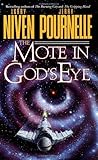
The Mote in God's Eye


The Mote in God's Eye (Moties, #1)The Mote in God's Eye by Larry Niven
My rating: 4 of 5 stars

Don't ask me why it took so long for me to get to this "classic" scifi novel. Yes, this was a hole in my reading list for far too long, but then again I took forever to get to Moby Dick and enjoyed the heck out of that one. I had read Niven and Pournelle's Inferno early on and wasn't terribly impressed. I also read Niven's Ringworld many years ago and found it to be . . . well, a three star book. My track record with these authors wasn't great, so I was rather reluctant to read this, but after a friend gifted me a copy at the end of a game of Traveller, I decided I'd give it a try.

Those who have played Traveller (which I've called The simplest RPG system out of this world) will immediately see the influence this work had on Marc Miller and colleagues in designing the game. A hereditary nobility trying to hold together disparate stellar systems, jump drive technology that makes it quicker to send a physical letter via snail mail on a mail carrier than to use electronic communication over distance, the absolute centrality of military life and, particularly, naval military life, to the workings of the empire, etc., etc., etc., will immediately jump out to those who play the game. For those who don't, there is still much to like here. It has its shortcomings - definitely a book "of its time," some people will balk at the characterization of women (or the one woman in the story) and the seemingly paranoid mentality of the military (which, if you've ever lived on a secure military installation, you know why that paranoia exists, whether it meets with your personal preferences or not). But despite these . . . I'll call them "smudges" on the narrative, Niven and Pournelle create a varied cast of characters whose reactions to "first contact" with an alien race are nudged and shifted by their positions vis-a-vis both the aliens and each other.

The "Moties," the alien race encountered here, are, honestly, only a little alien in their thinking. Their appearance, with multiple arms and a seemingly simple mammalian (simian?) physiology, makes them a little odd, but nothing truly outre. They aren't ordinary, to be sure, but they might just as well have been neurodivergent humans dressed up in fury bodies with asymmetrical arms. Still, they contrasted enough with the mindset of military-minded humans (and scientifically-minded humans, especially those with a strong stroke of idealism) that their interactions became more and more interesting the more the humans and aliens lied to each other, discovered undesirable things about each other, and then discovered that the other had lied to them. There are, of course, political implications on both sides, especially seeing that Motie evolutionary specialization was even more rigid than human societal castes. And this is one thing I liked a lot about the novel: it's not clean. It's dirty. It's confused. It deals in half-truths, deception, and groups that are internally riven with division because of their respective lines of demarcation, as well as being at odds with each other, sometimes for reasons that neither of them understand.

Do things "work out"? Sort of. And it's in that "sort of" that I found the most meaningful grist for rumination. Who exactly are "we" and what does "we" mean, anyway? Who am I in the midst of "we" and what happens when another "we" comes crashing into our universe (quite literally) unannounced? It's not as deeply existential as, say, Haldeman's Forever War, for instance, but it does cause one to at least give a sideways glance to the "big questions" and does so in an entertaining level, though you will have to work for your entertainment a little. I don't mind. I like books that demand something from the reader.

For example, this book has an incredibly long denouement. But it is absolutely worth the wait for Chapter 57: All the Skills of Treason. That is some masterful writing and one of the more clever resolutions I've seen in a science fiction novel. Well-played, Niven and Pournelle, well-played.

View all my reviews

____________________

If you like my writing and want to help my creative endeavors, please ko-fi me at https://ko-fi.com/forrestaguirre. Every little bit is seen and appreciated! Thank you!
Monday, August 17, 2026

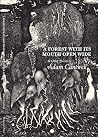
A Forest with its Mouth Open Wide & Other Stories


A Forest with its Mouth Open Wide & Other StoriesA Forest with its Mouth Open Wide & Other Stories by Adam S. Cantwell
My rating: 5 of 5 stars

Full disclosure: Adam Cantwell and I are what was historically-termed "pen pals". Or at least we've written a few letters to each other. If you can't handle the fact that this review is likely biased by our correspondence, then maybe you should just bugger off. I like Adam. And I like his writing. There, I said it.

In my miserable berth I grew deathly ill. The cold and torpor drew what was left of me to my low-lying parts; here my pain and ennui sloshed and settled and was distilled. The whispering proximity of the lethal sea called these dregs down ever further, and day after day my spirit seeped through tar and pitch and blackly down.

My liquid remains decanted through desert voids of seawater. It was an alien medium, primal, its essence was not the tang that clings to the red flesh of salmon or the morning chill borne on the fog but the dead-cold and salt of bones and freezing stars. My nothing-substance popped and dispersed, particles radiant from the dumb core, shreds of lost desire given over to huge black currents.


This quote, from the opening story "Orphans on Granite Tides" should give you a notion of the solace and comfort you'll find within the pages of A Forest with its Mouth Open Wide & Other Stories, i.e., none. I've earlier reviewed this story (I have the original publication from Les Editions de L'Oubli (aka Mount Abraxas Press), though this is the revised text as it originally appeared in Bastards of the Absolute , which I have not read. I don't know what the exact revisions are, but this version seems a hint darker than the Mount Abraxas version. Maybe I'll ask him in my next letter. I seem to owe him one, especially since his last mailing was a short stack of vinyl records from his musical projects Spaceboy and Villains.

The second story, "Black Chroma," is set in what seems to be a post-apocalypse, though it may be the structure of the narrator's mind that is collapsing (this may be the case with many of the narrators in this volume), rather than civilization. Paranoia and agoraphobia combine to expose (him?) to the bright pinpoint lights of the cosmos, a nakedness only occulted by self-burial.

Profoundly existential, yet hopelessly defiant (I am reminded of one of my favorite poems, William Ernest Henley's Invictus ), "The Chamber in the Universe" examines monuments, devotion, power, hope, and death. The temple representing as empty vessel exposing the hollowness of existence, while being the instrument by which the common-builder nudges the cosmos, even a particle's-width; one of the most human of desires: to matter, even when nothing matters. To make one's mark forever in the void.

"The European Monster Part Two" is dark and obtuse, much like the philosophy of Emil Cioran, the inferred inspiration for the story (first published in a volume of stories dedicated to the Romanian philosopher). Here the narrator finds himself in a labyrinthine situation, becoming a part of a (political? criminal?) machine at the heart of which is the titular monster, perhaps a modern Minotaur.

"Torso in Shadow" puts the baffled and baffling narrator in the subways beneath NYC, which may or may not be disintegrating above. Surely it is convulsing, socially or physically. Amidst these convulsions, in the underground, the narrator meets a woman. Perhaps this is Adam and Eve witnessing the birthing pains of a new world. Difficult to tell. But the attempt must be made. An ouroboros of a story, eating itself.

Originally written for a tribute anthology to Borges, "The Bow, the Arm, the Arrow" echoes the Argentine writer's sometimes-journalistic style, but with a tonal nod to Millhauser, as well. The story reminds me of a long-form vlog I recently watched about the composer Penderecki (a favorite of mine), but with the narrator experimenting with literature, rather than music. Sometimes experiments go wrong.

The titular story in the volume actually appeared alongside one of my own stories in the Mount Abraxas anthology Frostsigils , an homage to Paysage d'Hiver. As one would expect, it is dark, downright Gothic, and one can feel the cold sink into one's bones while reading. It's all about atmosphere, and it delivers that in shadowed robes with the deep moaning toll of an immense black iron bell.

With "Vod the Wrecker," I again find myself as "TOC mates" with Adam in the Raphus Press anthology Ghost Trains. But where I treated the train in question as a haunting presence, here, Vod is the brooding master, a near-god, over the twisted metal entrails of what was once the most powerful force in America. Vod destroys, remakes, and rides the bones of the ur-train like a pyrrhic steed, into oblivion.


In the amber-filtered urine-gray aged-out green glass of insulators, crystallizing dumbly over centuries, he saw an enviable solitude and immobility. The enamel of insignia and livery, some burned to peacock craquelure; the bent-blue of sulking steel glazed over with a million dullnesses of black and charcoal.


Transformation of the individual and of the world are the subject of "The Oligomancer". Here a migrant child of an itinerant oil-platform worker watches the world turn inside out from a privileged (so to speak) observation point on the derelict platform. A slowly unfolding apocalypse gives indicators from the horizon about the collapse of the outside world, which can't help but affect his own inner world. Again, the line between psychic and physical reality is not only blurred, it is completely shattered.

And, finally, "The Hag, the Cutthroat, the Amputee" is the musing of a being who, like Charon of Greek myth, ferries the dead across to their final destination, particularly those whose demise is caused by war. He(?) is very adamant to note that he is not Charon, and his thoughts regarding the dead make it clear that he does not share the detached observations of his more famous counterpart.

Those are the stories and my skewed observations of them. You want objectivity? Good luck finding it in this universe. But I will end by deferring to one of the great nihilists of our age, Thomas Ligotti, who stated, quite correctly:

The stories of Adam Cantwell's . . . could be fairly equated with the works of Kafka or Borges if their prose were not so luxuriant and surprising at every turn.

I have nothing more to add.


View all my reviews

____________________

If you like my writing and want to help my creative endeavors, please ko-fi me at https://ko-fi.com/forrestaguirre. Every little bit is seen and appreciated! Thank you!

Monday, January 6, 2025

Prisms of the Oneiroi


Prisms of the OneiroiPrisms of the Oneiroi by Martin Locker
My rating: 5 of 5 stars

While I've read bits and bobs of Martin Locker's work before, this is my first full-length foray into his work and I feel like I've struck gold in the Pyrenees. I paid for it (including shipping from Andorra), but this is worth ten times what I spent! There's a wonderful variety to the stories in this collection, all girded by Locker's own voice, or, more properly, voices, as his characters are distinctly-identifiable from one another. Each tale is a different facet of the same gem.

Ligotti has nothing on Locker when it comes to existential dread on a cosmic scale. This was the sort of suffocating fear of the universe that Lovecraft strove for, but Locker has found. "The Dreaming Plateau" is horror of a different order of magnitude, made all the more impactful by the elision of the most purple prose. The poetic heart is intact, but without un-necessary frills, with terrifying clarity. And for some reason, my mind kept flashing images from the Tibetan scenes in The Imaginarium of Doctor Parnassus throughout, which is not a bad thing. I was waiting for Tom Waits to burst through a door at any moment.

"Corfdrager" examines one of my favorite enigmatic pieces of art, Bruegel's "The Beekeepers and the Birdnester" (and the art used on one of my favorite albums from one of my favorite bands, Sunn's White 2) as a catalyst for the narrator's encounter with his family's past and his own inheritance via a seemingly academic investigation. One wonders, by the end, if the academics aren't the most horrific aspect of the story. If you went to graduate school, you know what I'm talking about here. The dive into apiary lore is more sinister and more irresistible than one might imagine.

While reading Prisms of the Oneiroi, I am using a Winterthur Poison Book Project bookmark (you can get one, like I did, for free here). The irony of reading "The Temple Consumes the Rose," which features a green book by Sar Peladan, is not lost on me. I might also be tempted to consume such a book, if I was to be rewarded the visions of Latoure, even if it cost me my life. Such is the price of true art. A moving occult tale.

"The Secrets of Saxon Stone" was a delight to read, and I am not being facetious. Daimons abound, the psychogeography of the region portrayed is reflective of the spirits that not only dwell there, but are interwoven into its very fabric. This is like Dunsany, but without the pedantics that sometimes overween his work. This is mythical and approachable, lending familiarity to the representation of the divine.

Locker displays his acumen for ethnography and mythic studies in "Sea Salt and Asphodel," a story of dreams, prophecy, and the cycle of life and death. The depth of immersion here just has to be experienced - I can't describe it. Suffice it to say that this tale is told in such a way that one feels at one with the others presented in the story. You don't read this story, you live in it. The reader feels a part of the tale, such is the attention to detail.

"In Search of the Wild Staircase" is an epistolary story in the vein of Harper's magazine travelogues from the late-19th- and early-20th-centuries, albeit with a folk horror twist. That twist is set on its head, though, as it is implied, at least, that The Church itself is the source of the frisson. The story ended a bit too hurried for me, but it's still a very solid work. I'll never look at the little country of Liechtenstein the same again.

Locker, you clever, clever man. "The Jasmine Tear" is a story worthy of a Twilight Zone episode, which is one of the highest compliments I can give to a short story. The koummya, the djinn, the deal with a demon, and the treasures of the Maghreb - this is worthy of Musiqa al-Ala; a masterstroke of storytelling that will stick in my mind until the Last Day (or fifty years, whichever comes first)!

I found "A Dialogue of Innocence with the Hidden Parish" deeply moving. First, it created a deep psychogeography of a particular house seeping with sadness, longing for company. I thought of my parent's home and the sorrow I associate with it, but more of that at a later time. I also thought of my own childhood and the deep impressions of place I felt as a young world traveller. Moving every two or three years (Dad was in the military) forces one to latch on to the feeling of a place rather quickly, so I might be a little hypersensitive that way. Combine that with the death of my parents a few years back, and maybe I was destined to fall in love with this story.

Ever contemplated choosing homelessness? I have (when it's warm out). In fact, I was very strongly tempted at my last job to just give a try at homelessness, but fate, thankfully, intervened. In "What the Vagabond Sees or The Parish Coda," an entire society and cosmology is outlined for English Vagabonds, whose motto is "No Parish But Albion". If you know, you know. I immediately connected with this tale, due in part to a trip I took in 2019 that allowed a fair bit of rambling around the Cotswolds. I recalled the many carefree hikes that friends and I took in the English countryside, from Brighton and Eastbourne to the Midlands to the Cotswolds, when I lived in the UK as a teenager. As I understand it, after The Great War, many veterans, disillusioned from the horrors they saw during the war, became homeless wanderers in the 1920s. I think that the song "The Tin Man" by Grasscut is inspired by that phenomenon or, if it's not, I'm going to interpret it that way anyway. I've often dreamt of what it would be, in my dotage, to hike around England until I just drop dead. I know I'm going to sound borderline insane, but it's a very tempting prospect, in all seriousness. This story just unlocks that morbid longing in my heart all over again. Maybe. Someday. Maybe. But only if I'm alone. And it's warm. But I can't imagine a better way to go.


View all my reviews

________________________

If you like my writing and want to help my creative endeavors, ko-fi me at https://ko-fi.com/forrestaguirre. Every little bit is seen and appreciated! Thank you!

Thursday, May 30, 2024

Waiting for the Dog to Sleep


Waiting for the Dog to SleepWaiting for the Dog to Sleep by Jerzy Ficowski
My rating: 5 of 5 stars

It should come as no surprise that Jerzy Ficowski is possibly the world's leading biographer of the great Bruno Schulz. Not only did Ficowski write the definitive Schulz biography, Regions of the Great Heresy, but one can hear echoes of Schulz's distinctive voice bordering the edges of Ficowski's short fiction, collected here in Waiting for the Dog to Sleep. Throughout my reading of the 28(!) stories in this volume, I found myself drawing frequent comparisons to Schulz, Kafka, and Calvino, and some of these stories should be spoken in the same breath as these greats.

That is not to say that Ficowski does not have his own voice; he does. But in order to entice readers to this book, I can't avoid the comparison. This work will sit comfortably - on its own - amidst works by the authors heretofore mentioned. Alas, this comprises all of the short fiction Ficowski ever wrote. He is much more well-known as a poet, and his poetic stance is reflected quite strongly in a few of these stories. At other times, his work is extremely straightforward and unadorned, which suits the stories in which ornamentation was not only un-necessary, but inimical to the goals of the narrative. Ficowski allows the form to follow the story, not allowing his own predilections to smother the necessary work that his words perform.

There is a wide variety here ("Something for everyone to hate," as Stepan Chapman used to say), and a lot to love. These pieces are all short and easily digestible, but some of them leave a long-lasting aftereffect, a lingering literary flavor that "sits well on the tongue," as they say. Here are my thoughts on each of the morsels:

The first story, "The Artificial Hen, or the Gravedigger's Lover" hovers somewhere between magic realism and surrealism. It's a strange, uncomfortable space. Most of the stories in this volume, I've found, fall into this strange liminal space between strange liminal spaces. Sometimes hewing toward more stark surrealism and at other times toward a warm magic realism a'la Gabriel Garcia Marquez.

"The Passing Settlement" is about what's right there in the title. But what's there is not quite what you think. A charming little bit about one of those "blink and you'll miss it" places in the middle of nowhere (which may well be the middle of everywhere).

"Old-World Entomology" is a short, concise gut-punch about moths, ancestors, memory, and futility. A three page long existential masterstroke.

Daydream? Ghost story? Liminal magic realism? It doesn't matter. "Recreation with the Paralytics" is a numinous tale, in any case. It will lull you into its own sacral reality, chestnuts, wheelchairs, and all.

"Proof of the Existence of Saint Eulalia" is, as the academics are wont to say "transgressive". Equal parts wicked and clever, this tiny tale packs a lot. Almost a prose poem, though without so much filigree. The sort of story about which a writer (this writer in particular) would say "I wish I had written it myself". And I do.

"The Pink House, or the Desert Sentries" is the sort of story that sends literature majors scrambling for hidden meanings and symbolism when maybe, just maybe, the author was simply telling a story with no meaning . . . which, of course, carries hidden meanings. It is, in this way, a tricksterish story. Ficowski channels Kafka herein, and the academics start sprinting for their podiums . . .

It's funny, when I read the next tale, I had just had a conversation with my wife about the traces we do and don't leave behind when we die. This story, "Chorzeluk," is about making a memory mountain out of a molehill and the proposition that it's sometimes best to let silence speak for itself.

"Before the Wall Collapses" is a small slice of a small slice of the world, an urban trap, of sorts, as much psychological as physical, inhabited by the narrator's grandfather.

Ever wonder what it might feel like to be a victim of the Dungeons & Dragons spell "Otto's Irresistible Dance"? I have. The answer might be found in "Tango Milonga," a tale of magic realism that evokes Italy Calvino in all the best ways. That really is the highest praise I can give to a story. I am hoping there are more like this in Ficowski's collection, but this could carry the whole book! The price of admission is worth it for this story alone.

"Window to the World" is a window on frozen hope and the helplessness one faces in the face of cold, strong winters, and the inevitability of death. This could easily be a short Brothers Quay film. I might add that the Quays (my favorite directors) are, not surprisingly, mentioned in the translator's notes.

"The Sweet Smell of Wild Animals" is magical realism par excellence. This story would rank up among Millhauser and Calvino's best. A fantastic fantastical story (replete with obligatory clown) of an unexpected train ride to a zone of liminality between city and circus, mechanics and magic. An amazing tale of tails.

I keep using referents to magic realists most readers know. It can't be helped. "An Escape" brushes against Kafka's territory or that of a very, very restrained Solzhenitsyn. I wasn't as enamored of this story as others, but it is still well-realized, with a Rod Serling-esque cliffhanger ending.

Existentialism by way of an attempt to fade into non-existence is the theme of "Mimesis". Where best to hide? Or, rather, best to hide as what? What happens when one disappears into . . . a piece of architecture, for example? And what of the pull of such an act on others. One must be strong or dissolve.

"An Attempt at a Dialogue" is a psychogeographical dreamscape of a story with a strange hauntological twist that teases the edges of time-travel, questioning both past and present and the (false?) notion of selfhood. It leaves philosophical quandaries far beyond the limits of the ink on the page and even beyond the strangeness that the story infers.

To call "The Joy of Dead Things" a "nice" story gives the wrong connotation. Maybe "comfortable" is the word I'm looking for, but only to those of us who love to walk through sleepy, dilapidated towns, unkempt ruins, dirty side streets, and ancient overgrown cemeteries, physically-realized dreamscapes. If that's you, then you, like me, will feel comfortable with this story, "soothed" even.

In "Outskirts on the Sands," we find a narrator who constantly, stubbornly, thrusts himself into the past, intentionally avoiding the present until a girl, an amalgam of all his pasts, gently compels him into the present. But the pull of nostalgia is too powerful, and he loses his present, ironically, to a new future. Another strongly psychogeographic work.

A weirdly- beautiful story, the imagery of "My Forest" is going to stay in my head for a long, long time, particularly the fantastically gorgeous apocalyptic closing scene. I would love to quote it, but I don't want to spoil the dark beauty of it all, one of the most simultaneously moving and disturbing images I've seen painted with words. So many hints and implications . . . I can't get over how "ripe" this little tale is. I think I'm in love with it.

"Aunt Fruzia" can be killed off by a salacious story involving a nun, we learn. A domestic dinner story gone wrong (because the narrator just can't help himself from provoking his aunt). The analogies of dinner were so good, I'd prefer to take them literally. But that's cannibalism, and cannibalism is a no-no, kids.

The one disappointing story in the collection for me was "An Alliance". Is the alliance in "An Alliance" really an alliance at all? Or is it just spousal spitefulness? There's probably an analogy in this story, but I'm not seeing it.

"Gorissia" (as the Romans named it) is a village in which the people embrace the final embrace, that of the grave. It's a story as old as time, as discovered by the narrator, an archeologist noted for his previous Neolithic discoveries. And the story will continue on in perpetuity. The archeologist is, in essence, robbed of the fruits of his profession.

"Intermission" is a story of war, during which the line demarcation living and dead is all but erased and only fear can save you. It is an autobiographical tale of Ficowski's participation in the Warsaw uprising.

By the end of "They Don't Ring at the Bernadines'," Ficowski slips into, or rather ascends into full surrealist mode. This story of religious figures versus their adherents approaches, but doesn't quite cross the threshold into all-out absurdity. The restraint is apropos, given the story itself.

I was waiting for a story that would touch directly on the holocaust, and in "'Cause He's Stupid and 'Cause He's Abram," I begrudgingly found it. As you can imagine, it doesn't end well. In this sad case, ignorance truly is bliss. The story begins with the following paragraph, just to give you a taste of Ficowski's writing ability:

He had a molting beard the color of hempen harl, his frayed canvas clothes were made up of holes and cracks painstakingly sewn together. Niemira from Lesne claimed that Abram had stolen those rags from his field scarecrow and was now parading about in them. Possible, but if so, Stupid Abram hadn't taken them to make himself frightening only so that he would have something to wear: without them he was already fairly frightening, though more naked.

You can probably gather that Ficowski shows a wry humor, even in his portrayal of the most horrific of circumstances. I thought of the masks of comedy and tragedy strapped to each other often as I read this book. Sometimes the wires get crossed, and it makes for a heady mixture of emotions.

"Post-patrimony" is a deep dive into psychogeography, how the inhabitant is tied to the habitation and the fragile relationship between the two. When one dies, the other decays, and yet there is something irreducable at the heart of place, a kernel of immortal being that persists, a Genius loci that may take a familiar form.

"Stumps" is one of those strange stories whose strangeness resides, coiled up like a snake waiting to strike, in its utter banality. An ordinary day with one out of the ordinary element (in this case a beggar) that sends everything sideways, forcing the narrator to look at the world in an even more strange way: loaded with meaning amidst the ordinariness of living.

"Signs of the Times, or Diction" is too slight. While I can appreciate stories that only hint and infer, I'd like at least a thread to follow. Yes, this narrator has no thread, that's the point of it all. So, while clever, this story only pans out as average because it's too brief to take full hold.

"Spinning Circles" may be close to perfect, the fabled perfect circle sought after by the Greeks. A wanderer who hopes to reach The City, despite the entries awaiting him, follows his spinning hoop, the last holdover from his distant childhood, only to learn that the circle, which has a mind of its own, will never take him back to where he wants to go. Or will it? Where does the circle end, if it ends at all?

And here the collection ends. I must note that Twisted Spoon Press is starting to impress me. I only have two data points at this time, but what I see is very promising, indeed. I strongly recommend picking up this collection as a start, especially if you are partial to Central and Eastern European authors in translation. I am becoming more and more enamored of this niche, and Ficowski's collection is a very strong example of the sort of writing I've been finding from that corner of the world. Go get yourself a copy!


View all my reviews

________________________

If you like my writing and want to help my creative endeavors, ko-fi me at https://ko-fi.com/forrestaguirre. Every little bit is seen and appreciated! Thank you!

Monday, January 1, 2024

The Graphologist and Other Stories


When Rhys Hughes is on a roll, nothing can stop him. Of the four stories in this short collection, two are good, two are outstanding, and the stand outs were not the ones I was expecting to shine. I went into "The Puppet Show" thinking, oh no, here we go with a Jon Padgett copycat. But this story twisted in unexpected ways and unfolded a unique tale of existential dread that proved every bit as effective as anything Padgett, Ligotti, etc., have produced, while remaining true to its own vision of cosmic horror. The second standout story, "The Filtered Ones," about ghost-pirates with a psychogeographic layer, flips from existential dread to enduring hope. Yes, I know, ghost-pirates. I was very skeptical going into this one, ready to be disappointed. But the story turned out to be a delight! The other two tales, "The Tipping Point" and "The Graphologist" are both good, but they are very much overshadowed by the greatness of "The Puppet Show" and "The Filtered Ones". Nothing disappoints, and Hughes excels here at taking the reader's expectations and fully flipping them on their head.Strongly recommended, especially for the two standout stories!


________________________

If you like my writing and want to help out, ko-fi me at https://ko-fi.com/forrestaguirre. Every little bit is seen and appreciated! Thank you!

Wednesday, November 22, 2023

Decasia: The State of Decay. A film by Bill Morrison.


My first forays into "experimental" film were courtesy of the International Cinema at BYU when I was an undergrad. Though not as highly-experimental as Morrison's Decasia, my early exposure to such films as Svankmajer's Faust and Wender's Wings of Desire whetted my appetite for more. When a friend of mine, who shared a shift as a security worker at night on campus, invited me and a few others over to watch Lynch's Eraserhead, I was hooked. 

I stumbled on Morrison's work while searching for clips from my favorite directors, The Brothers Quay (if you don't know how much of a Quay fanboy I am, you obviously have not been reading my blog for long). Morrison's Light is Calling came up in my search, and my interest was piqued. I watched it and was entirely blown away. 

Now, while Light is Calling is done in a warm sepia-tone, Decasia is purely black-and-white, which suits my (very mild) hue blindness just fine. Like any experimental cinematic work, this one takes patience and, in places, pure endurance. I admit to nearly shutting the whole thing off during a sequence in which an anonymous diver is climbing a ladder up to a high diving board (at least that's what I think was happening). Everything is in fairly slow-motion. Not super slowmo, but slow nonetheless. Morrison is willing to make you work for your insights. 

What we're given is a series of black-and-white films damaged by time either by smeared development fluid or outright disintegration of the cellulose acetate medium. The images are often difficult to discern, sometimes inscrutable. At other times, there are moments of relative clarity - the many cuts of whirling dervishes that seem to thread the sparse motifs together are decidedly old and far from perfect, but they offer the eyes a bit of a rest from the more challenging segments. 

I find it interesting that so much of Decasia is set in, well, Asia, whether Asia Minor or the Far East. Though Morrison has said nothing of colonialism that I can find in his interviews, a fair amount of footage is taken from documentary film of the middle east and Japan, among other locales. One of the more haunting segments is that of a pair of Catholic nuns standing as sentinels as a group of young uniformed schoolgirls, likely Vietnamese, if I am correct in my surmisings, marching past into what I presume must be a Catholic mission-school, probably in French Indochina. In one particularly attention-grabbing moment, one of the girls looks back at the camera and we see her full face for the first time. There is a strong look of suspicion in her eyes. It's probably just childhood curiosity for seeing a film camera for the first time, but I like to think of her as telepathically saying "I will be freed from this. If not me, then my children, or my children's children. We won't tolerate this forever."

Other segments are mostly banal documentary pieces, with a few bits from dramatized silent movies scattered throughout. I didn't recognize any of them, but my silent movie mental catalog is quite minimal. When such dramatized performances were presented, there was, for me, a mixed tale of the wonder of acting with th tragedy that, while these images survive, the actors clearly did not. It didn't help that there were, in close proximity to these sections, film of underground miners' bodies being dragged out from mines. A strange contrast. 

The music for the film was originally the film for the music. The initial performance of Michael Gordon's composition was the occasion for which the film was initially created. The music came first, then the film came as a reaction to that music. It's obvious that Gordon and Morrison played off of each other, though, to produce the "final" version that appears in Decasia. Gordon's atonal, intentionally de-tuned avant-classical orchestral piece and Morrison's abstract, surreal imagery play well of of each other.

A PRI interview on the DVD provides some insight into both Morrison's motivations for creating the movie and Gordon's thought process behind the music. Though the interview claims that you can't have one without the other, I'm willing to accept that as a challenge and watch Decasia muted with, let's say SunnO))) playing as musical accompanyment. Actually, I can think of a number of bands whose work would compliment the visuals. The Kilimanjaro Darkjazz Ensemble jumps right out front. Much of Wagner Ó¦degard's work would work, as well.

Morrison claims that the work is both existential and life-affirming. There is no doubt about the former. The film throughout evokes an existential dread through a two-fold process of obscuring and revealing, forming a sort of pulsating rhythm between the eerie and the weird. The viewer often feels trapped between several worlds at once: The world from which they are viewing the movie, the world in which the film was initially captured, and the world that some of the captured film is trying to portray (this is particularly true of pieces that show actors from the 1920s or '30s portraying scenes in historical costume).  Decasia is not only a film, it is a place, its own strange world of mixed up timelines bubbling in and out of perception. Needless to say, it is a very strange place to inhabit, even if only momentarily, a discomfiting space that reminds one of one's mortality in the strongest of ways. 

On the flipside, there is a strange element of hope throughout, as well, that maybe something of us can survive that change called death and still affect the world. It's not an overtly spiritual plea by Morrison, but a little whisper of what might possibly be. Just maybe. Time will truly tell, right?


________________________

If you like my writing and want to help out, ko-fi me at https://ko-fi.com/forrestaguirre. Every little bit is seen and appreciated! Thank you!


Monday, August 14, 2023

Being and Time


Being and TimeBeing and Time by Martin Heidegger
My rating: 4 of 5 stars

"Did I learn?" This is the only possible question I can ask about my reading experience with Martin Heidegger's notoriously difficult tome Being and Time. I would be lying if I said I clearly understood more than 25% of this work. Warning: unless you are a trained philosopher or a genius autodidact, you will find within these pages a long stretch of imposter syndrome waiting for you. I cannot rightfully or accurately assess whether I "got" this book. Some of it, sure, but I don't know enough here to assess what I really, really know about Heidegger's philosophy.

But did I learn? Let's find out. Below, I've cut and pasted the notes I've taken along the way. Immediately following each self-quotation, I will assess whether, at the end of it all, I learned anything in relation to these initial impressions. Let's go:

Well, the foreword and translator's notes successfully put me to sleep. Hoping that the actual text is a little more engaging.

This did get better. As I crawled along and picked up an occasional idea here and there, along with bolstering my knowledge by watching very specific youtube videos on particularly difficult passages, I found myself more and more engaged because I understood more of the previous groundwork as I went along.

Heideggering is hard work. I'm glad I know some German or the footnotes here would be mostly nonsensical. Or at least misleading.

Yes, Heideggering is hard work. That did not change. Knowing German helped quite a bit, but sometimes my knowledge of German actually got in the way because of the way that Heidegger uses the German language. Some of his wordplay is incredibly subtle and I suspect that even native speakers with a high level of academic training need to use the footnotes as a crutch to help understand the precise way in which he uses specific words with specific nuances. The footnotes, along with having German "at hand," so to speak, were extremely helpful.

My brain hurts.

This was true throughout.

That Philosophy 101 course I had 27 years ago isn't helping me much here, for some reason. I want a refund on that portion of my tuition!

It actually came in handy later, when Hegel and Aquinas came up I had a comparative framework to diff off of Heideger's ideas, which gave me an unexpected and needed context. But I still want that refund!

I cheated and watched a youtube video or five to get some grounding. Glad I did that.

Essentially, Heidegger is rewriting Philosophy 101 as it relates to ontology.


I'm still glad I "cheated". That helped things immensely. And I STILL want that refund!

Hmm. About 10% of the way through the book and I understand about 25% of what I've read.

This proportion of understanding proved true from the beginning to the end. I understood things well about a quarter of the time. Truth be told, I *somewhat* understood other things maybe another 15-20% of the time. Not bad for an imposter.

Page 65 . . . and I'm just at the beginning of Part 1?

Yes, I was. But that preamble was necessary not to set the stage, but to strip the stage down to it's loose wooden planks and rebuild philosophy. Heidegger was a philosophical marine drill sergeant. He destroys you, then builds you up again.

We're going on a cruise in a couple of weeks. I strongly suspect this will NOT be a book I take with me. Sorry, Heide.

Well, that cruise didn't happen. My wife got a blood clot the week before we were supposed to leave, and with here then-recent cancer scare, we couldn't take a chance. Good thing, too, as we would have likely ended up in a hospital somewhere in Anchorage. We still plan on taking the cruise, but it's probably going to be a year or two. 2022 was pretty brutal.

"Linguistic gymnastics" is the phrase that comes to mind when trying to describe what my brain is doing now. And I've fallen off the balance beams more than once here.

See my comments about German above. Lots of linguistic gymnastics in this work.

I'm glad I don't *have* to read this. It's one thing to discipline myself to read something inscrutable; it's quite another to have it assigned to you.

In the end, I'm glad I read it. But I could easily see a huge number of philosophy majors going to the counselor's office to change their majors after this. Easily.

Every two pages I spend on Heidegger is a hard-won battle. Most of the time, I lose, but I'll hold onto my feeble victories and improve upon them. Slow and steady wins the race.

It wasn't *always* torture, just most of the time. Slow and steady did win the race, incidentally. Or at least I finished the marathon.

This text can feel so mechanical at times that one forgets it is about human beings. Then, occasionally, one slips past the strictness of the language and realizes that not only is Heidegger not philosophizing about an "ideal" human being, but that he is sympathetic to humans in their weaknesses, even when they don't reach their full potential.

This was a surprising revelation that became more and more clear the more I read. Heidegger's primary concern was the inner life of an individual human being, replete with its faults and foibles.

Any review I do for this book can only scratch the surface.

c.f., this pithy review.

Back to the philosophical salt mines . . .

Looking back on this phrase, it was definitely ill-advised and I didn't even think about the implications at that point, given Heidegger's overly-problematic political leanings. It was not intentional, but I suppose it might have been subconscious. My apologies for the "bad optics". I suppose I could redact this note altogether, but that wouldn't be intellectually honest.

I'm not sure if Being and Time is considered "analytical philosophy," or if I'm even using the right term, but this sort of Definitional work seems like definition for the sake of definition. It's academically interesting, but emotionally flat and intellectually tedious. But I will press on and finish. I'm learning things, but it's not particularly enjoyable.

Obviously, from my earlier comments, this feeling came and went. But when it came on, it came on strong. Reading more slowly helped me to cut through this academic wall and get to the actual "soul" behind it. I do believe the book has "soul," but it takes some digging to get to it.

The whole notion of death in this book is utterly fascinating. While acknowledging the cessation of being in this world, and thus no longer being a Dasein, Heidegger hints that there is a sort of existence of one, even as that one has ceased being in the worls as Dasein here. But the Being of that being is unknowable by Dasein.

This actually helped me connect with this work in a way I hadn't up to this point. This probably has to do with my admiration for Existential philosophy in general. The seeming paradoxical nature of Heidegger's statements in relation of Dasein to death actually tied things together quite nicely for me. Your mileage may vary.

Death enters the picture and suddenly all that came before in this tome makes much more sense. Existentialism instantiates clarity!

As I just said . . .

317 pages in, I feel like I'm beginning to grasp what Heidegger is on about. Call me ignorant. But I am starting to put two and two together.

Mmmmmaybe I was learning something?

There is something fundamental about the call of conscience, an irreducible something that is at the core of Dasein's Being. There is no good answer to "where does it come from?", it is intrinsic to Being. So far as I can tell, this is the closest Heidegger gets to some notion of "spirit," "soul," or "essence". But what do I know?

This, I think, is where Heiddeger's view of some sort of "soul" became more clear. I went back and scanned throughout the book, and one can find ghostly whispers, very faint, of this feeling, here and there throughout. Perhaps this is inevitable when one is talking about the inner life of a human?

There's something a bit Ayn-Randian about the concept of conscience here, but it seems less mercenary. Self-serving? Yes, more a focus on authenticity, to being true to one's self, than just snubbing every other human being around you without mercy for the sake of the argument.

Heidegger's ties to nazism are fairly clear, from what I understand. Though Ayn Rand wasn't a nazi, per se, her individualism-to-the-point-of-extreme-selfishness rings with some of the same echos, albeit on a personal, rather than national scale. I find Heidegger much more kind (if that's the right word) than Rand, but still adamant about the individual need to be oneself, despite what society as a whole thinks. Of course, if you get a whole bunch of people who think they are being individualistic, while they are merely all following one person's individualistic personality, well, you get facism.

I'd love to be able to state that I understood thus and such percentage of this book. But that would imply a continuous "block" of understanding, and that's just not true. It's more like a journey where certain points were more lucid and memorable than others, like pearls unevenly distributed along a string.

This notion also held through, especially in hindsight. And this is the most corect summation of my reading experience with Being and Time. Will I read it again in full? Probably not. But I will dip into sections from time to time in order to both build my understanding of this work and to provide context when other philosophers refer to Heidegger.

So I feel that I did learn from the book. And i will keep on learning. Some of the ideas herein and some of the structures have provided glimpses for me into the workings of philosophy, even if uneven and obfuscated by my own ignorange. Gradually, though, I'm hoping the light seeps in and grows and I can use this as a springboard into other, perhaps equally difficult, works. My intellectual muscles have been strengthened, though I have yet to understand how to integrate the whole body of work into my philosophical routine. That, I think, is a lifelong pursuit.


View all my reviews

____________

If you like my writing and want to help out, ko-fi me at https://ko-fi.com/forrestaguirre. Every little bit is seen and appreciated! Thank you!

Saturday, April 22, 2023

Puppet: An Essay on Uncanny Life


Puppet: An Essay on Uncanny LifePuppet: An Essay on Uncanny Life by Kenneth Gross
My rating: 5 of 5 stars

Puppets and I go way back. I want to say that the Muppets and Sid and Marty Kroft shows (HR Pufnstuf, Far Out Space Nuts), though the latter was more costumed humans than puppets, I admit, introduced me to bodies animated by unseen humans. But, outside of television (and that P movie by that D company), I quite fondly recall my mother making little puppets out of felt and doing little puppet shows for me. She was a drama-girl all the way. Furthermore, I remember seeing street puppets when I lived in Italy as a boy and at least one Punch & Judy show in Brighton, England, when I lived in the UK as a teenager.

But it was later in life that I learned to appreciate the uncanny nature of puppets. In the early 90s I discovered the movies of Jan Svankmajer, which sometimes featured marionettes, then, in the early 2000s, I discovered the stop motion films of The Brothers Quay, which have become an obsession of mine. Back in 2003, I believe it was, I saw another Punch and Judy show (this one in Minneapolis, of all places), I took my kids to a live puppet show (with puppets more reminiscent of Frank Oz's early creations, than anything else) not many years after. Then, in 2019, while on vacation in Europe, my wife and I visited Salzburg, Austria and attended the Salzburg Marionetten Theatre. And just tonight, I signed up for a Domestika course on making wooden marionettes.

I think I'm becoming a little obsessed. Maybe I was obsessed all along and am just now admitting it.

Back in 2021 (it feels strange to say that - has it really been that long?), I read and reviewed Victoria Nelson's outstanding book The Secret Life of Puppets, which I had stumbled on at Goodreads, if I remember correctly. Then, my favorite podcast, Weird Studies, did an episode on this same book in November of 2022. They followed this with an episode about the movie Evil Dead II, which also dipped into the uncanny nature of puppets. This is where I first saw reference to the book being reviewed presently.

It is this uncanny aspect of puppets that Kenneth Gross examines in Puppet: An Essay on Uncanny Life. All the while I was reading, I felt as if I had the voice of Mark Fischer whispering in my ear. His book/essay on The Weird and the Eerie could have formed the skeleton for Gross's essay, though Gross's work preceded Fisher's by five years. So, perhaps it is the other way around? However, I find no reference to Gross's work in Fischer's bibliography. Maybe this is just another magical synergy that seems to happen so often with these sorts of confluences.

The movement and intelligence that are apparent in a puppet is "weird" (in Fisher's sense) because there should be no movement or intelligence or intention in unliving material, yet that intent seems to come through the unliving (perhaps undead?) material of the puppet. There is movement in what there ought not to be. This offends our logic while simultaneously spiking our curiosity, a morbid curiosity for that which is incapable of morbidity, strangely enough.

It feels quite natural for humans to view these artificial beings as artifacts with some connection to the past. I've seen countless cast off dolls in the mud, for example, and it piques my sense of wonder. How did this get here? Who lost it? Is there some latent connection with a past owner? This begs the further question: Are puppets, dolls, and marionettes some sort of mana batteries, storing energy from some past life force? Perhaps the mystery of these unseen lives that live behind the figures is what we hope to see through to, with the "little people" serving as scrying devices into past lives, their joys, and tragedies. But are our visions clouded and warped by looking through these anthropomorphic lenses? Could some malevolent spirit twist or visions of the past if we are not careful? Do we dare look into their eyes?

Puppets and the stages on which they come "alive" ae not like us. They are exaggerated and often missing many of the subtle and not-so-subtle things that make up life. This creates what Fisher termed "the eerie". Much that should be "there" is not, yet some law of puppetry seems to govern their universe, laws that do not apply in the same way to us. Nor do our laws apply to them. So which reality is real? Which laws actually inhere?

Just as the paradox of life seemingly manifest in dead things causes unease and fascination, the utter unknowability of what it feels, tastes, smells, or sounds like to be a dead thing that was once living simultaneously terrifies us and fills us with curiosity, longing, even, to know and, with much fear and uncertainty, to experience what the dead experience. It is the age old push and pull of existential dread, brought to life(?) by the infusion of seeming intent into dead matter. The puppeteer possesses the puppet with life-force, animating it, the living possessing the dead in a reverse-seance. Who is the medium here?

Puppeteers I have met indeed often speak of waiting for some impulse from the puppet they hold, a gesture or form of motion that they can then develop often being shocked by what emerges.

The act of puppeteering blurs the line between tool and wielder. yes, the human informs the dead material, but the dead material imposes its own limitations, resisting, even fighting back!

The unliving puppet is, of course, innocent, as it can only react to others' manipulations. Yet many puppet shows are transgressive and anything but innocent (go watch a Punch and Judy show, if you don't believe me). Here the inherent innocence of the puppet allows for a buffer to the audience. Hence the shocking nature of the horror trope of puppets and other artificially animated human stand-ins possessed of self-realized inimical animation.

Remember, though, that's it not always the humans facing the puppet that have need to fear that strange intersection of life and death, of immaterial energy and material existence. As Gross implies, this liminal zone is fraught with danger for all:

Then there was the marionette of Antigone who had hung herself with the very strings that had earlier given her life. That had its own kind of truth.

View all my reviews

_______________

If you like my writing and want to help out, ko-fi me at https://ko-fi.com/forrestaguirre. Every little bit is seen and appreciated! Thank you!

Monday, August 15, 2022

The Ballet of Dr Caligari and Madder Mysteries


The Ballet of Dr Caligari and Madder MysteriesThe Ballet of Dr Caligari and Madder Mysteries by Reggie Oliver
My rating: 4 of 5 stars

With few exceptions, I have come to love the work of Reggie Oliver. While I was lukewarm about Flowers of the Sea , I was head-over-heels about The Complete Symphonies of Adolf Hitler and Other Stories and Mrs. Midnight and Other Stories . I had heard mixed reviews from readers I respect and admire, so I was curious where this volume would fall.

I began with misgivings. While the opening story, "A Donkey at the Mysteries," had some great moments, the ending fell a bit flat for me. I loved the subtext of unknowingly participating in rites one does not understand, but I was hoping for a moment of anagnorises that never materialized. The story had momentum, a series of setups, then . . . nothing. If this was authorial intent, the potential was under-utilized. Perhaps this is because I had read and quite enjoyed Brian C. Murarescu's investigation into ancient Greek and Roman cults of psychedelia(?), The Immortality Key . I had been (pardon the pun - but I am a dad) keyed up for the read, but was disappointed. Not upset. Just disappointed. Have I mentioned I'm a dad?

The second story was a touch better. "The Head" is a double entendre laced with Oliver's bleak humor. It's a strange admixture of sitcom and dread horror that devolves into an absurdist experimentalism. I really do like the two main characters (as much as one can like a madman and a disembodied head), and, as with other works by Oliver, his characters really shine. A worthy story, not his best, but a good read nonetheless.

When I started to figure out the subject matter of the third tale, I was prepared to be really, really disappointed. As a rule, I hate werewolf stories. But I might have to make an exception for "Tawny". I didn't love it, but this English social comedy with a lycanthropic twist was an amusing read.

Then, suddenly, the collection hit its stride. "The Devils Funeral" is peak Oliver. Clergy, madness, corruption, decay, and the near simultaneous death of Dante Gabriel Rossetti and Charles Darwin as a sideshow that leaves lingering questions. The question that keeps being posed is "who is the enemy"? It's a seemingly simple question with a dastardly labyrinth of possible answers and meanings, most of it unanswerable and meaningless. Existentialism reigns above. And, as above, so below.

A sinister comedy, or a comedic tale of horror? "Baskerville's Midgets" displays Oliver's insider's insight into the actor's life beyond the stage. This (and other stories about the intersection of horror and theater) is a story that only Oliver could have written. His background as an actor, playwright, and fiction author find a fitting culmination in this story, which will have you checking under your bed for (?).

Oliver next completes an M.R. James fragment "The Game of Bear". The transition, though carefully documented, would be fairly seamless without the indicator, which only serves to sever the tale in two. Oliver does an admirable job of mimicking James' voice, particularly in the climax of the story. Of course, James did put a strong personal stamp on the structure and tone of the English ghost story, so no surprises here.

"The Final Stage" is an existential tale that only one who has acted onstage can fully appreciate; not only because of the settings and situations, but because of the attitude that one must take to truly become immersed in their characters, not just the willful suspension of disbelieve, but the willful deceit which one must not merely engage in, but wallow in, if one is to be "a brilliant actor". There is a price to pay. But how are the funds exchanged? Does the character take from the actor, or the actor from the character? The economies of "real" life and faux-life are powerfully in play here.

With the introduction of a certain trope about mid-way through the story, I was ready to write off "The Endless Corridor" as just another vampire story. It is not just another vampire story. It is, in fact, much more nuanced and much more sinister than that trope led me to believe. Oliver, with considerable panache, twists the old trope into something entirely new and more horrifying. My trepidation was allayed, but my frisson was piqued.

Oliver continues to unveil the "back" of the theater in his mystery "The Vampyre Trap," an excellent, if old-fashioned tale of jealousy and ambition behind the curtain. One wonders who the actors are and who the characters are, as these roles become muddled. What better place for a murder or three in a place whose sole purpose is deceit and drama? There are strong resonances between this story and "The Final Stage" earlier in the volume, not because of direct subject matter, but because both hint at a certain sinister something taking place behind the masks of the masks of the masks.

The title story is the most brilliant story in the volume, but only those who have watched Das Cabinet des Dr. Caligari will fully appreciate its impact. If I were to teach a class on the "O'Henry ending" I would show the movie, then have students read this. Textbook. And fantastically well-crafted. This is a Reggie Oliver masterpiece; one of his best stories ever.

How can I resist a story about one of my favorite eras of painting, that of the Pre-Raphaelites? I can't. Nor can the protagonist and victim(s) of "Love and Death" resist the alluring illusion of beauty, over-shrouded by the absolute victory of decay and death. Everyone in this tale is caught in this trap. Perhaps only the reader can escape. Perhaps not. But the allure remains.

"Porson's Piece" is as solid of an English ghost story as I've ever read. The village in which most of the action takes place shares half a name with <a href="https://forrestaguirre.blogspot.com/2020/06/a-day-hike-in-cotswolds.html>a village in the Cotswolds that my wife and I hiked through in 2019</a>, and I think I might know some of the "fictional" spots described. One path in particular (a photo of which is at my blog) was described in such a way that I cannot shake the feeling that this very path was the one Oliver here described. This added to the verisimilitude for me, but maybe I am just hallucinating, like the main character. Or maybe not.

Oliver begins "Lady With A Rose" with an ekphrasis of a Titian painting. The story is erudite and the characters colorful (pun intended), but not as startling as many of his other works. The final "twist" was to be expected and sort of just . . . ends there.

This collection has some real gems in it, but the opening and closing stories were unspectacular. An odd way to construct a collection.

The great in this collection carries the less-spectacular tales. Perhaps I've read too much of Oliver and am a bit jaded? I don't think so. He still astounds me, at times. I would hate to discourage anyone from reading "Porson's Piece," "The Ballet of Dr. Caligari," "Baskerville's Midgets," or "The Devil's Funeral," all of which were outstanding stories. But I can't give it a perfect five. Nor can I drop it to an "average" rating of three stars. I'm firmly in the four camp with this one.

View all my reviews

If you like or appreciate my writing and want to lend your support, ko-fi me at https://ko-fi.com/forrestaguirre. Every little bit is seen and appreciated! Thank you!

Wednesday, April 20, 2022

Reading: The Longue Durée

 Admittedly, I am not using the term "long durée" as Fernand Braudel did. I'm coopting the term and twisting it to my own ends (as any good author and historian will do), redefining and, more importantly for the present post, re-scaling it to reflect my love of reading and the puissance of certain texts in my mind (and sometimes my life, truth be told, as I have taken life lessons from some of these works). 

In a previous post, I had mentioned my goal of reading what is on my shelves currently, then re-reading some works alongside one another for the purposes of cranial cross-pollination, if you will. I think that many synergies lurk within certain pairings of books (or even triads) that multiply and expand single ideas with one another to create thought structures that are more than the sum of their parts. This is one thing I miss about graduate school (probably the thing I miss about graduate school): being able to devote time to a syllabus of study that allows me, in a concentrated amount of time, to bash ideas up against each other to see what sticks and what structures emerge from the "chaos". This might explain why I like some of the music I like.

But I'm not here to write about music. I want to write about reading, if only briefly. 

I read extensively, in a fairly broad range of styles, genres, and topics. I love reading. But, to be honest, I love reading writing that makes me have to meditate, to contemplate. If I'm not reaching for a dictionary, at least occasionally, I am usually dis-satisfied. I read to both be entertained and to learn. I read to stoke the fires of my own imagination and creativity. I read for the magic of it all. 

Currently, on Goodreads (still my favorite social media and maybe, someday, my only social media), I show 1035 books read. This is probably a hundred or more too short, as I can't remember or record all the books I enjoyed as a young person. These are books I've read through in all but a handful of cases (where my loathing for the work in question was so strong that I had to record that I hated it). I supposed that the works I did hate served some sort of utilitarian purpose, even if it was simply to hone my disdain for certain styles of writing or, more properly, to sharpen my sense of righteous indignation towards writers who "cheated" me with a dis-satisfactory bait-and-switch or Deus ex Machina. 

Other works, however, stuck with me. Even if they didn't strike me as I finished them, they haunted me, over time. I could not get them out of my head. When I have an idle moment and can think upon things, these books come back into my mind, unbidden. They are alive in my mind, as it were. They have an enduring presence that I cannot shake. They may not be my favorite works - indeed some of them I found excruciating to read (I'm looking at you, Joyce) - but they have stuck with me and they just won't get out of my head. This is what I mean by The Longue Durée. These works have impressed me in the long term enough that they crowd the literary memory spaces of my brain. For whatever reason, to me, they are important and lasting. When my thoughts fall slack to their lowest ebb, these are the books that seem to almost accidentally slip into my head. They form the base of my intellect; they are the undergirding to how I think. 

This list could be very, very long, but I'm trying to keep it very short for the sake of brevity and concision. I am inevitably excluding a lot of important books and I will, no doubt, regret the inevitable omissions. In passing, I note how few of these books are actually fiction (which I write). In all honesty, there is little fiction that sticks in my mind enough to be considered Longue Durée, so if you see a fictional work below, do note that it must have made a huge impression on me. Again, I cannot necessarily pinpoint exactly why that is. But here is my very short list, which I will amend after my grand experiment of re-reading concludes (hopefully in early to mid-2023) - in no particular order:


Hamlet's Mill, Giorgio de Santillana

Enchanted Night, Steven Millhauser

Searching for Memory Daniel L. Schacter

The Roots of Civilization: the Cognitive Beginnings of Man's First Art, Symbol and Notation, Alexander Marshack

Three Novels by Samuel Beckett: Molloy, Malone Dies, The Unnamable, Samuel Beckett

The Voice of the Air, John Howard

Ulysses, James Joyce

Hierarchy Theory: A Vision, Vocabulary, and Epistemology, Valerie Ahl

Six Memos for the Next Millenium, Italo Calvino

Irrational Man: A Study in Existential Philosophy, William Barrett

Stealing Cthulhu, Graham Walmsley

Sub Rosa, Robert Aickman

The White Goddess, Robert Graves

The Academy Outside of Ingolstadt, Damian Murphy


What are your Longue Durée books? Post them in the comments!


If you'd like to lend a hand to my creative endeavors, here's your chance! 


________________________

If you like my writing and want to help out, ko-fi me at https://ko-fi.com/forrestaguirre. Every little bit is seen and appreciated! Thank you!

Monday, June 14, 2021

Sacrum Regnum II


Sacrum Regnum IISacrum Regnum II by Daniel Corrick
My rating: 5 of 5 stars

After being entirely blown away by Sacrum Regnum I, I was excited, but a touch guarded, when approaching this second volume in the series. While I saw a lot of names that I normally love, I was wary of the sequel, worried that it would either fall flat or "jump the shark".

My fears were completely unfounded. This second volume absolutely lives up to the promise of the first. My only disappointment is that a volume three was never compiled.

But why focus on what might have been, when we can focus on what is? And this volume is absolutely brilliant! By that, I don't mean bright and shiny, oh no, this volume is dark, in places very dark. I mean smart, intelligent, dignified, and, dare I say it: literary? It is, with the first volume, a Symbolist master stroke, and a worthy bow to the Symbolist and Decadent literature of the past, without being enslaved to it.

My praise for Sacrum Regnum II does not, however, mean that I felt entirely comfortable with it. Not by a long shot.

For example, I feel, as the kids say these days, "seen" after reading John Howard's tale of a slightly neurotic numismatist, "Into An Empire". Yes, I saw myself in the protagonist on several levels. John, how did you get into my head? This hits too close to home for this mildly neurotic wannabe numismatist. I even restrict myself to pre-1776 Germanic state silver coins in a similar manner to the story's main character, Payton. Seriously, I feel naked before your pen. That is to say, I could completely immerse myself in Payton.

Next, "The Human Cosmos" is Charles Wilkinson at his best. Strong echoes of Italo Calvino ring throughout, and that is some of the highest praise I can give a story. An ambiguous story (in the best way possible) of fabulism that ends poised on the knifes' edge of dark and light. I am reminded of my favorite quote by Calvino: I am a Saturn who dreams of being a Mercury, and everything I write reflects these two impulses. Wilkinson hits both sides of that balance at the same time.

Colin Insole's "Dreams from the Apple Orchards" (which I have read before) is an excellent example of psychogeography, where the landscape itself pulses with the negative energy of those who lived their before. The setting is the character, the setting that has seen so much of corruption and baleful intent. A thin veneer separates the trappings of civilization from the base layer of chaos beneath.

I had wanted to read Thomas Strømsholt's fiction before, but this was my first chance to do so. "Szépassony-völgy" packs an unexpected gut punch. Strømsholt layers a seed of utterly mindless random brutality under a veneer of mythic legend and romantic nostalgia and longing for past love. The contrast is striking and invokes a strong existential response in the reader, leaving one's head reeling. Powerful.

An entire section about author Quentin S. Crisp, replete with an interview with the author and a piece of short fiction, entitled Crispiana opens a window into the brain of the author, at least what he's willing and able to share about his brain. An interesting peek at an author whose work I quite like. As with the first volume of Sacrum Regnum, I love the collection of fiction, non-fiction, poetics, and reviews. An eclectic selection, but with it's own firm voice.

The Poetics section in this volume contains work by Mark Valentine, Loha Connell, and Bethany van Rijswijk, along with a translation of Stefan Grabinski's "Red Magda".

Ah, kids. Can't live with them, can't bury a fire hatchet in their forehead when they are possessed by fiery arson demons without feeling some degree of guilt. Watcha gonna do with "Red Magna"? This brilliant (pardon the pun) translation will lodge itself in your brain, just like an axe. The effect is no less painful. I did warn that some of these works go to very dark places.

Mark Valentine turns his always-keen critical eye on novelist Claude Houghton in his article "The Stranger Who Opens the Door - The Novels of Claude Houghton". As is usual, the reader is sent off scurrying to find the work of another forgotten author. Valentine is an archaeologist of literary treasures that need to again see the light of day. This essay is no exception!

Martin Echter's essay on the aesthetic principles espoused and practiced by Hanns Heinz Ewers is an exemplary examination of not only the writer's oeuvre, but of the undergirding philosophy that drove Ewers' work. A marvelous examination of an incredibly underrated author.

I had read, with interest, Mark Valentine's essay on Mary Butts from his collection Haunted by Books, whom I had not heard of to that point, with interest. Now, with Nigel Jackson's essay "Obscene Ikons: Desacralization & Counter-Tradition in the Work of Mary Butts," I have felt compelled to add her complete short fiction to my To-Be-Read list. For those who know me well, you know I don't add things to my TBR list lightly. I curate it a great deal (and am often chided for how few books I have on my TBR list on Goodreads). So, yes, I expect something special from Mary Butts' work.

. . . and the review of Georg Trakl's The Last Gold of Expired Stars in the book review section cements my decision to buy that book, as well. Thankfully, it was already on my TBR list.

There is some high praise for The Ten Dictates of Alfred Tessler by D.P. Watt. But isn't Watt always deserving of high praise? Yes. Absolutely.

A critically-constructive eye is placed upon Alex Miles' debut weird fiction collection The Glory and the Splendour. I haven't read said collection, but the assessment here seems fair, yet firm: there's potential here, but it needs work. It's strangely refreshing to see a review that is measured and doesn't overstate the work being reviewed, but sees raw potential.

Another balanced, insightful review, this time of Quentin S. Crisp's All God's Angels, Beware! clearly explains what it is that makes Crisp's work tick. I have yet to see a clearer explanation of how he does what he does when he writes. It is unique, quirky, weird, and charming at the same time. It has heart and this essay shows how and why this is done. An important essay on Crisp's fiction, to say the least!

When I read through the list of forthcoming books here, I am reminded of how good of a year 2013 was for literary fiction of the sort that I love. Halcyon days, to be sure. Hopefully, they'll return. In some small way that's happening, but we need an updated equivalent to Sacrum Regnum or an outright resurrection of the same to really seal the deal, as far as I'm concerned. Where is our Sacrum Regnum? And here I go again, pining for the past by longing for the future. I'm tempted to try to make it happen myself. It's been a while since I've edited . . . hmm . . .

View all my reviews

__________

If you like my writing and want to help out, ko-fi me at https://ko-fi.com/forrestaguirre. Every little bit is seen and appreciated! Thank you!